Showing posts with label California. Show all posts

30.1.21

How A Compton Artist’s Lost Prison Painting Found Its Way To The Hammer Museum

Fulton Leroy Washington, a.k.a. Mr. Wash, in his Compton apartment and painting studio with a Kobe Bryant portrait he made. (Francine Orr / Los Angeles Times)


Fulton Leroy Washington knows, all too well, the rules around making art in prison, those strict regulations for inmates working in the well-guarded hobby shop: no sharp-edged tools, no oil paints with chemicals that could be used for tattoos and no canvases larger than the storage locker lest the works get stolen or vandalized at night.

Washington, who goes by Mr. Wash, spent more than 20 years behind bars for three nonviolent drug offenses he said he did not commit. 

Over those two dark decades in various correctional institutions, Mr. Wash painted photo-realistic portraits of other inmates — up to 75 works a year, he said, factoring in his other drawings and tattoo designs — and gained attention in the media along the way.

The Los Angeles native’s story is well known in art circles: He was arrested in 1996, convicted in 1997 and, because of prior nonviolent drug offenses, sentenced to life imprisonment due to federal mandatory minimums at the time. 

President Obama commuted his sentence in 2016. Mr. Wash now lives in Compton, where he paints, works on proving his innocence and is a criminal justice reform advocate for others. He has a fashion line, Wash Wear, and was the subject of a 2019 Webby Award-winning short documentary about his life.

Lesser known is the story behind one of his paintings, “Mondaine’s Market.”

The work hangs in the Hammer Museum in Westwood as part of the “Made in L.A.” biennial. But it nearly didn’t make it there. Mr. Wash lost track of the painting while he was incarcerated, created a replica of it last year for the biennial, then found the original in Kansas City, Mo., in May. 

Both versions are on view in the exhibition, which this year also takes place at the Huntington Library, Art Museum and Botanical Gardens in San Marino.

“It’s been a journey, that’s for sure,” Mr. Wash said on a visit to his apartment, a small one-bedroom crowded with still-drying canvases, coffee cans stuffed with paint brushes and splotchy palettes on nearly every surface.
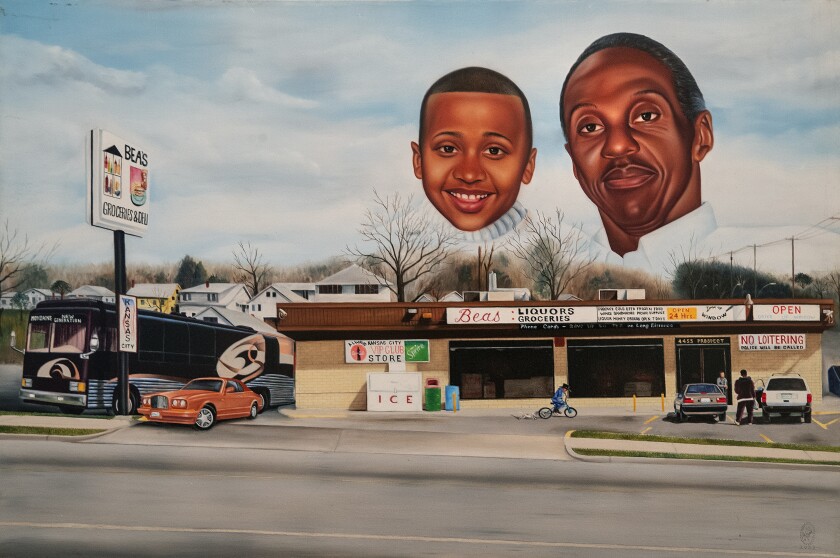
The original version of “Mondaine’s Market,” 2005, on display at the Hammer Museum as part of “Made in L.A. 2020: a version.” (Mel Melcon / Los Angeles Times)


Hammer curators Lauren Mackler and Myriam Ben Salah first approached Mr. Wash about inclusion in the exhibition in 2019. They had seen an image of “Mondaine’s Market” online and requested the portrait for the show. It depicts John L. Mondaine, a fellow inmate at Florence Federal Correctional Institution in Colorado whom Mr. Wash painted more than 15 years ago.

In the work, Mondaine’s enlarged, disembodied head floats in an overcast sky alongside his grandson’s head. Below is the Kansas City grocery store, Beas, that Mondaine owned. Mr. Wash — a contractor and welder who taught himself to paint in prison — obtained photographs of the site from Mondaine’s family and copied minute details from the location, along with imagery from magazines, into the piece, such as store signage, license plates and a bus’ LED destination screen. He even painted the interior of the store — shelving, stacked merchandise and a register — then painted over it, tinting the building’s windows so the inside is barely visible.

He and Mondaine designed the work together, Mr. Wash said, in the prison’s hobby shop (painting in one’s cell was prohibited at the time), talking for hours about imagery, proportions and placement. It took Mr. Wash two years to complete the work in 2005.

“He wanted a painting describing his legacy,” Mr. Wash said of Mondaine. “He came to me and said he wanted a picture of the store. He figured he was probably going to die in prison, and he wanted to be in the sky, surrounded by clouds, with his family.”

Mackler and Ben Salah felt the painting represented a body of Mr. Wash’s work depicting inmates in real and imagined landscapes, outside the prison walls, where — on the canvas, at least — they could connect with loved ones and assert their identities. The curators were also struck by the level of detail in the work.

“He’s a really skilled painter with a unique sense of composition,” Mackler said. “But the level of detail in that particular painting, personifying and animating the figures and architecture, was really exciting. There are worlds within worlds in the Mondaine painting.”
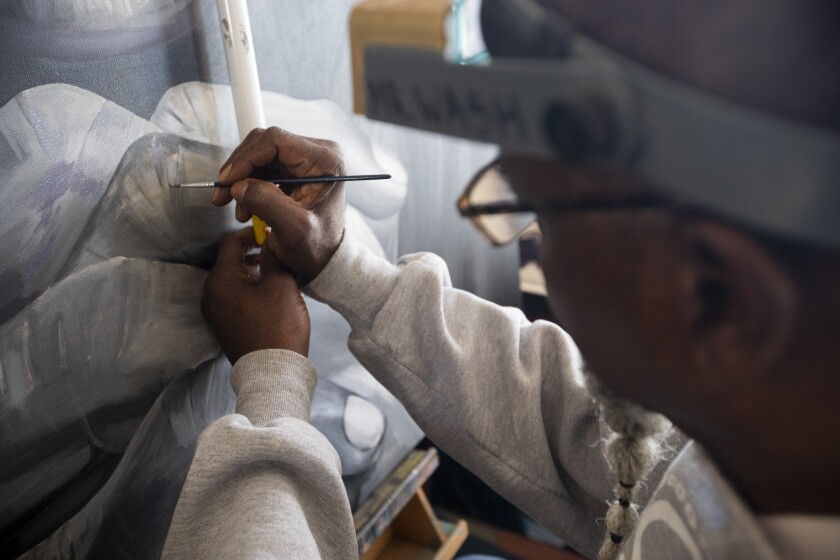
Mr. Wash, who was released from prison in 2016 after President Obama commuted his sentence, lives and paints in Compton. (Francine Orr / Los Angeles Times)

But there was a problem: Mr. Wash, now 66, had long ago lost track of “Mondaine’s Market” — along with Mondaine himself, who was released in 2005. The painting had been shipped to Mondaine’s family when Mondaine was still behind bars. (Inmates were not allowed to keep hobby shop works more than 90 days, Mr. Wash said.) But Mr. Wash had never been in touch directly with Mondaine’s family because, he said, there’s an unofficial rule: Don’t connect with other inmates’ families.

“You could get stabbed and killed for that,” Mr. Wash said. “If anything happens to their house, their family, I don’t wanna get blamed.”

Any business around his paintings — procurement of the photographs from which Mr. Wash worked, payments for portraits, the shipping of finished works — was handled by one of Mr. Wash’s eight children, a family friend, his lawyer or the organization Help Us Help Wash, founded by his supporters around 2013 to aid his legal defense. The organization also assists other individuals who say they have been wrongfully convicted.

Mr. Wash’s art liaisons, however, didn’t typically keep sale records, nor could they keep track of inmates who frequently moved within the prison system or their families. Commissions were just too plentiful. Mr. Wash’s talent earned him respect in prison, where he also taught art classes, and he said he had a waiting list of up to two years for new portraits.

Mr. Wash searched for the Hammer painting for more than four months. The shipping address was no longer valid, and phone numbers were out of date. Mondaine, by now in his 70s, was not on social media. Mutual friends turned up nothing.

The Hammer curators suggested Mr. Wash paint a replica of the work from memory, using the only photograph Mr. Wash had of the painting.

“But trying to paint a complex picture like that from a photograph?” Mr. Wash said. “The details were super small. First I said: ‘No.’ Two or three times. Then, finally: ‘OK, I’ll try.’”
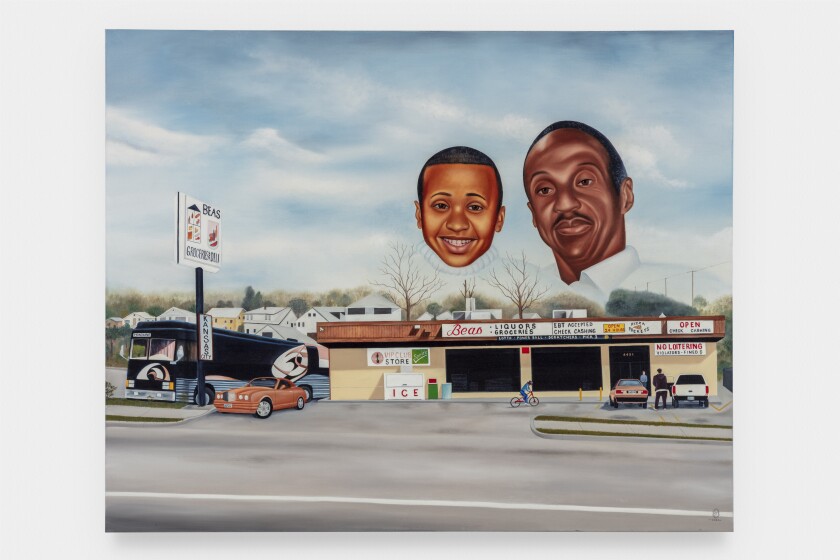
The re-creation of “Mondaine’s Market” is at the Huntington Library, Art Museum and Botanical Gardens as part of the pandemic-postponed “Made in L.A.” biennial. (Joshua White / JWPictures.com)

Re-creating the work as a free man was a vastly different experience, Mr. Wash said. The most striking difference was scale. No longer confined to working on small canvases that would fit inside his prison storage locker, Mr. Wash went big with the replica, more than doubling its size on a 4-by-5-foot canvas.

“I’d never had the opportunity to paint in oil that large before, it was an opportunity,” he said. “But in making it a larger picture, it required new techniques — the thickness of the paint, the precision of the brushes, how long the paint takes to dry. I still painted with the same brushes I painted with in prison, but it was harder. There were new decisions.”

Free time was also an adjustment. In prison, Mr. Wash had been allowed just two-hour stretches to paint, so he was forced to work quickly and efficiently. Creating the replica in the COVID-19-era shutdown last spring, he had nothing but free time. He hunkered down in his living room — “kids can’t come by, grandkids can’t come by, nobody can visit” — painting for 12 to 16 hours straight until his body ached.

“With an unlimited amount of time to paint, your calculations are different. It can take longer,” he said. “Which is better? I’m still figuring that out.”

Some details in the original painting, particularly building signage, were too small to see clearly in the photograph of the work. Mr. Wash scanned the image into his computer and enlarged it, but the details were still blurry. So he improvised, resulting in tiny differences between the two works. One version of Beas market advertises hamburgers, phone cards and money orders; the other, pizza, Lotto cards and check cashing. The bus’ destination in each work is different.
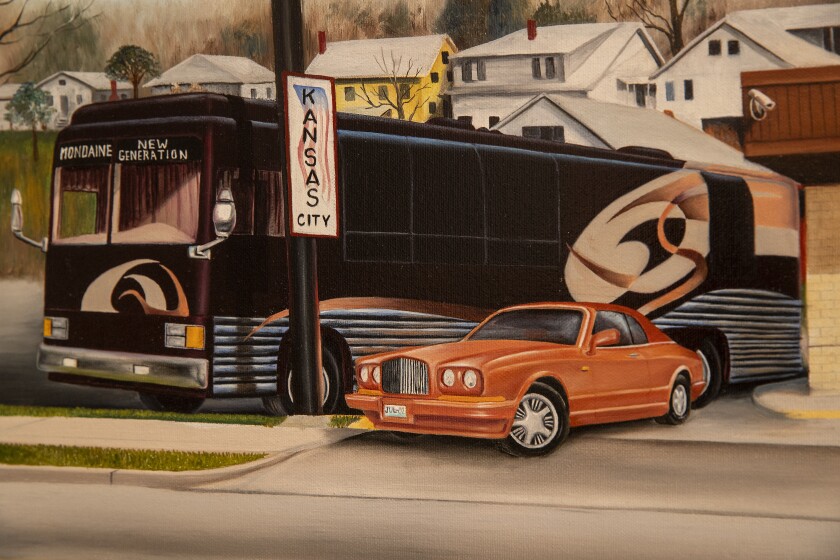

A detail from the original “Mondaine’s Market,” which Mr. Wash re-created for the “Made in L.A.” biennial. (Mel Melcon / Los Angeles Times)

All the while, as he painted, Mr. Wash kept searching for Mondaine and the original painting. Finally, through a string of mutual associates, Mr. Wash located Mondaine in Kansas City, living with his wife and son. He was 73 and blind.

The painting was hanging in the living room, above the couch. “They’d cherished it,” Mr. Wash said.

So much so that when Mr. Wash showed up on their doorstep weeks later to retrieve the work for the exhibition, as they had agreed on over the phone, Mondaine had a change of heart.

“But I told him, ‘Hey man, it’s me, Mr. Wash, you can trust me.’”

When the painting arrived at Mr. Wash’s apartment days later, he placed it beside the replica, which was still drying. It was the only time he saw the works together before they were shipped off to separate museums. Seeing the works side by side, nearly identical, brought a sense of accomplishment but also felt oddly melancholic, he said.

“It made me question myself. Are the energies of paintings equal in terms of detail, depth, the amount of time?”

The original “Mondaine’s Market” hangs prominently at the Hammer, and the replica is on view at the Huntington. The biennial engages themes of duality and reflections, so the mirrored works, positioned 25 miles from each other, have added resonance. (The museums’ galleries are closed, but the exhibition is installed and parts of it are viewable online.)
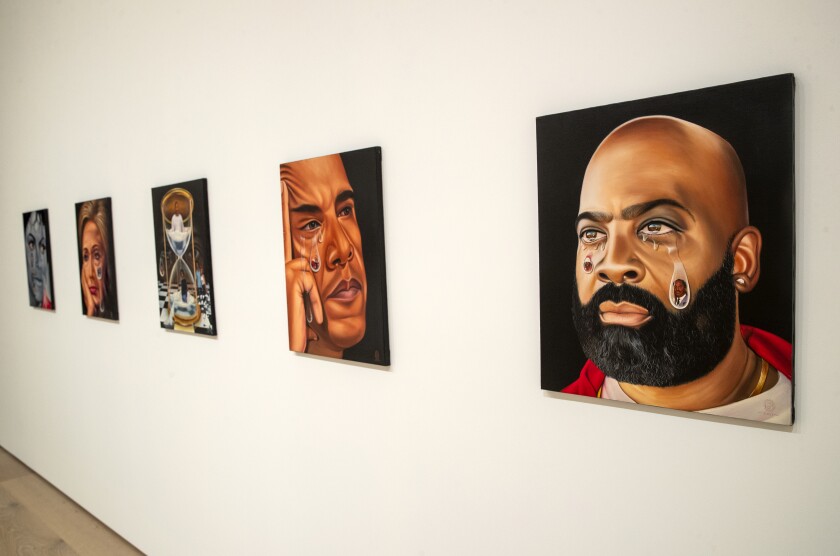

Mr. Wash’s Teardrop paintings, on view at the Hammer Museum. (Mel Melcon / Los Angeles Times)

The Hammer is also showing paintings from Mr. Wash’s teardrop series. Each portrait — of public figures such as Obama and Michael Jackson, along with fellow prison inmates — features robust tears rolling down the subjects’ cheeks. Tiny figures and narrative vignettes appear inside the teardrops.

On Feb. 11, the Hammer will stage a free virtual discussion between Mr. Wash and assistant curator of performance Ikechúkwú Onyewuenyi that will touch on the artist’s experience, his painting process and criminal justice reform, among other topics.

Mr. Wash also will show paintings in the group exhibition “Shattered Glass,” opening March 20 at the Jeffrey Deitch gallery in Los Angeles.

He was so energized by creating the larger replica for “Made in L.A.” that he painted an enormous work for the Deitch show, a 4-by-5-foot memorial portrait of Kobe Bryant shedding basketball tears — especially poignant on the one-year anniversary of the athlete’s death this week.

“To finally see what it feels like to paint in a larger size, the difficulty in that, that was the greatest accomplishment, something I was always deprived of,” he said.
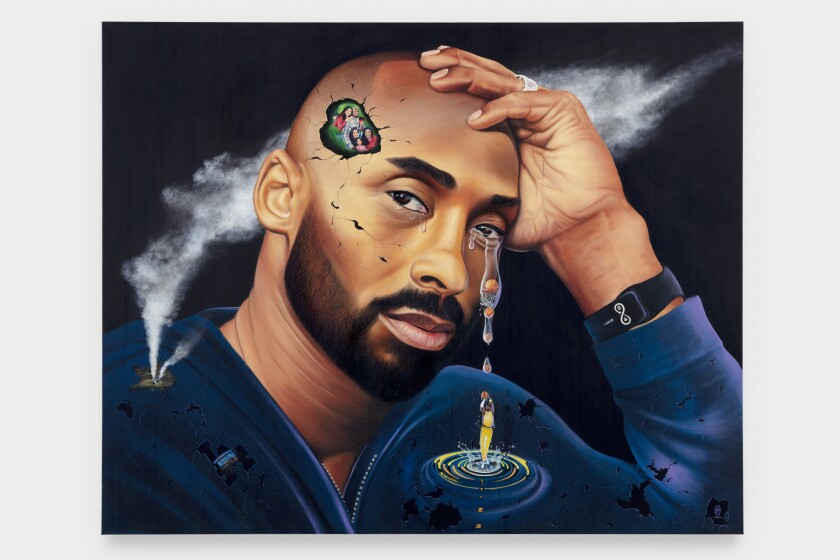
Mr. Wash’s memorial portrait of Kobe Bryant, “Shattered Dreams” (2020). ( Mr. Wash / Jeffrey Deitch)

The mirrored “Mondaine’s Market” works represent a melding of the past and the present for Mr. Wash, he said as well as a chance to bend another rule:

“You get a second shot at a few things,” he said. “This was one of them. A chance to do things differently. That’s a positive. I feel so blessed.”


'Made in L.A. 2020: a version'

Where: Hammer Museum in Westwood and Huntington Library, Art Museum and Botanical Gardens in San Marino (exhibition opening is dependent upon county COVID-19 tier rating and related guidelines)

When: Through April 25
Info: Online viewing links at hammer.ucla.edu
Virtual event: Mr. Wash in conversation with Ikechukwu Onyewuenyi, 5-6:30 p.m. Feb. 11; free. Check the Hammer website for details, including how to RSVP and receive an invitation to join.

18.1.21

Another Monsanto Roundup Case Likely to Settle as Bayer Works Through Tens of Thousands of Cancer Claims


Bayer has lost three trials to date — juries in each of the trials found that Monsanto’s glyphosate-based herbicides do cause cancer and that Monsanto spent decades hiding the risks.

Seven months after Bayer AG announced plans for a sweeping settlement of U.S. Roundup cancer litigation, the German owner of Monsanto Co. continues to work to settle tens of thousands of claims brought by people suffering from cancer they say was caused by Monsanto’s weed killing products.

On Wednesday, one more case appeared to find closure, though the plaintiff did not live to see it.

Lawyers for Jaime Alvarez Calderon, agreed earlier this week to a settlement offered by Bayer after U.S. District Judge Vince Chhabria on Jan. 11 denied summary judgment in favor of Monsanto, allowing the case to move closer to a trial.

The settlement will go to Alvarez’s four sons because their 65-year-old father, a longtime winery worker in Napa County, California, died just over a year ago from non-Hodgkin lymphoma he blamed on his work spraying Roundup around winery property for years.

In a hearing held in federal court Wednesday, Alvarez family lawyer David Diamond told Judge Chhabria that the settlement would close out the case.

After the hearing, Diamond said Alvarez had worked in the wineries for 33 years, using a backpack sprayer to apply Monsanto’s glyphosate-based herbicides to sprawling acreage for the Sutter Home group of wineries. He would often go home in the evenings with clothing wet with herbicide due to leaks in the equipment and weed killer that drifted in the wind. He was diagnosed in 2014 with non-Hodgkin lymphoma, undergoing multiple rounds of chemotherapy and other treatments before dying in December 2019.

Diamond said he was happy to settle the case but has “400 plus” more Roundup cases still unresolved.

He is not alone. At least half a dozen other U.S. law firms have Roundup plaintiffs they are seeking trial settings for in 2021 and beyond.

Since buying Monsanto in 2018, Bayer has been struggling to figure out how to put an end to the litigation that includes more than 100,000 plaintiffs in the U.S. The company lost all three trials held to date and has lost the early rounds of appeals seeking to overturn the trial losses. Juries in each of the trials found that Monsanto’s glyphosate-based herbicides do cause cancer and that Monsanto spent decades hiding the risks.

In addition to efforts to resolve claims currently pending, Bayer also hopes to create a mechanism for resolving potential claims that it could face from Roundup users who develop non-Hodgkin lymphoma in the future. Its initial plan for handling future litigation was rejected by Judge Chhabria and the company has yet to announce a new plan.

Carey Gillam

26.8.20

An Apocalyptic August in California


In the early hours of Tuesday, August 18th, the California sky split with lightning: dry, purple, spectacular, relentless. The following evening, the sunset was streaked, psychedelically, with luminous shades of clementine and fuchsia. A heat wave—the sort that was described with words like “historic” and “unprecedented”—was finally on the wane, and the stream of cool air was welcome. I stood outside my apartment, in San Francisco, and sent photographs of the sunset to friends on the East Coast. The landscape here so regularly stuns and humbles; I wasn’t thinking.

The magnificence of the evening sky was due to particulate matter generated by the C.Z.U., L.N.U., and S.C.U. Lightning Complex fires, which had been sparked by the storms. So far, the latter two are the second- and third-largest fires, respectively, in California history. (The largest, the Mendocino Complex Fire, occurred in 2018.) This past week, evacuation orders were issued across the state, including in Napa, Sonoma, Santa Cruz, and parts of San Mateo County, which abuts Silicon Valley. People fled their homes in Solano County, near Sacramento, and in rural areas close to the Sierra Nevada mountain range, which includes Yosemite National Park and Tahoe National Forest. (To date, more than a hundred thousand people have been evacuated.) Photographs surfaced of burning houses, burning farmland, burning woods. Images of Big Basin, California’s oldest state park, showed five-hundred-year-old redwoods blackened and scarred. There were pictures of people standing in the smoldering remains of their homes—a twisted gate, a gnarled oven—and of evacuees’ stalactite-looking tail lights, melted en route to safety. Once again, California has declared a state of emergency.

The state has always had a fire season, but this month’s fires are unprecedented. Unprecedented does not mean unanticipated: in recent years, fires have intensified—a consequence of climate change, exurban sprawl, and neglected electrical infrastructure. A certain amount of dry vegetation is natural, but rising temperatures have yielded longer periods of drought, accompanied by insect infestations and disease; these factors have led to weaker, drier, and dead trees, and to parched brush and grasses—in short, abundant kindling. Californian housing policy, and the subsequent housing crisis, has led developers and residents to push outward, and nearly a third of residential buildings in the state are situated where urban and wild lands meet. Meanwhile, in 2019, P. G. & E., the electrical utility that services much of California, declared bankruptcy, after being found liable for the wildfires of 2017 and 2018. That year, Sonoma’s Kincade Fire, the state’s largest that season, was catalyzed when a P. G. & E. transmission line malfunctioned.

Forest mismanagement has contributed to the problem. In the early twentieth century, the United States Forest Service adopted a policy of suppressing all fires, and California followed suit. For decades, the state resisted mitigation strategies such as controlled burns, in which fires are deliberately set to clear out dry brush and overly dense clusters of trees. California began setting controlled burns in the seventies but only addressed a modest fraction of vulnerable territory; in 2018, Cal Fire, the state’s fire-protection agency, made plans to triple the amount of “prescribed fire” on state-controlled land, but the burns were temporarily paused this spring, due to the coronavirus. In recent years, the state has strategically deployed herds of goats, which can be spotted not just in the countryside but in various parts of San Francisco—on hillsides below the mansions of Pacific Heights, and on the shoulder of Highway 1—contentedly clearing the brush. The goats are credited with saving the Ronald Reagan Presidential Library from last year’s fires. But, over all, the state’s parks and forests are still glutted with flammable vegetation.

In 2018, one source of the Mendocino Complex Fire was a rancher working to plug a wasp nest; as he hammered down a stake, a spark flew into dry grass. This month’s fires were set off by lightning strikes. But fires thrive in hospitable environments; their growth can seem preternatural. By Friday, August 21st, there were five hundred and sixty fires spread across the state. More than a million acres have burned.

San Francisco during fire season is subdued and strange. It is hard to overstate just how close the wildfires are. Nearly everyone here has a personal connection—friends, family, memories—to the areas most affected. City residents are protected by both density and geography. Still, the air feels heavy; ash drifts onto everything. People close their windows and hibernate. Those who can work from home do so. Things shut down. In 2018, this meant public schools, offices, and cable cars; last year, it meant parts of the electrical grid. This year, the rhythms of the city were already disrupted. The cable cars shut down in mid-March. School buildings and white-collar workplaces have been shuttered for months. The Bay Area was in the midst of planned, rolling blackouts, prompted by the heat wave.

One benefit of living in California during the pandemic has been the abundance of open, uncrowded natural spaces. The heat wave tested this; the wildfires nullified it. It is a cruel irony that outdoor spaces are now inhospitable and unsafe. People cannot congregate indoors, owing to the virus; they cannot congregate outdoors, because of the fires. (In other parts of the country, where winter is unforgiving, this dynamic may soon become familiar; both ash and snow render outdoor dining—a Hail Mary pass for restaurants during the pandemic—untenable.) In the Bay Area, where housing is short and the cost of living is high, many people live in homes and apartments that are packed beyond comfortable capacity; in San Francisco, thousands of people live in parks or on the street. There are very few places to go.

In 2018, during the Camp Fire—the state’s deadliest wildfire, sparked by neglected P. G. & E. equipment—my household purchased N95 masks from a hardware store. This spring, we donated the unused masks to local medical workers, handing them off to a P.P.E.-clad administrator in a hospital parking lot. We figured that the pandemic would pass before fire season; we would be able to restock before fall. (We did not yet know that the N95 masks we had purchased, which had exhalation valves—a comfort when the sky is smoke-choked—would turn out to be a public-health hazard during a respiratory pandemic.) Now we’ve begun discussing how we might apportion our apartment in a covid-19-safe way, should friends or family be evacuated. We’ve contemplated hanging up tarps and building ad-hoc air-filtration systems; for now, we’ve settled on indoor masks. Because of the fires, we can’t simply open all the windows.

People want to help, but aid, like everything, is complicated by the virus. Many organizations on the ground are asking for money rather than dropped-off donations, which come with a risk of transmission; money is tight at a time when nearly fifteen per cent of Californians are unemployed. Service journalism during wildfire season is usually bleak; with the pandemic, it’s nearly apocalyptic. “Masks for Smoke and COVID-19—What Kind is Best?” a headline on KQED asks. In a running series titled “How to Survive,” the San Francisco Chronicle offers detailed guides: “How to keep flames from igniting your home”; “What to do in 1st critical minutes.” It is tempting to turn to metaphor, or to memes. On social media, a viral photograph of a sign outside a senior center—advising hand washing, mask wearing, and social distancing, and swarmed by an inferno—earned the caption “This is fine.”

But memes are a distraction, and metaphor fails. Public schools, previously closed as a public-health measure, are reopening as evacuation shelters. It is grape-harvesting season, and the vineyards are on fire. Farmworkers, who have been hit hard by the coronavirus, are still moving methodically through fields of produce, harvesting fruits and vegetables in brutal heat and toxic air. Many are undocumented, without health insurance, and ineligible for government assistance. Then there is the crisis of firefighting resources. In the past, California has bolstered its crews with inmate firefighters, who are paid a dollar an hour to stand at the front lines under showers of retardant. Many were released from prison earlier this year, as a protective measure against the coronavirus; because they have criminal records, it is extremely difficult for them to get jobs with Cal Fire. Others are still incarcerated in facilities where the virus is widespread. The state has had to appeal to out-of-state agencies, which are sending equipment and assistance: fire engines from Arizona, Nevada, and Texas. Everything seems characterized by a sense of wild fragility.

It’s hard not to see all this in terms of a cascading series of national failures: the chaotic, politicized, fabulistic response to the virus; the political influence of oil and gas conglomerates; the fecklessness of private utility companies; cruel immigration policies and weakened labor protections; environmental rollbacks; a weakened social safety net. Some failures, like global warming, are bigger than any one country’s, although the United States has failed here, too. According to meteorologists, last week’s dry lightning was connected to the heat wave, which was generated by winds from Tropical Storm Fausto. Colorado is also experiencing a spate of wildfires, one of which is the second-largest in its history. These are the conditions for secondary environmental and public-health crises. Smoke from the fires in California and Colorado is uncoiling across the country. Plumes have already drifted as far as Kansas.

The air is cleanest on the coast, even as smoke billows from beach towns like Point Reyes and Santa Cruz. On Friday night, people gathered on Ocean Beach, in San Francisco, to picnic, fly kites, and take photographs of the sunset’s radioactive, marigold glow. Tanker ships turned toward the open Pacific; a flock of pelicans pushed northward. A hurricane of birds, stretching the length of about two city blocks, hovered ominously over the waves, and a surfer, caught beneath them, emerged from the water to say with slack awe that he had never seen anything like it. A friend of mine wondered aloud whether the birds knew something we did not. No, thank you, I thought. A “Spare the Air” alert—a temporary ban on wood burning—had been issued for the entire Bay Area, but, in a spot designated for bonfires on the beach, people nurtured small ones against the wind.

The crescent moon hung low and orange. Back in my own neighborhood, on the southeastern side of the city, diners lingered at sidewalk tables outside bars and restaurants, masks pulled down around their chins like orthodontic headgear. A group of teen-age girls cruised up Valencia Street on e-scooters; a man playing a guitar serenaded two-tops at a Spanish restaurant. The air wasn’t clear, but it offered some relief. In October, the traditional fire season will begin.

Anna Wiener