Showing posts with label paintings. Show all posts

23.4.25

The Rise of Pablo Picasso


How a young man from Málaga became one of the costliest painters on earth.


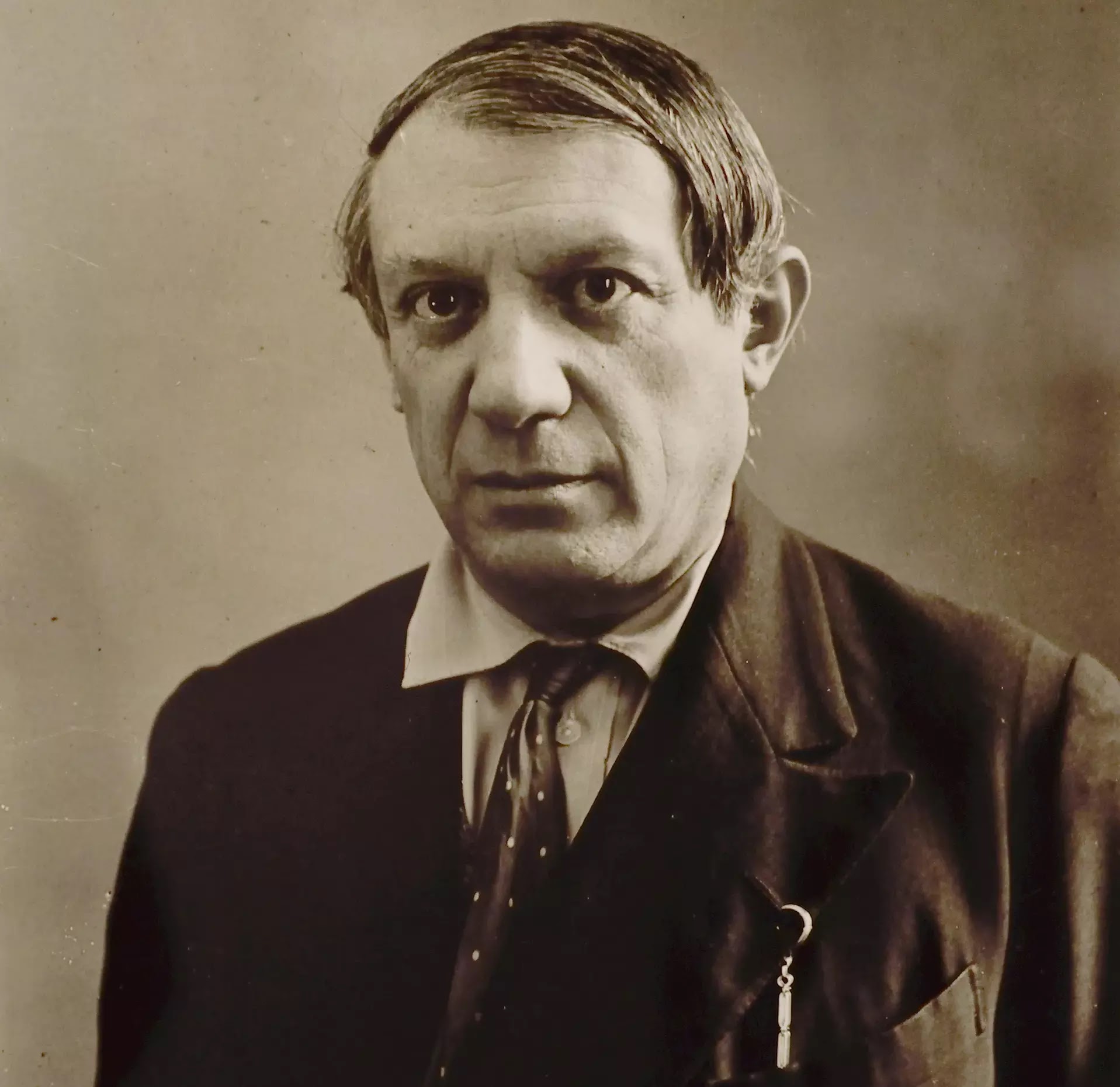
Pablo Ruiz y Picasso has been the most talked-of and written-about artist on earth. Commercially he has become the costliest painter alive and aesthetically he has remained the most influential. His pictures, like hand-painted gilt-edged stocks, have followed a rising graph of their own; he has influenced a generation of painters who copied what they understood of him and he has influenced a public which has bought him without always understanding any part of him. When he first came to Paris, as a Spanish youth of nineteen, he dressed as a laboring man because of poverty and a preference for the picturesque. Even in recent years, when seen sitting prosperous and unoccupied in a Left Bank café, he has retained a look of sombre isolation and of a man devoted to work. Miss Gertrude Stein’s friend, Miss Alice B. Toklas, says a friend of hers said Picasso looks like a handsome bootblack.

He is a Spanish bourgeois. He was born in Málaga, October 25, 1881. His mother’s people were silversmiths, originally from Genoa; his father, of Basque origin, became drawing teacher at the estimable Barcelona Academy of Fine Arts, which, had it known what the son was in future to paint, would not have thought it fine or art. Young Pablo’s connection with his father’s institution was that of a passing prodigy who at the age of fifteen completed in one day the competitive art examination which older students were given a month for. A few months later he was received at the Madrid Academy for a year; then, three years later, in 1900, he went to Paris, centre of European art.

Impressionism, the great nineteenth century iconoclastic art movement, which the public had greeted with jeers, was then on its highly respectable way out. Cubism, the twentieth century’s new revolutionary art formula, which the public was also to hoot at, was almost on its way in, though Picasso, who was to lead Cubism, didn’t know it yet. He was still busy painting like the Impressionist Toulouse-Lautrec. Picasso finally settled in Montmartre at 13 Rue Ravignan in a ramshackle edifice resembling a Seine laundry boat and nicknamed Le Bateau-Lavoir. Those were heroic Montmartre days, since a handful of imaginative, important artists were, in poverty, hatching their fabulous future. Though he was unsociable, Picasso’s talent eventually placed him with the other talented unknowns with whom he belonged—with the minor poet Max Jacob, first to discover and make a cult of Picasso; the major poet (then editor of a physical-culture magazine) Guillaume Apollinaire, first to write of Picasso; the struggling painters Derain, Braque, Matisse, Modigliani, Juan Gris, Van Dongen, and Marie Laurencin. Other friends were Frédé, art-loving innkeeper of the uproarious Lapin Agile, who used to bring his pet donkey to parties; innocent Douanier Rousseau, about to marry for the third time; and Picasso’s model, the beautiful Fernande Olivier. Everybody was, or acted, young; everybody borrowed money from everybody else, and owed money for paint and rent; everybody quarrelled, made love, drank, ate risotto because it was cheap, and worked like a steam engine. Picasso carried a revolver, kept a tame white mouse in a table drawer, couldn’t afford even the luxury of painting on his walls—as he had when a student in Spain—pictures of the furniture he lacked. When he didn’t have white paint for his pictures, he painted with blue; when he ran out of new canvas, over the portrait of a crippled flower-seller he painted the big red harlequin that later figured in the Rouart collection; when he lacked linseed oil, he painted with lamp oil. He always kept on hand a supply of lamp oil because he worked at night so people couldn’t bother him.

At one time he was so poor that he and Max Jacob occupied the same bed in turns. Jacob, who besides being a cultivated poet was an impoverished novelty-shop clerk, slept at night while Picasso worked; when Jacob got up in the morning to let Picasso go to bed, the floor would be carpeted with drawings, which Jacob had to walk on and from which his footprints later had to be cleaned by art experts, since every early Picasso fragment eventually became so valuable that it could be sold. These first few Paris years in Picasso’s young twenties were viewed as a period of art, partially happy and entirely human, and were thus rare for him. At this time he painted his sad groups of the blue-colored Blue Period (after pleasant trips home to Spain) and his precious, romantic, rosy-tinted Rose Period figures (after a journey to Holland, which he found gloomy and didn’t like). This was also the feverishly fecund Harlequin Period, during which he painted the tumblers, harlequins, and jugglers whom he admired at the Médrano Circus; when he sympathetically painted the beautiful thin skulls of the poor, topped by gay clowns’ hats; when he portrayed the spangled acrobat, his wife, and male child, posed like a new Holy Family in lovely disguise. This was Picasso’s only art period of sentimental and sociological sensibility, and he probably didn’t mean it to be either. He was simply a young painter who was painting.

The first picture Picasso ever sold was bought the day after he arrived in Paris in 1900 by a Mademoiselle Berthe Weill, who ran a bric-a-brac shop and bought anybody’s first picture at any time. The next year, Vollard, the great eccentric art merchant, gave Picasso an obscure little exhibition called “Scènes des Courses et des Cabarets” and bought some pictures which, as was his habit, he hid in his cellar, where they brought Picasso no renown. Soulié, a mattress dealer on the Rue des Martyrs, also bought Picassos, apparently for a horse dealer with leanings toward art speculation. The art merchant Sagot, who kept his pictures in an old pharmacy and gave artists handouts of stale medicines, also purchased Picassos—at cruelly low prices. Once, when Picasso refused 700 francs (then $140) for three big paintings, Sagot offered 500 francs and, to Picasso’s helpless, hungry fury, got them the day after for 300. Picasso was then alone in his spirited resistance to the art merchants’ racket. As a chorus girl traditionally hopes for a butter-and-egg man, so in France the poor, unknown artist must hope to be kept by an art merchant, to whom he cedes a long term contract for his future at a low price. Even when a beginner, Picasso refused to do this, as he also refused to manifest group solidarity and show his pictures at the Salon des Indépendants. In purchasing Picasso as a discovery, Russian, German, and American collectors were ahead of the French, who had also been slow in taking to Impressionism. The first collector to buy Picasso was Shchukin, the rich Russian industrialist whose Picassos now hang in the Soviet Museum of Modern Western Art in Moscow. The expatriate German collector-merchant Kahnweiler was another early buyer.

However, just before this time, Gertrude Stein, rich in enthusiasm but modest in means and then about as unknown as a writer as Picasso was as a painter, began her famous and eclectic Picasso collection and her friendship with him, which, through squabbles and over years, have been two of the most important personal elements in the Picasso legend. For her first Picasso, she and her brother Leo paid Sagot 150 francs and all three quarrelled about the picture’s merits. It was the early, exquisite, conventional nude, “A Little Girl with Basket of Flowers.” Miss Stein, who was already ripe to prefer stranger sights in art, thought the girl looked classically flat-footed; Sagot suggested they guillotine the girl and keep only the head. After Miss Stein became friends with Picasso she bought directly from him; she says that from 1906 to 1909 the Stein family controlled the Picasso output, since no one else wanted it. By 1919 she could no longer offer to buy at 100 francs pictures that were worth thousands, so Picasso gave them to her. In 1906, she posed eighty times for his portrait of her, after which he wiped the face off, saying he couldn’t “see” her any more, and then finished the likeness in Spain, where he couldn’t see her at all. He also gave her this portrait because, as he later said, at that time in his career the difference between a gift and a sale was, after all, negligible. He also said, when friends complained that the portrait didn’t look like her, that someday she’d look like the portrait. This has never happened, and became less likely than ever to happen when she cut her hair, which upset Picasso more than any of her other friends because his portrait showed her with her hair long. The 1906 Stein portrait was a boundary mark; it showed that the gay, romantic period was definitely at an end, that the intellectual, serious search for Cubism was now on.

Why Cubism had to be invented still puzzles a large public. At the time, the poet Apollinaire, in his famous essay on the subject, said that Cubism was “a search for a new composition with formal elements borrowed not from the reality of vision but from the reality of conception”—words which bewildered Parisians no less than the paintings themselves. More bluntly defined, Cubism was apparently an effort scientifically to give painting not two but three dimensions, these to be attained, in theory anyhow, by depicting the subject—whether an apple or a man—as if it or he consisted of visible geometric facets. Thus, in practice, the Cubist portrait of a handsome man looked like a still life of beautiful building blocks. Cubism also was probably an early prophetic Zeitgeist reflection of the non-naturalistic machine-age civilization. In any case, Cubism marked the point in modern art where the artist and public no longer saw eye to eye no matter what both were looking at; when the artist, indeed, began deliberately painting what he did not see and what no one else could check up on.

Who, from what source, at what date, and with what picture, invented Cubism, which Picasso at any rate was to dominate, is still a delicate dispute. The first authentic example of Cubism, modern museum men say, was done in 1907 by Picasso—his big painting “Les Demoiselles d’Avignon.” Miss Stein says Picasso’s three 1908 pictures of some cubelike cottages in Spain were “the real beginning of Cubism.” She also says that some African Negro masks (whose exotic angularity also reportedly aided in formulating Cubism) were perhaps shown by the sculptor Maillol to the painter Matisse, who then showed them to the painter Picasso, though there was also the tradition that Picasso first saw the masks through the painter Derain. She says still further that probably the name “Cubism” was invented by Apollinaire. Jean Cocteau says Cubism was a name invented by Matisse to deride a south-of-France picture by Braque in the 1908 Indépendants show; Apollinaire says that the Negro sculpture “which was destined to influence new French art” was discovered by Vlaminck and that the friendship between Picasso and Derain in 1905 “gave birth to Cubism, which at first was, above all, a sort of impressionism of the forms which Cézanne had envisioned toward the end of his life.” Picasso himself simply and plurally says, “When we made Cubism we didn’t mean to make Cubism but to express what was in us.” Although the French public at first said only that Cubism was crazy, a leading art merchant added, “I am now buying Picasso not because I have any taste for him but because he will be worth a lot of money someday.” By 1910, Cubism was a regular French studio school, with Jean Metzinger as its first academic theorician and Gleizes, Delaunay, and Léger as faithful exponents. Picasso’s precise early version of Cubism was so much copied that he called one of his best impersonators “the louse that lives on my head.” One night, at the beginning of the World War, Picasso and Miss Stein were taking a walk when they saw a camouflaged truck for the first time. He was amazed by its resemblance to Cubist art, and, in the tone of a man who has just been plagiarized, said, “Why, it is we who invented that!” Later, when a new field uniform for the French army was being discussed, he told Cocteau, “If they want to make an army invisible at a distance, all they have to do is dress the men as harlequins.”

After the war, when the alien Kahnweiler’s scholarly Cubist collection, which had been seized by the French government, was sold for low prices by an anti-Cubist auctioneer (whose head Braque punched, to teach him about modern art), Cubist paintings, like any commodity in a bear market, slumped. Now the New York Museum of Modern Art’s recent Cubist acquisition, “Les Demoiselles d’Avignon,” has just been valued by art experts at $20,000, the highest figure any contemporary canvas, even by Picasso, has reached. When, years ago, the collector Shchukin first saw the picture, he wailed that its ugliness marked the end of modern French art. Many people still think the historic young ladies from Avignon are a frightening lot.


By 1912, for those painters who had struggled in Paris to create the new art, the big moment had passed, because prosperity was creeping up on them. Poverty had united Picasso and his comrades; success separated them. He moved from Montmartre to the nicer Left Bank, and they, too, went their more comfortable ways.

From 1896 down through 1939 (according to experts, when they can agree), Picasso’s pictures fall into about twenty-six styles, most of them such typical Picassos that they look as if they had been painted by twenty-six different men. No other painter of his stature has ever offered so many completely differentiated versions of himself as Picasso. For forty years he has been in a constant fit of metamorphosis. Starting in his youth as the most gifted graphic artist of his time—i.e., the one most able to delineate likenesses of things or people in the grand manner—he has spent his years detailing unlikenesses in an increasingly varied and cerebral manner. He has also, his classicist enemies maintain, debauched the aesthetic tradition of Europe by the power of his painting personality and has made ugliness the style. When a painter fails to settle down into one matured mood, critics usually figure he hasn’t found himself. Picasso is deemed to have found himself two dozen times over and, among his special public, has made much of his reputation precisely on his restless, drastic mutations—which he silently invents in his own seasons and which only his devotees garrulously explain throughout the years. Assuming that Picasso (or anyhow part of Picasso) will be considered a master two hundred years from now, collectors and experts in the twenty-second century will have a hard time identifying a Picasso as easily as they identify, for instance, a Titian today, except for the fact that Picasso usually carefully and legibly signs his pictures with his name, often adding the year in roman numbers, plus the month and day on which the picture was completed. However, modern French experts say that all Picasso’s styles, no matter how different, and whether autographed or not, have one recognizable entity, a thing they call le signe, meaning the graphic “line” peculiar to him which they count as a signature in itself.

To the public, out of his twenty odd periods the most intelligible and appreciated are the melancholy Blue (1901-04); the picturesque Harlequins, Clowns, and Saltimbanques (1905); the sentimental Rose (1905-06); the Analytical Cubism, especially because of the fine, fertile, popular compositions featuring bits of guitars and newspapers (1909-12); and the Classic Figures (first part of the 1918-25 style). The faces and eyes of three women also date and differentiate some of his works. The almond-eyed French Fernande Olivier is visible through the romantic Rose Period. The second feminine, straight-eyed face is that of the Russian ballet dancer Olga Koklova, whom Picasso married in the Paris Russian Church in 1917. Through her, the Spaniard in Picasso was temporarily exotically influenced by the new popularity of anything Slavic; Picasso was the first of the big painters to shock aesthetes by descending to the task of making some of Diaghilev’s Russian Ballet stage sets—for “Parade,” “Tricorne,” “Pulcinella”—and the cruel, truncated décors for the ballet “Cuadro Flamenco.” The enlarging domestic influence of Madame Picasso marked the early 1920 period of gigantic female nudes, sometimes also attributed to the influence of Greek sculptures or just to big French women bathing on the Juan-les-Pins beach. A typical and tender 1923 line-edged classic portrait of Picasso’s wife eventually won the Carnegie Institute art prize in 1930. In 1927, when some experts consider Picasso terminated his many experiments with Cubism, he painted a final Cubist portrait of his son, Pavlo, dressed as a harlequin. Picasso’s marriage was ended by divorce in 1937. Since then the profile of Dora Maar—a profile usually painted with two handsome sloe eyes and both handsome nostrils visible—as marked Picasso’s recent deliberately deformed and decorative curvilinear portrait work. Dora Maar is a Yugoslav of good family who shortened her name from Markovitch and is now a well-known professional photographer in Paris.

A complete list of Picasso’s various artistic activities and periods is a lengthy affair, since it also comprises periods classified as Negro, realist, abstract, monochrome, planes, papier collé, pointillism, neo-Impressionism; a period of neo-Renoirism called “Homage to Renoir” (at which old Renoir took umbrage), classicism, heroicism, an adult or second Roseism, imitations of his own Cubism, rectilinear forms, sumptuous still lifes, portraits in which people look like still lifes of machinery, surrealism, sculpture, fantasies molded from wire, tin, or pressed paper, the so-called unheimlich or unpleasant manner, enormous natures mortes, and sleeping women. In 1933 he had a period known as the Relâche Period because during it he did not paint at all. Then came bullfights, extraordinary legendary man-animal figures, and finally the Spanish war and his much-discussed mural of the bombed city of Guernica.

The Spanish war profoundly affected Picasso, theretofore politically indifferent. His patriotism, previously visible principally in the nostalgic Spanish shadows of his Blue Period, became passionately republican. He refused to shake Italians by the hand because they were bombing his land; his broadsheet, “Songes et Mensonges de Franco,” he sold in postcard format for charity; he gave “Guernica” for propaganda to the Spanish Pavilion in the Paris Exposition; in optimism, he gave big sums to the Spanish government to buy planes; and finally, in defeat, he gave money to the Spanish refugees in the French border camps. The Spanish war furnished a terrible, trite human tableau which distracted Picasso for the first time from a preoccupation with his own visions. Since the Spanish war ended, the only show of Picasso’s paintings in Paris (at the Galerie Rosenberg, his official merchant since the first World War) displayed nearly nothing but peaceful, pretty flowers.

The first major retrospective show of his works ever held in Europe took place in Paris in the spring of 1932 at the Galerie Georges Petit. It was followed by an even larger show in the autumn at Zurich. “Picasso, Forty Years of his Art,” the current retrospective at the Museum of Modern Art here, is the biggest Picasso exposition yet assembled, covers work from 1899 through 1939, and includes three hundred and sixty items, of which one hundred and fifty are canvases. About twenty drawings and originals of book illustrations from private European collections failed to arrive at the last minute owing to the difficulties of shipping since the war. Two of the Gobelin tapestries, as well as a rug Picasso designed, are also shown. He has interested himself in modern crafts, thinks an artist should apply himself to anything stimulating that turns up, has made patterns for linoleums and tile mosaics, and at one time experimented with painting pictures in furniture paint.

According to correct Spanish usage, Picasso should (and occasionally did in his early days) sign his pictures Pablo Ruiz, which is his real name; his father’s name was Ruiz, his mother’s was the Picasso. In the Spanish formula which combines both parents’ names for the child—i.e., Pablo Ruiz y Picasso—the mother’s name is written last. It was her name that Pablo Picasso chose to be known by.

Being an iconoclast, Picasso believes painters should paint in comfort and that French studios are either too hot in summer or too cold in winter. He paints at his ease in a pair of bourgeois Paris apartments at 23 Rue La Boëtie. He and some selected paintings live in the downstairs flat, his palettes and other canvases live upstairs. Though he no longer paints exclusively at night, he is a restless man, always working at or fiddling with something, and his output is tremendous. There are thousands of Picasso canvases now in collections, private hands, or commercial circulation in Europe and America. He also owns stacks of his work which he has never offered to sell; when war broke out in September he stored some of his most valuable canvases in steel safe-deposit closets in a bank. Because he hates sweeping or having things moved, the dust in his atelier is epic, as is the confusion caused by drawings on chairs, sculpture in the corners, paint tubes on the floor, and an assortment of the pretty rubbish painters, like little girls, pick up—lengths of frayed, colored velvet, odd old boxes, stray pieces of once fine furniture from earlier periods.

Because he can never make up his mind what to do with his belongings, Picasso has gradually accumulated five different dwelling places. These he has taken on not as a well-organized man expanding into new forms of life but as somebody irresolute who has hired havens. He has a small weekend house at Le Tremblay; a country property, Boisgeloup, near the medieval Norman town of Gisors; for summer painting he recently acquired his friend Man Ray’s modern penthouse at Antibes. Picasso’s newest Paris dwelling—if he can ever decide to move in—will be on the Rue des Grands-Augustins, where several years ago he rented two floors in the magnificent seventeenth-century mansion which was formerly the town house of the Ducs de Savoie. The place is said to be a noble architectural curiosity, with broken floor levels, nests of small rooms, and sudden great salons. In anticipation of eventual residence, the painter long since installed modern necessities and what he calls his Maginot Line—a grille which cuts across the staircase leading to his front door and would prevent visitors from reaching his doorbell. Friends say he hates hearing his doorbell ring but hates it more when it doesn’t ring at all. Wherever he lives, he lives simply, eats out a lot in small restaurants, and, in the modern intelligentsia French style, as a rule not only entertains his friends but even sometimes writes poetry not at home but in a corner café. His poetry is in the association-surrealist manner.


Picasso’s domestic entourage consists principally of a chauffeur named Marcel and a factotum named Sabartés, who is a friend of long standing and a compatriot. Picasso clings to his well-worn Spanish connections, and has painted portraits of Sabartés, who, in turn, has written articles about the painter. Among those close to Picasso, his despotism, indecisions, hermetically sealed character, and energetic talents arouse a curious loyalty. The painter’s chauffeur can, in a pinch, give the dates of his master’s canvases. Today Picasso’s car, incidentally, has the look of a second-hand elderly Hispano of the kind that seats seven bolt upright, but when he bought it brand-new, at great cost, it seemed like a chariot for Picasso’s brief experiment with luxury.

As a man, Picasso is complicated and more confusing to others than he is to himself. He says that if one took the tendency one likes least in oneself and strengthened it, one would probably have one’s true character. He is indecisive and dominant; he makes promises because people seem to like promises, but he never keeps them. By procrastination he lets circumstances overtake him and solve him along with themselves. Because he is a Spaniard, he takes cruelty for granted, either in art or life. Since he is short, physical strength fascinates him. He greatly admires boxers. He himself has boxed, on two isolated occasions, with Derain and Braque, both big men and amateurs of the sport. He’s fond of animals, has owned kittens, a St. Bernard, a Mexican hairless, and an Afghan hound. His pets are run on the principle that they must look after themselves. He suffers from cold, used to wear a coat that hung to his heels, likes only the hot Spanish climate, and formerly complained that the chillier French landscape smelled of mushrooms. He is not a concertgoer; when young he said he knew nothing of music and didn’t understand it. He is kind to young painters, visits their expositions, hears their questions out, and gives no advice. He would rather be praised by them than by the art critics.

In speech he is discursive except on big topics; then he eagerly treats himself and the listener as if they were two problems entitled to a solution. Miss Toklas says his conversation is flabbergasting and that he is invariably willing to be proud, even at a sacrifice. Racially and constitutionally, he is a tragic-minded man, sad, sarcastic, with malice in speech taking the place of wit. His most-quoted phrases are usually too libellous to print. When he quarrels with friends, the reconciliations have to be arranged in the complicated Latin manner. He is a hypochondriac who has a little kidney trouble. He has small, handsome hands and feet which please him, and a rebellious, pendent lock of hair which, as the French say, cuts his forehead like a scar. His eyes are remarkable; he has a wild little right eye like a Spanish bull’s and a kinder, larger, and more human left eye. When he enters a room his brown glance seems to register everything in it in a sudden inclusive flash, like a photographer’s lens taking a group photograph. Once, when he was looking at some Rembrandt etchings, the owner said it was as if Picasso’s stare would pull the lines off the paper, the way the sun’s heat dries up the pattern of moisture on an old leaf.

There was a period in the nineteen twenties when, whirled along by the fashionableness of the postwar Russian Ballet, Picasso frequented that mixed artistic, monied, demi-aristocratic, semi-mondain Paris circle called le beau monde, where he was a welcome figure, since personalities were the rage. In the last two years, Picasso has been principally seen in public at the St. Germain-des-Prés café tables of the Flore. The small group most often seen with him include serene Paul Eluard, the surrealist poet; Madame Apollinaire, and the Cahiers d’Art editorial group, who are the painter’s art publishers. Even in a crowded café there is a feeling of dominance, abundance, and experience concentrated in the dark presence of Picasso. In his absence, what he may be doing or has done is a source of apparently stimulating speculation to his devotees. Is he painting or is he only drawing today? Did he wear his new gay tie yesterday? What did he say last week and who wrote it down—for his group first, and for posterity second? For many admirers, and with his multiple professional achievements as warrant, Picasso emanates the aura of genius in which they like to reside, though all they get out of it is proximity.

He is generous to his poor friends; he offers them gifts in kind rather than money, perhaps out of respect for Iberian standards of friendship, perhaps out of respect for cold cash. He gives hams, wine, invitations to dinner, and, above all, he gives his valuable drawings, which the friends can sell when they are in distress. Though he once refused to sign a series of new etchings because he wasn’t satisfied with it, for a poor friend with a once-signed old etching which dealers declared was a forgery, Picasso re-signed “Picasso, Picasso, Picasso” all over the margin. Because he asks—and gets—the highest prices, his enemies say he is money-mad. What he says about this is, like everything he says, full of common sense. “I am anti-commercial,” he says, meaning that he is against the merchant-inflated art market, “but I am interested in money because I know what I want to do with it.” When he sells a new picture these days the price is usually around $5,000. If its period becomes popular, the chances are that its value will increase, although not indefinitely, at the rate of a hundred per cent a decade. A good Picasso of the Harlequin or Rose Period, for instance, now brings about $15,000. Since Picasso himself says that he has painted in his lifetime about four thousand pictures, an efficiency expert could compute that he turns out an average of two pictures a week.

He says a painting has an integral life of its own when it is being worked on; thus he was not surprised when he started painting a portrait of the poet Jean Cocteau and it turned into a picture of some girls rolling hoops. “I act with paintings the way I act with things,” he says. “I make a window the way I look through a window. If the open window isn’t any good in my picture, I paint a curtain and close the window the way I would in a room.” He also says, abstrusely, that before he came along painting had been the sum of additions but his painting is the sum of destructions. When an intrepid American lady asked him what his painting was supposed to mean, he answered, “Madame, on ne parle pas au pilote.” Usually all he will say is that a painting means whatever the person looking at it sees for himself. Picasso can, if he chooses, still draw perfectly in the academic manner. When somebody said he drew better than Raphael, he said that might be all very well but what he would prefer to hear was that he had a right to draw as he pleased even if it was the opposite of Raphael. He has a detached attitude about the future of his work. Of a painting of his which he considered bad but which he had sold, he said calmly, “Time will sort all those things out. . . . A picture lives by its legend, not by anything else.” One of the strangest pictures in the Picasso legend is one belonging to the Spanish painter Zuloaga; it is a Picasso painted in his teens. It is of a pretty Harrison Fisher type of girl with pink cheeks and a stylish hat.

Picasso is his own type of genius. “Work,” he says sombrely, “is a necessity for man. Man invented the alarm clock.”

Janet Flanner

23.1.22

717-Gigapixel, 5.6-Terabyte Photograph of Rembrandt’s “The Night Watch”


Generally, seeing art on a computer screen is never as good as seeing art in real life. At Glasstire, we’ve always espoused this statement, and I do firmly believe it still. 

However, there are certain times when seeing an artwork online — and the capabilities offered by digital technologies — comes close to eclipsing the live experience.

Maybe this isn’t for me to judge, as I’ve never been to Amsterdam’s Rijksmuseum, but the institution’s recent online offering of a 717-gigapixel (that’s 717,000,000,000 pixels) image of Rembrandt van Rijn’s The Night Watch (1642) is very compelling, and perhaps even better than seeing the nearly 15-foot-wide canvas in person.


Rembrandt van Rijn, “The Night Watch,” 1642, Oil on canvas, 379.5 cm × 453.5 cm. Collection of the Rijksmuseum

There’s been a lot of work done on and press about the painting recently. In June of last year, Artnet News reported that, with the help of artificial intelligence, museum experts were able to reconstruct missing sections of the painting, which were lost after the work was trimmed so it could fit inside Amsterdam’s Town Hall in 1715. This was just the latest revelation during the Rijksmuseum’s ongoing effort to conserve and restore the painting, which began in 2019. Likely because the piece is so well-known (and because the public wouldn’t want it to disappear for years into a back room), conservators worked on the painting in a glass chamber, in full view of the public.

The process of how this 717-gigapixel photo came to be is stunning, and the level of detail it makes legible is more stunning still. See information about the process below, via the Rijksmuseum. And see (and zoom into!) the photo here.

This is the largest and most detailed photo ever taken of a work of art. It is 717 gigapixels, or 717,000,000,000 pixels, in size.

The distance between two pixels is 5 micrometres (0.005 millimetre), which means that one pixel is smaller than a human red blood cell.

The team used a 100-megapixel Hasselblad H6D 400 MS-camera to make 8439 individual photos measuring 5.5cm x 4.1cm. Artificial intelligence was used to stitch these smaller photographs together to form the final large image, with a total file size of 5.6 terabytes.


Brandon Zech

13.5.21

10 People & Things Connecting Pablo Picasso With Russia


Russian collectors and avant-garde artists recognized Picasso as a formidable figure in 20th century art early on, while present-day visitors to the Pushkin Museum in Moscow and the Hermitage in St. Petersburg eagerly rush to the rooms where his works are displayed. Interestingly, Picasso had far more connections with Russia than one might think.

1. Art collectors
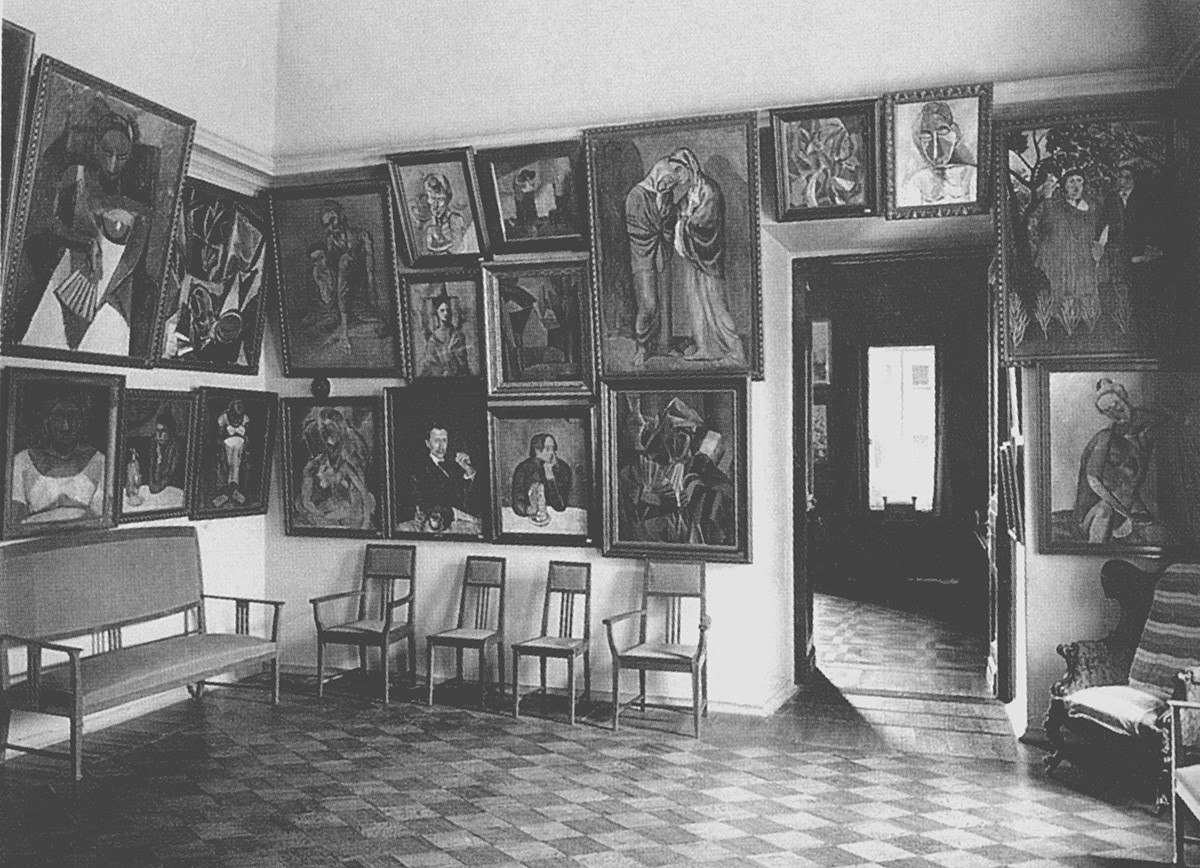
Picasso Room in Shchukin's house.Heritage Images/Getty Images

In 1908, Henri Matisse and a Russian art buyer visited Picasso's studio together. The latter selected two paintings, including Queen Isabeau, and paid generously for both. For the artist, who at the time was rather hard-up, the appearance of this buyer, named Sergei Shchukin, was a godsend. Over a period of six years, the Russian philanthropist bought more than 50 works by Picasso from his Cubist, Rose and Blue periods, including Woman with a Fan and The Absinthe Drinker. 

His collection of Picasso’s works effectively became the largest in the world. Another famous Russian art collector, Ivan Morozov, showed an interest in Picasso's works as well, acquiring two prominent paintings—Girl on a Ball and Harlequin and His Companion. After the Bolshevik Revolution, Shchukin's and Morozov's collections were nationalized and the Museum of New Western Art was established on their basis. It existed until 1948, when its collection was divided between the Pushkin Museum and the Hermitage.

2. Monograph
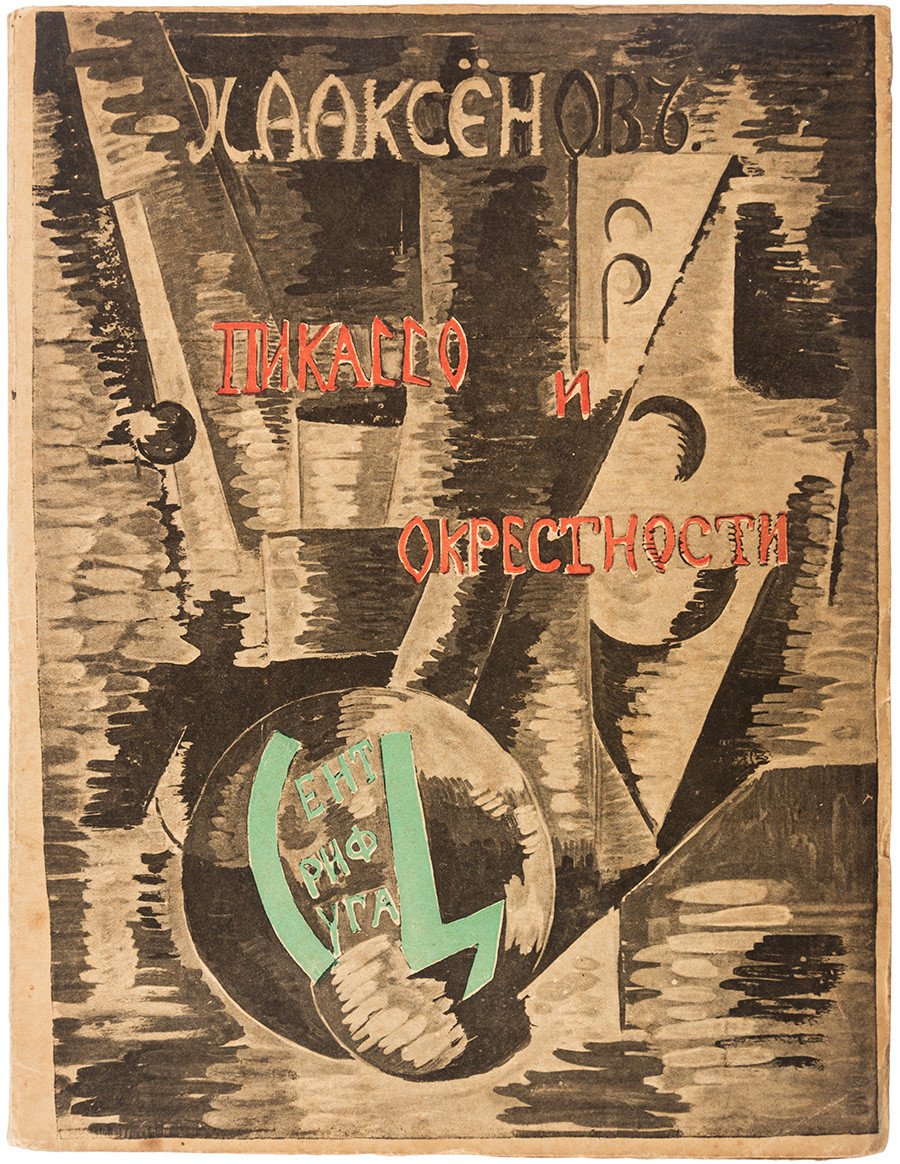
Alexandra Exter, 1917, Pikasso I Okrestnosti (Picasso and Environs), Moscow, Tsentrifuga.Shapiro Auctions

The first ever monograph about the artist was published in Russia in 1917. In his paper "Picasso and the Environs," the poet and art critic Ivan Aksyonov, a member of the Centrifuge futuristic association, wanted, as he put it, to warn the public about what they should not be searching for in the Spaniard's works and how they should look at them. Aksyonov must have either visited Paris and met Picasso shortly before the start of World War I, or his source could have been Alexandra Exter, an avant-garde artist who lived in Paris and was familiar with local art criticism (and who, incidentally, designed the cover for his book).

3. Pupils
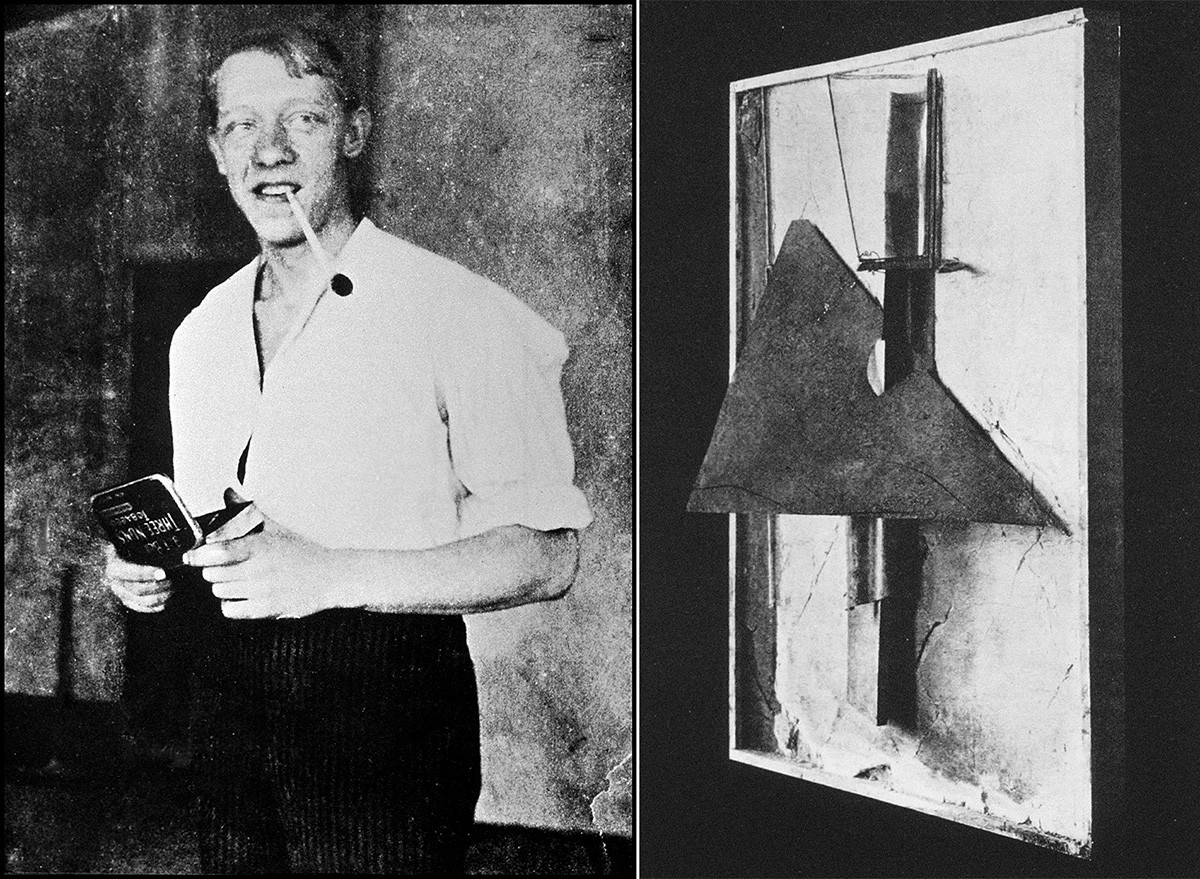
Tatlin's Corner Counter-Relief.Heritage Images/Getty Images

Russian avant-garde artists admired Picasso's work, although they had to do so from a distance since the Spaniard was a figure beyond their reach. But then again, what do limitations that even mean to somebody who is passionate about art? In 1914, the artist Vladimir Tatlin traveled to Berlin as a member of a bandura ensemble performing at an exhibition of Russian art. But Berlin was not in fact his final destination. Tatlin dreamed of going to Paris and meeting his idol, and in the end he actually managed to do so. 

According to one version of events, it was all thanks to Marc Chagall, while according to another he succeeded solely on his own resourcefulness. Tatlin put on some eye-catching clothes and settled down with his bandura outside Picasso's studio. Picasso noticed this unusual character and invited him in to sit for a painting. The moment the Spaniard left the room, Tatlin began to frantically make sketches of everything he saw around him until Picasso returned and kicked the "sitter" out. According to another theory, Tatlin admired Picasso so much that when they met, he immediately offered to become his servant in the hope of finding a way to discover the secret of his genius. Whatever actually took place in reality, Tatlin regarded Picasso as his teacher and after his return from Paris focused on creating counter-reliefs.

4. Ballet
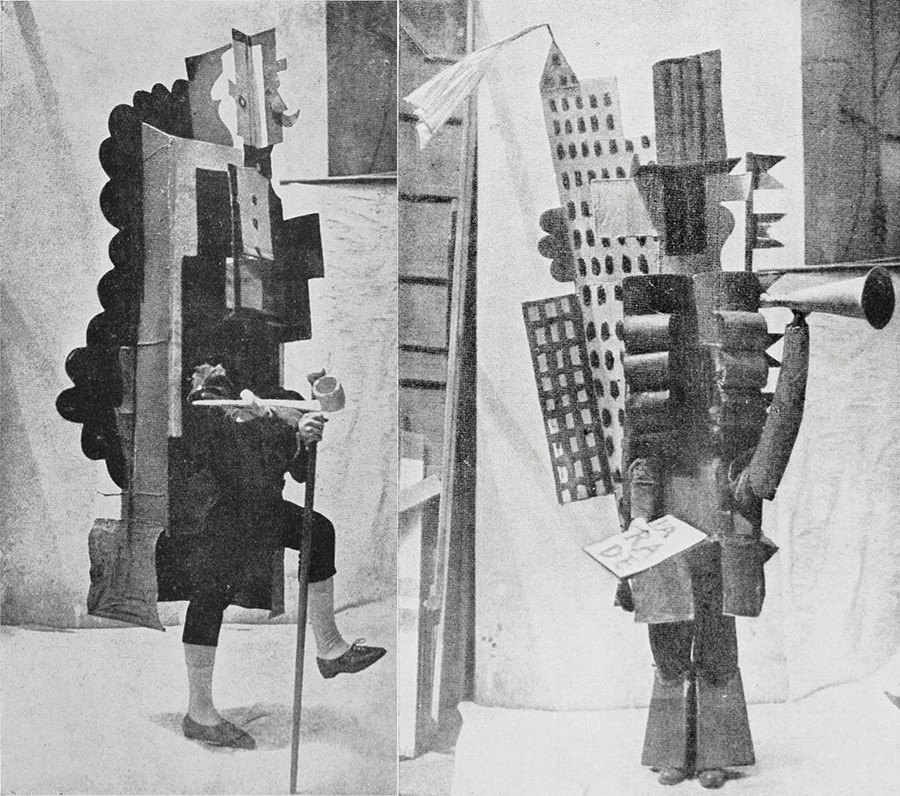
Costume design by Pablo Picasso for Serge Diaghilev's Ballets Russes performance of Parade at Théâtre du Châtelet in Paris 18 May, 1917.Public domain

In the spring of 1917, Sergei Diaghilev's Ballets Russes had a new production at the Théâtre du Châtelet in Paris. This time the famous impresario had decided to combine art, ballet and poetry into the one-act ballet Parade. The ballet, which was based on poems by Jean Cocteau, was created by choreographer Leonide Massine and composer Erik Satie, while the scenery, costumes and the circus-inspired curtain were designed by Pablo Picasso.

The result exceeded all expectations. Instead of ballet tutus, the dancers were dressed in bulky costumes made of papier-mâché, wood and metal, which were so uncomfortable that any attempt at movement in them looked mechanical and awkward. Against the background of Cubist scenery, the dancers were transformed into moving fragments of a collage. Thus Cubism made its first foray into the world of theater, while Parade became one of the first Surrealist events.

5. Composer Igor Stravinsky
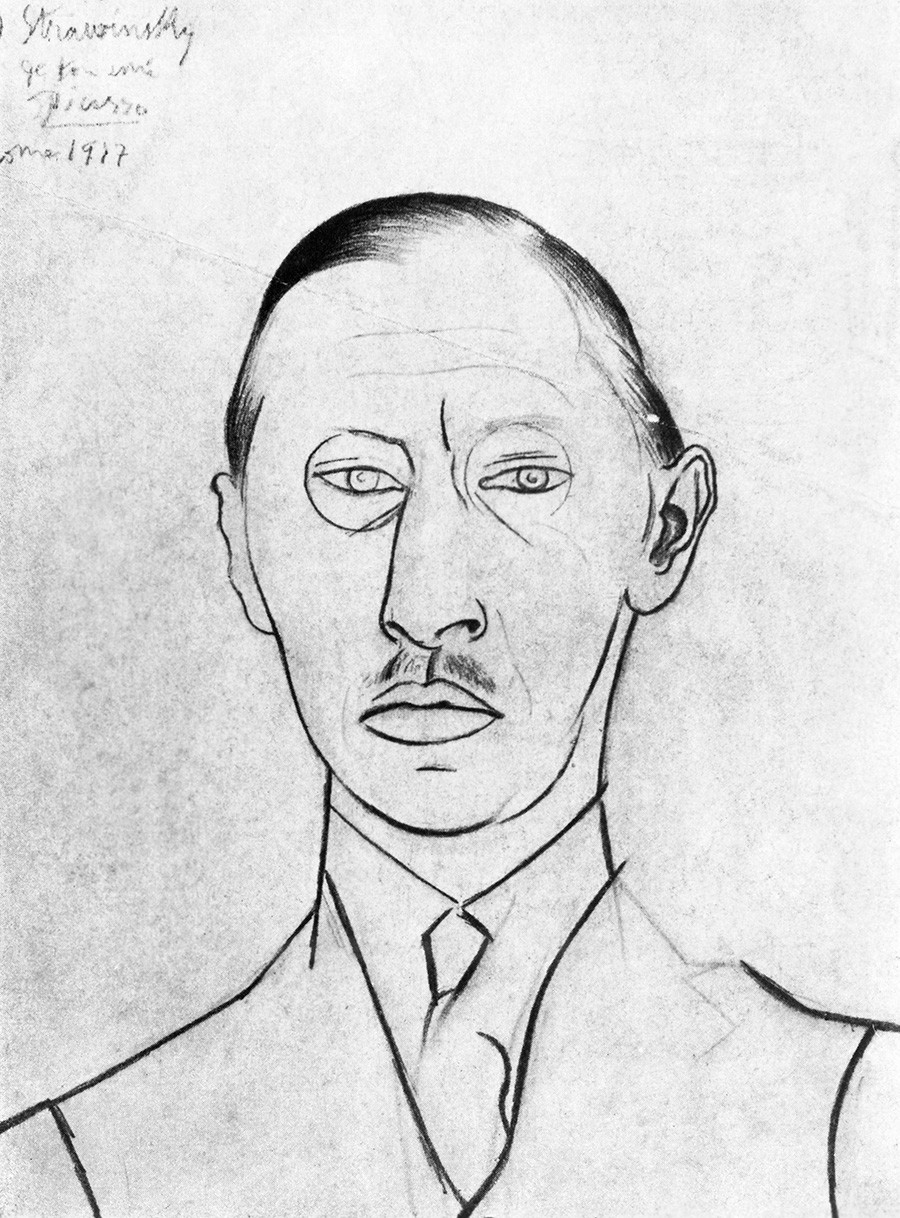
Sketch of Famous Composer Igor Stravinsky by Pablo Picasso.Bettmann/Getty Images

To prepare the sets and costumes for Parade, Picasso went to Rome, where he met Igor Stravinsky. They became friends, and their soon friendship evolved into professional collaboration when Picasso worked as a designer on Stravinsky's ballet Pulcinella and painted several portraits of the musician. 

Stravinsky tried to take one of these with him to Switzerland, but border officials demanded to know what it was and refused to believe that it was a pencil drawing by a famous artist since it looked more like a blueprint. The composer agreed that Picasso's work was indeed nothing more than a blueprint of his face. In the end, the portrait had to be sent by diplomatic mail through the British Embassy.

6. Wife and son
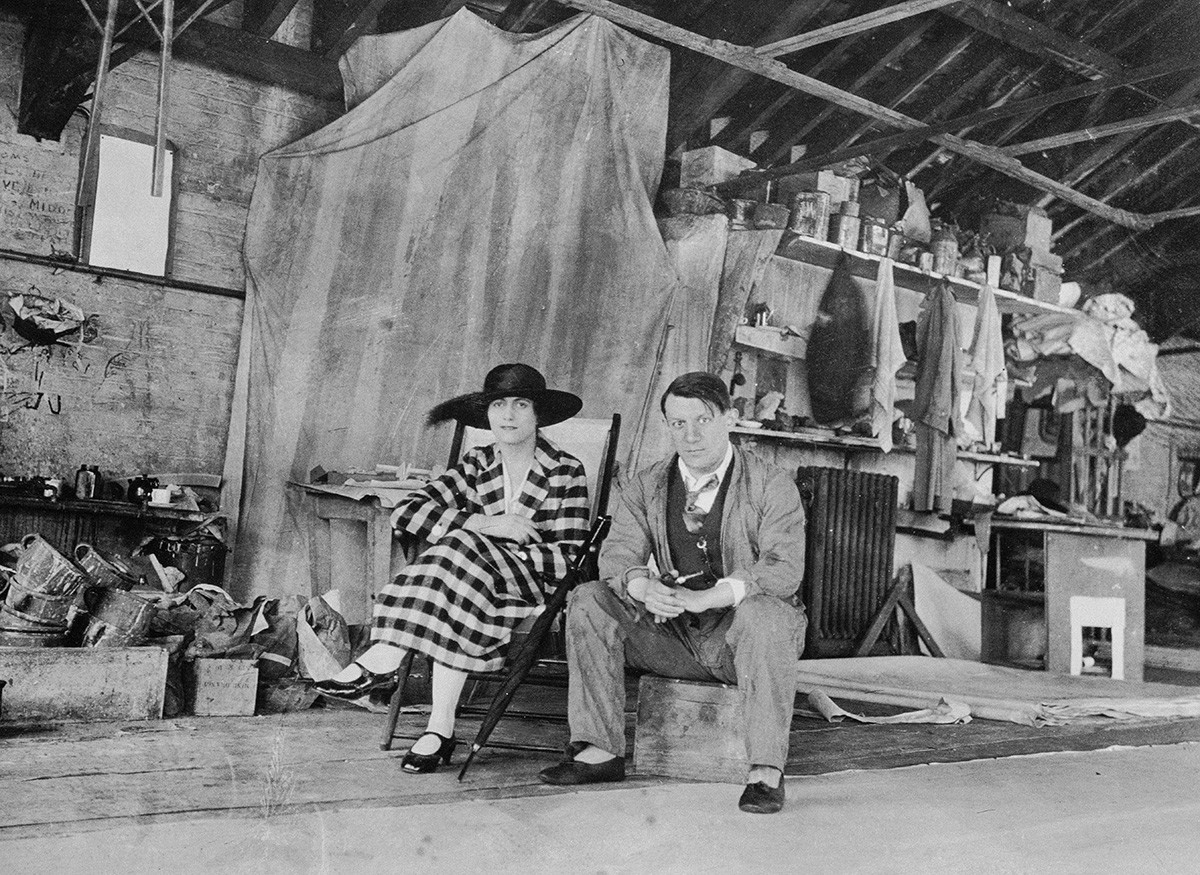
Pablo Picasso and Olga Khokhlova in the painting studio in London, 1919.Heritage Images/Getty Images

In Rome, Picasso met Olga Khokhlova, a ballerina with Diaghilev's Ballets Russes. Picasso and Khokhlova got married in the summer of 1918. The ceremony took place at the Russian Orthodox Cathedral in Paris and was attended by, among others, Gertrude Stein and Sergei Diaghilev. In 1921, the couple had a son, Paulo, and in 1935 they split up, although they never officially got divorced.

7. Author Ilya Ehrenburg
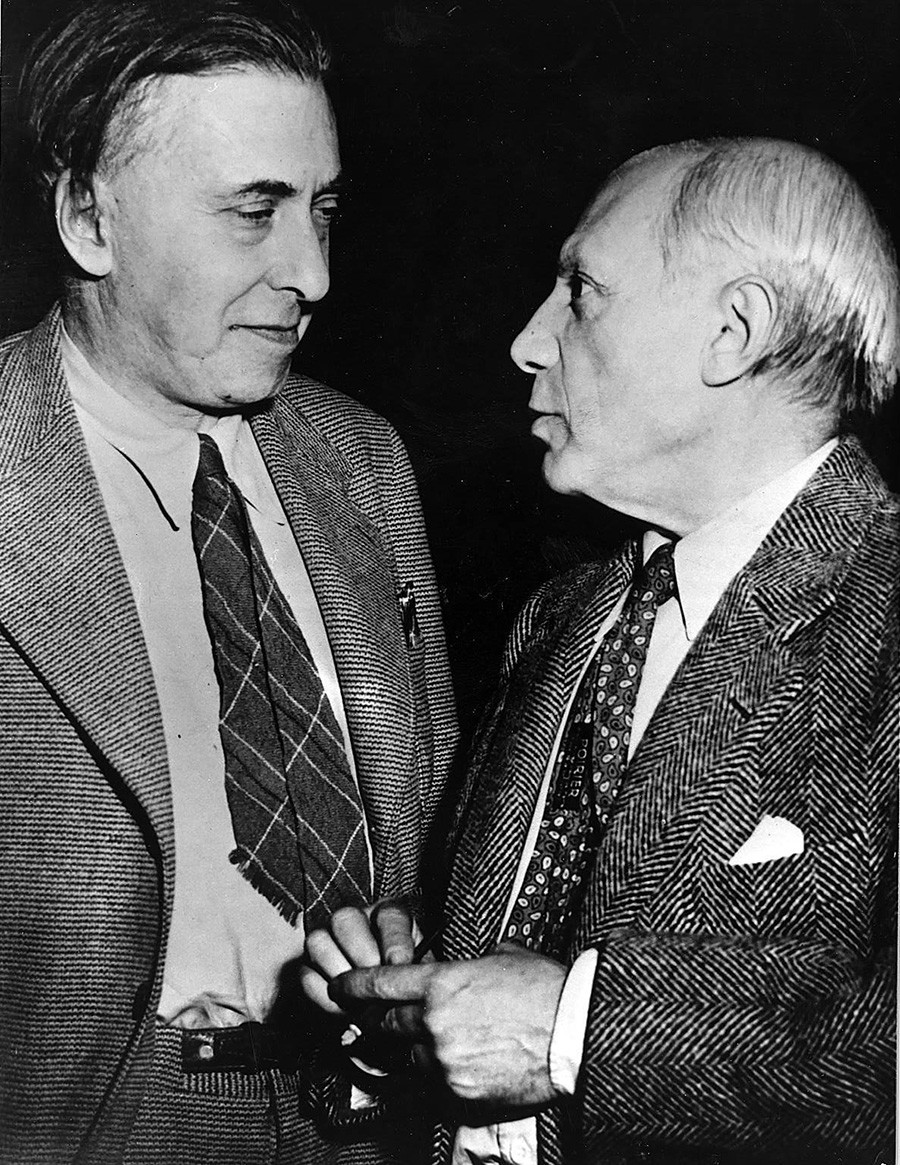
Ullstein Bild/Getty Images

Picasso became friends with the writer Ilya Ehrenburg in 1914. Ehrenburg admired what he described as the "destructive power" of Picasso's art, and he half-jokingly called the Spaniard a good devil. 

Picasso once decided to paint a portrait of Ehrenburg, but just as the latter made himself comfortable in an armchair preparing to pose, Picasso announced that he was finished. Ehrenburg was surprised at how quickly the portrait was finished, to which Pablo laughingly replied they had after all known each other for more than 40 years, and all this time had been training for how to paint portraits in just five minutes.

8. The first exhibition of Western avant-garde art in the USSR
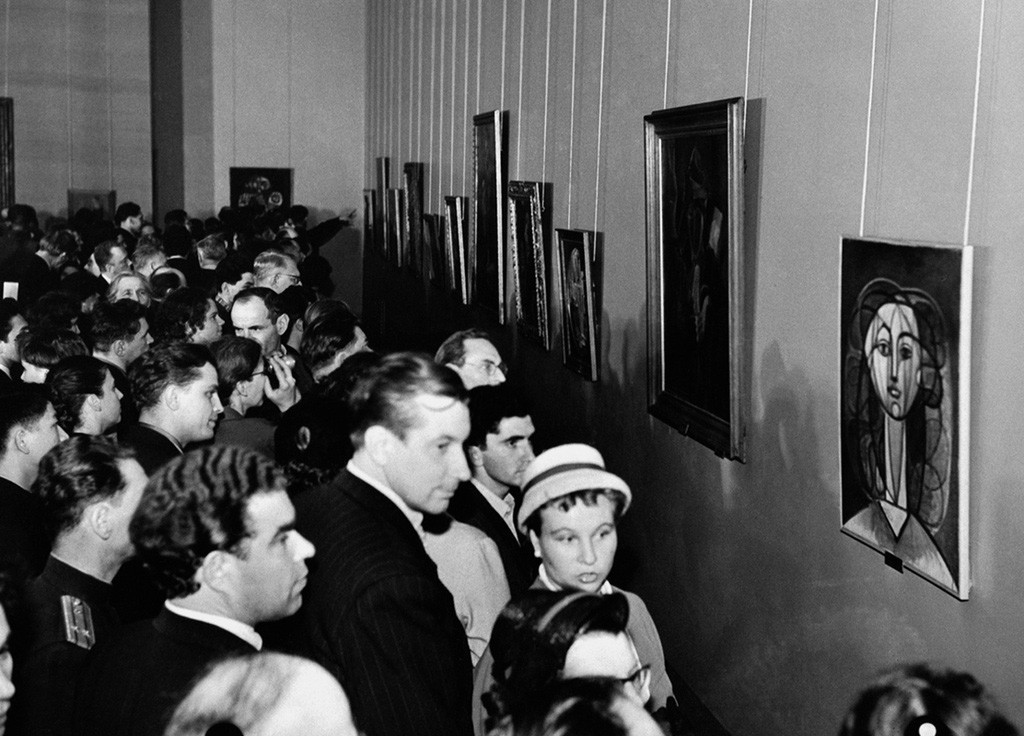
Exhibition of Pablo Picasso in Moscow.Emmanuel Evzerikhin/TASS/Russia in photo

It was Ehrenburg who introduced the Soviet public to Picasso and helped organize exhibitions of his work in the Pushkin Museum and the Hermitage in 1956. 

The exhibitions became a harbinger of the approaching political thaw, with such enormous excitement around them that people would stand in line all night long in order to get in. Ehrenburg famously tried to reassure the public with the line, "You have waited for this exhibition for 25 years, can you wait for 25 more minutes please?"

9. Stalin portrait
Archive photo

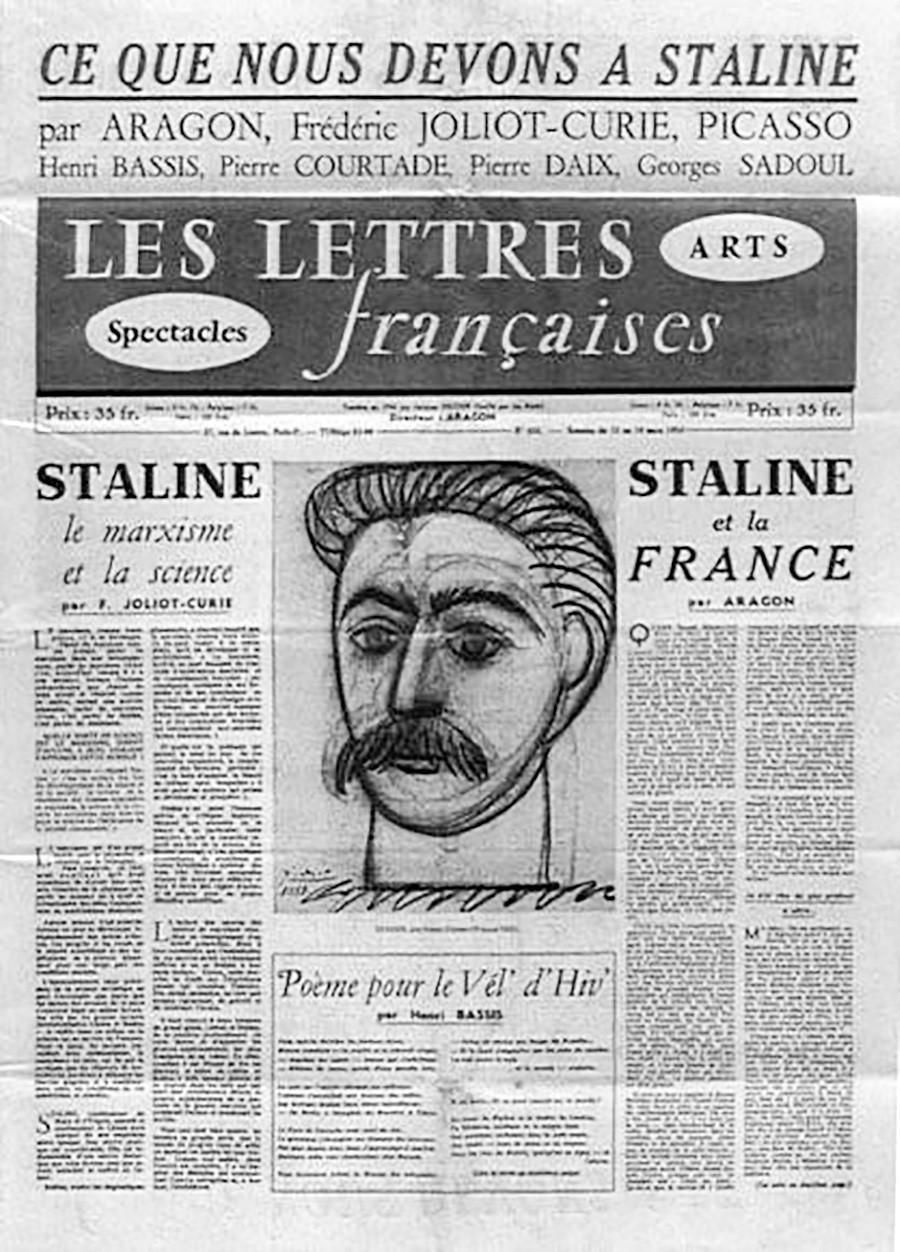
In the Soviet Union, Picasso was sometimes referred to as "Comrade Pablo" since he joined the French Communist Party in 1944. That was his way of protesting against the war and horrors perpetrated by the Franco regime in his native Spain. When Joseph Stalin died in 1953, Picasso painted his portrait, but to the communists' outrage he depicted Stalin as a young man. 

This turned into something of a scandal when members of the French Communist Party voiced their indignation that Stalin had been presented in a non-canonical image. For his part, the poet Louis Aragon, who was editor-in-chief of Les Lettres Françaises, which had printed the portrait, reproached his friend: "Stalin cannot be invented."

10. Lenin Prize
A poster for World Congress of Partisans for Peace, 1949.Legion Media

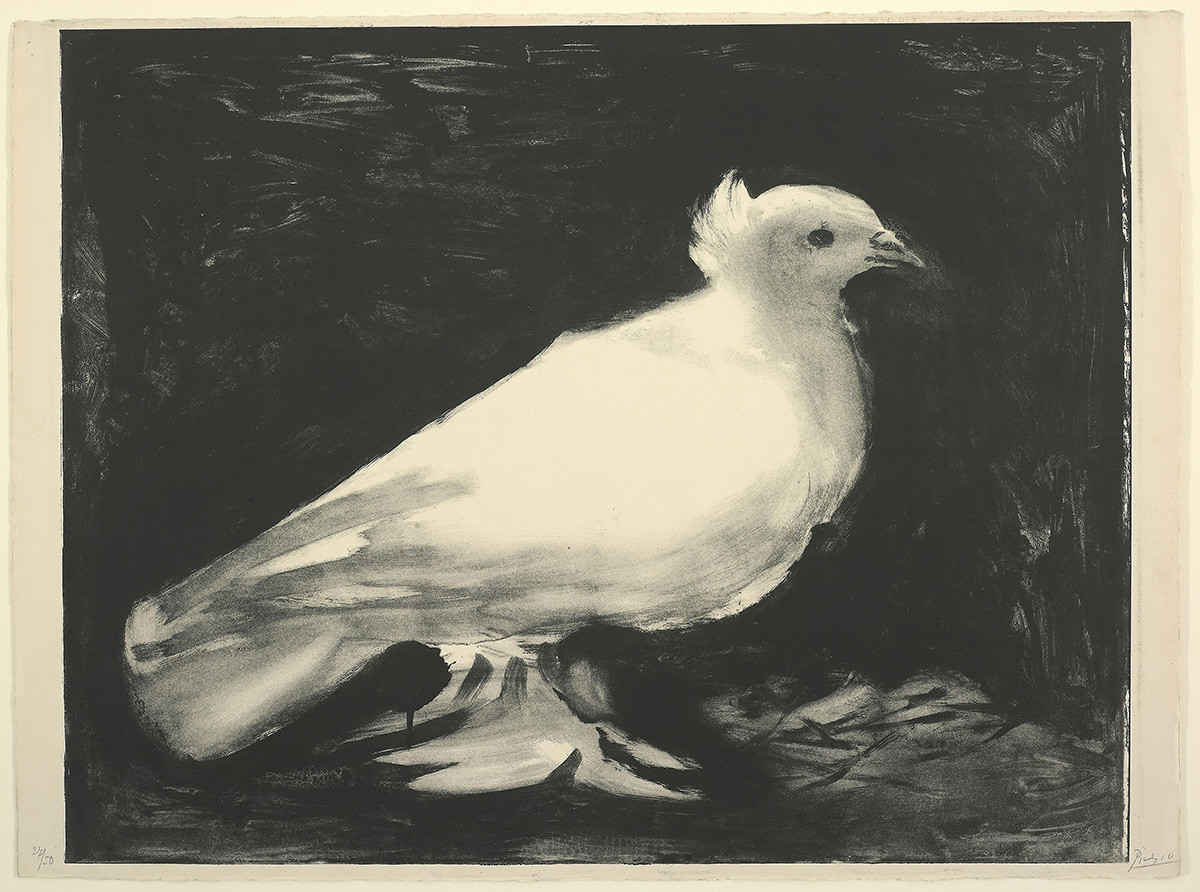
In 1949, Paris hosted a World Congress of Partisans for Peace, and Picasso created a poster depicting a dove for the forum. The symbol soon became globally famous, and the artist would use it many times afterwards. In 1962, he was awarded the Lenin Peace Prize, which was brought to him in Mougins in France by his friend Ilya Ehrenburg.


Anna Popova

1.2.21

United Photo Press 2nd open call | #uppartforall Free Art Festival Online 2021


UNITED PHOTO PRESS want to set again an example in times of the Covid-19 crisis and general curfew and promote the creativity of those UPP members & guests who sit at home and do not know what to do with new photos and paintings... themselves.

We call on artists to send us works dealing with the new phenomenon of social distancing. We are currently facing involuntary quarantine and isolation. From one day to the next, you can no longer live as you have always been used to.


What do I see from my window?
What do I see when I go out for basic needs? (pharmacy,supermaket,etc.)

What am I painting in my quarantine?
What artist activities am I developing in the quarantine?
What does it do to humans?
What happens to the public space without the usual dynamic?
How does this dynamic shift into private, at home?
How does it change interpersonal relationships when social distancing becomes everyday life?
Do we all currently live in long distance relationships?
Is the journey currently going inwards?
And what comes after this general isolation phase?
Etc...Etc...Etc...


We call all UPP artists members and guests to send us *artworks that deals with these questions. All positive contributions will be presented for free on our facebook  made accessible to everyone all over the world  complying with regulations of  Directive on Copyright in the Digital Single Market in EU.

Artists participating in the #uppartforall free art festival online can benefit from a large existing network and publishing.


We are aware that the movement of social distancing art is still in its infancy. At the same time we see your social distancing artworks as documentation, of the present „unimagined' time. Without a doubt, the website alongside its contributions will last for weeks, months and years and gain relevance as a historical statement. 


Vernissage 1st february 2021 (12:00/gmt) on our special page on facebook:
https://www.facebook.com/uppartforall/


*all artworks (max. 4 photos per artist, max resolution 1280x720 / 1MB)  must be sent till 15 of february 2021 with name of the author, link of website or social network, email and contact to UPP email: info@unitedphotopress.net
When you send the photos by email to the  #uppartforall free online art festival, you automatically authorize the digital publication of them by the United Photo Press.


30.1.21

How A Compton Artist’s Lost Prison Painting Found Its Way To The Hammer Museum

Fulton Leroy Washington, a.k.a. Mr. Wash, in his Compton apartment and painting studio with a Kobe Bryant portrait he made. (Francine Orr / Los Angeles Times)


Fulton Leroy Washington knows, all too well, the rules around making art in prison, those strict regulations for inmates working in the well-guarded hobby shop: no sharp-edged tools, no oil paints with chemicals that could be used for tattoos and no canvases larger than the storage locker lest the works get stolen or vandalized at night.

Washington, who goes by Mr. Wash, spent more than 20 years behind bars for three nonviolent drug offenses he said he did not commit. 

Over those two dark decades in various correctional institutions, Mr. Wash painted photo-realistic portraits of other inmates — up to 75 works a year, he said, factoring in his other drawings and tattoo designs — and gained attention in the media along the way.

The Los Angeles native’s story is well known in art circles: He was arrested in 1996, convicted in 1997 and, because of prior nonviolent drug offenses, sentenced to life imprisonment due to federal mandatory minimums at the time. 

President Obama commuted his sentence in 2016. Mr. Wash now lives in Compton, where he paints, works on proving his innocence and is a criminal justice reform advocate for others. He has a fashion line, Wash Wear, and was the subject of a 2019 Webby Award-winning short documentary about his life.

Lesser known is the story behind one of his paintings, “Mondaine’s Market.”

The work hangs in the Hammer Museum in Westwood as part of the “Made in L.A.” biennial. But it nearly didn’t make it there. Mr. Wash lost track of the painting while he was incarcerated, created a replica of it last year for the biennial, then found the original in Kansas City, Mo., in May. 

Both versions are on view in the exhibition, which this year also takes place at the Huntington Library, Art Museum and Botanical Gardens in San Marino.

“It’s been a journey, that’s for sure,” Mr. Wash said on a visit to his apartment, a small one-bedroom crowded with still-drying canvases, coffee cans stuffed with paint brushes and splotchy palettes on nearly every surface.

The original version of “Mondaine’s Market,” 2005, on display at the Hammer Museum as part of “Made in L.A. 2020: a version.” (Mel Melcon / Los Angeles Times)


Hammer curators Lauren Mackler and Myriam Ben Salah first approached Mr. Wash about inclusion in the exhibition in 2019. They had seen an image of “Mondaine’s Market” online and requested the portrait for the show. It depicts John L. Mondaine, a fellow inmate at Florence Federal Correctional Institution in Colorado whom Mr. Wash painted more than 15 years ago.

In the work, Mondaine’s enlarged, disembodied head floats in an overcast sky alongside his grandson’s head. Below is the Kansas City grocery store, Beas, that Mondaine owned. Mr. Wash — a contractor and welder who taught himself to paint in prison — obtained photographs of the site from Mondaine’s family and copied minute details from the location, along with imagery from magazines, into the piece, such as store signage, license plates and a bus’ LED destination screen. He even painted the interior of the store — shelving, stacked merchandise and a register — then painted over it, tinting the building’s windows so the inside is barely visible.

He and Mondaine designed the work together, Mr. Wash said, in the prison’s hobby shop (painting in one’s cell was prohibited at the time), talking for hours about imagery, proportions and placement. It took Mr. Wash two years to complete the work in 2005.

“He wanted a painting describing his legacy,” Mr. Wash said of Mondaine. “He came to me and said he wanted a picture of the store. He figured he was probably going to die in prison, and he wanted to be in the sky, surrounded by clouds, with his family.”

Mackler and Ben Salah felt the painting represented a body of Mr. Wash’s work depicting inmates in real and imagined landscapes, outside the prison walls, where — on the canvas, at least — they could connect with loved ones and assert their identities. The curators were also struck by the level of detail in the work.

“He’s a really skilled painter with a unique sense of composition,” Mackler said. “But the level of detail in that particular painting, personifying and animating the figures and architecture, was really exciting. There are worlds within worlds in the Mondaine painting.”

Mr. Wash, who was released from prison in 2016 after President Obama commuted his sentence, lives and paints in Compton. (Francine Orr / Los Angeles Times)

But there was a problem: Mr. Wash, now 66, had long ago lost track of “Mondaine’s Market” — along with Mondaine himself, who was released in 2005. The painting had been shipped to Mondaine’s family when Mondaine was still behind bars. (Inmates were not allowed to keep hobby shop works more than 90 days, Mr. Wash said.) But Mr. Wash had never been in touch directly with Mondaine’s family because, he said, there’s an unofficial rule: Don’t connect with other inmates’ families.

“You could get stabbed and killed for that,” Mr. Wash said. “If anything happens to their house, their family, I don’t wanna get blamed.”

Any business around his paintings — procurement of the photographs from which Mr. Wash worked, payments for portraits, the shipping of finished works — was handled by one of Mr. Wash’s eight children, a family friend, his lawyer or the organization Help Us Help Wash, founded by his supporters around 2013 to aid his legal defense. The organization also assists other individuals who say they have been wrongfully convicted.

Mr. Wash’s art liaisons, however, didn’t typically keep sale records, nor could they keep track of inmates who frequently moved within the prison system or their families. Commissions were just too plentiful. Mr. Wash’s talent earned him respect in prison, where he also taught art classes, and he said he had a waiting list of up to two years for new portraits.

Mr. Wash searched for the Hammer painting for more than four months. The shipping address was no longer valid, and phone numbers were out of date. Mondaine, by now in his 70s, was not on social media. Mutual friends turned up nothing.

The Hammer curators suggested Mr. Wash paint a replica of the work from memory, using the only photograph Mr. Wash had of the painting.

“But trying to paint a complex picture like that from a photograph?” Mr. Wash said. “The details were super small. First I said: ‘No.’ Two or three times. Then, finally: ‘OK, I’ll try.’”
The re-creation of “Mondaine’s Market” is at the Huntington Library, Art Museum and Botanical Gardens as part of the pandemic-postponed “Made in L.A.” biennial. (Joshua White / JWPictures.com)

Re-creating the work as a free man was a vastly different experience, Mr. Wash said. The most striking difference was scale. No longer confined to working on small canvases that would fit inside his prison storage locker, Mr. Wash went big with the replica, more than doubling its size on a 4-by-5-foot canvas.

“I’d never had the opportunity to paint in oil that large before, it was an opportunity,” he said. “But in making it a larger picture, it required new techniques — the thickness of the paint, the precision of the brushes, how long the paint takes to dry. I still painted with the same brushes I painted with in prison, but it was harder. There were new decisions.”

Free time was also an adjustment. In prison, Mr. Wash had been allowed just two-hour stretches to paint, so he was forced to work quickly and efficiently. Creating the replica in the COVID-19-era shutdown last spring, he had nothing but free time. He hunkered down in his living room — “kids can’t come by, grandkids can’t come by, nobody can visit” — painting for 12 to 16 hours straight until his body ached.

“With an unlimited amount of time to paint, your calculations are different. It can take longer,” he said. “Which is better? I’m still figuring that out.”

Some details in the original painting, particularly building signage, were too small to see clearly in the photograph of the work. Mr. Wash scanned the image into his computer and enlarged it, but the details were still blurry. So he improvised, resulting in tiny differences between the two works. One version of Beas market advertises hamburgers, phone cards and money orders; the other, pizza, Lotto cards and check cashing. The bus’ destination in each work is different.


A detail from the original “Mondaine’s Market,” which Mr. Wash re-created for the “Made in L.A.” biennial. (Mel Melcon / Los Angeles Times)

All the while, as he painted, Mr. Wash kept searching for Mondaine and the original painting. Finally, through a string of mutual associates, Mr. Wash located Mondaine in Kansas City, living with his wife and son. He was 73 and blind.

The painting was hanging in the living room, above the couch. “They’d cherished it,” Mr. Wash said.

So much so that when Mr. Wash showed up on their doorstep weeks later to retrieve the work for the exhibition, as they had agreed on over the phone, Mondaine had a change of heart.

“But I told him, ‘Hey man, it’s me, Mr. Wash, you can trust me.’”

When the painting arrived at Mr. Wash’s apartment days later, he placed it beside the replica, which was still drying. It was the only time he saw the works together before they were shipped off to separate museums. Seeing the works side by side, nearly identical, brought a sense of accomplishment but also felt oddly melancholic, he said.

“It made me question myself. Are the energies of paintings equal in terms of detail, depth, the amount of time?”

The original “Mondaine’s Market” hangs prominently at the Hammer, and the replica is on view at the Huntington. The biennial engages themes of duality and reflections, so the mirrored works, positioned 25 miles from each other, have added resonance. (The museums’ galleries are closed, but the exhibition is installed and parts of it are viewable online.)


Mr. Wash’s Teardrop paintings, on view at the Hammer Museum. (Mel Melcon / Los Angeles Times)

The Hammer is also showing paintings from Mr. Wash’s teardrop series. Each portrait — of public figures such as Obama and Michael Jackson, along with fellow prison inmates — features robust tears rolling down the subjects’ cheeks. Tiny figures and narrative vignettes appear inside the teardrops.

On Feb. 11, the Hammer will stage a free virtual discussion between Mr. Wash and assistant curator of performance Ikechúkwú Onyewuenyi that will touch on the artist’s experience, his painting process and criminal justice reform, among other topics.

Mr. Wash also will show paintings in the group exhibition “Shattered Glass,” opening March 20 at the Jeffrey Deitch gallery in Los Angeles.

He was so energized by creating the larger replica for “Made in L.A.” that he painted an enormous work for the Deitch show, a 4-by-5-foot memorial portrait of Kobe Bryant shedding basketball tears — especially poignant on the one-year anniversary of the athlete’s death this week.

“To finally see what it feels like to paint in a larger size, the difficulty in that, that was the greatest accomplishment, something I was always deprived of,” he said.
Mr. Wash’s memorial portrait of Kobe Bryant, “Shattered Dreams” (2020). ( Mr. Wash / Jeffrey Deitch)

The mirrored “Mondaine’s Market” works represent a melding of the past and the present for Mr. Wash, he said as well as a chance to bend another rule:

“You get a second shot at a few things,” he said. “This was one of them. A chance to do things differently. That’s a positive. I feel so blessed.”


'Made in L.A. 2020: a version'

Where: Hammer Museum in Westwood and Huntington Library, Art Museum and Botanical Gardens in San Marino (exhibition opening is dependent upon county COVID-19 tier rating and related guidelines)

When: Through April 25
Info: Online viewing links at hammer.ucla.edu
Virtual event: Mr. Wash in conversation with Ikechukwu Onyewuenyi, 5-6:30 p.m. Feb. 11; free. Check the Hammer website for details, including how to RSVP and receive an invitation to join.

17.4.20

Artistic Strategies for Co-Working in Tight Quarters

To create a sense of privacy in their small apartment, the married painters Elaine and Willem de Kooning 
would work in corners facing opposite directions.

To bathe in passionate intimacy on a daily basis, while living together in the same house and often in the same bedroom with the loved one, has always seemed to me the most certain way to lose someone,” the American-born writer, longtime Paris salonnière, and avowed enemy of cohabitation Natalie Clifford Barney once wrote. To which I would like to reply: Yes, but have you tried living together and working together in the same house and often in the same bedroom with the loved one?

That is the bind that many couples are now finding themselves in, thanks to stay-at-home orders in response to the coronavirus pandemic, and I suspect that more than a few are finding this particular intimacy bath a bit too snug. For relief, we can look to the example of a number of artistic and literary couples throughout history who have managed this same arrangement. Artists are, of course, notoriously difficult people to live with, requiring vast stretches of solitude to do work that tends to make them moody and distracted when they’re away from it. For two such finicky creatures to pursue this vocation under the same roof and stay together—well, surely there are some lessons here for us all.

Let’s start in England, which, as Elizabeth Hardwick noted in a 1955 essay, has long specialized in partnered writers. “The Brownings, the Webbs, the Garnetts, the Carlyles, Leonard and Virginia Woolf, [John] Middleton Murry and Katherine Mansfield—the literary couple is a peculiar English domestic manufacture, useful no doubt in a country with difficult winters,” Hardwick wrote. “Before the bright fire at tea-time, we can see these high-strung men and women clinging together, their inky fingers touching.”

For Hardwick, the most “fantastic” of these partnerships was between George Eliot and George Henry Lewes, whose twenty-four years together do seem uncommonly contented. Eliot found writing extremely painful, and needed constant encouragement to stick with it. Lewes was happy to provide that encouragement, and was able to do so without sacrificing his own work. In her book “Parallel Lives,” Phyllis Rose described the couple’s days: “They walked together, wrote together, read Homer, and learned languages together. . . . they even raised tadpoles together. Every night after dinner they read aloud to each other, for as much as three hours.”

But even this most companionable of couples ran into some difficulties working in close quarters. In the first home they shared, Eliot and Lewes worked side by side in the same small sitting room, and, according to the biographer Gordon S. Haight, “Though [Eliot] did not complain of it at the time, many years later she confessed that the scratching of George’s pen used to drive her nearly wild.” When the couple eventually settled in the Priory, their principal residence for the remainder of their lives, they were sure to claim their own individual studies.


The married poets Robert and Elizabeth Barrett Browning were another literary couple who lived and worked under the same roof, in their case an apartment in Florence. According to the biographer Margaret Forster, the Brownings worked at opposite ends of the apartment, with the dining room in between, doors firmly closed. In addition, they would not show each other their day’s work nor discuss it; she felt strongly that their personal intimacy should not extend to their literary work. “An artist must, I fancy, either find or make a solitude to work in, if it is to be good work at all,” she wrote in a letter to a friend.

Making a solitude where one does not naturally exist is a common theme in these partnerships. A closed door works wonders for this, but not all artists enjoyed even that small luxury. In 1946, after being evicted from their twenty-five-hundred-square-foot loft on Twenty-second Street (they were months behind on the rent), the married painters Elaine and Willem de Kooning moved to a much smaller space on Carmine Street, a one-and-a-half-room apartment with the bathtub in the kitchen. The historian Mary Gabriel, in her book “Ninth Street Women,” explains that, because there wasn’t enough space to work in separate rooms, the de Koonings set up their “studios” in corners of the apartment and “established privacy by facing in opposite directions.”

Not surprisingly, this proved a very flimsy solitude. Willem—whom everyone called Bill—quickly became annoyed by Elaine’s rushed working style. Elaine had her own complaints. She said, “Bill whistled while he worked. You know, Mozart and Stravinsky. Bill could whistle these fantastic melodies. But I found it just a little, tiny bit irritating.” Fortunately for them both, Bill soon found a separate studio, though the combined rent ended up being more than the loft they had been evicted from.

In the era of the coronavirus pandemic, obtaining a separate space outside the house is not really an option. A more actionable case study can be found in the artist Judy Chicago’s autobiography “Through the Flower,” where she described the challenges of trying to work in the same Los Angeles house as her second husband, the sculptor Lloyd Hamrol. Their problem was clashing schedules. Chicago wrote:


I liked to get up in the morning and go directly about my business, going into my studio without talking to anyone. Then I liked to work all day and go out at night. Lloyd, on the other hand, preferred to work at night, sleep later than I, and he loved to talk in the morning.


To manage the conflict, the couple “worked out a system in which we could both have the psychic privacy we needed to do our work,” Chicago wrote. “We established ‘silent days,’ where we would pass each other and not speak. This allowed us to be in the house together without feeling that we had to be accessible to the other person’s needs all the time.” The key to the arrangement, Chicago continued, was to be “very straightforward with one another.” If one person needed some alone time, it was simply a matter of verbalizing that need—then the other person would say “Sure” and make separate plans.

What a simple yet ingenious arrangement! Indeed, it sounds so wonderful that we should not draw any conclusions from the fact that, within a year of this description, Chicago and Hamrol had split up.

Not all partnered creators found co-working inimical. Simone de Beauvoir and Jean-Paul Sartre typically spent the mornings working apart, but in the afternoon they were content to write together in Sartre’s apartment. It’s worth noting, however, that Beauvoir never had trouble concentrating on her work. As she wrote, “Sometimes I would sit at my worktable in either place for four hours at a stretch without once lifting my head.”

But the most beautiful image of co-working partners I’ve run across features the English artists Vanessa Bell and Duncan Grant (who, like Beauvoir and Sartre, and Eliot and Lewes, never married). At Charleston, Bell’s country house in East Sussex, they shared a ground-floor painting studio where they went to work together each morning after breakfast. Bell’s son Quentin described them as being “like two sturdy animals side by side in a manger, munching away contentedly, not needing to talk to each other but just happy in the presence of the other.” Alas, even this Eden was impermanent; Bell eventually craved a studio of her own and converted a spare bedroom on the top floor for this purpose.

And what of the cohabitation-averse Natalie Clifford Barney? In 1915, the American painter Romaine Brooks showed up at Barney’s salon, and before long the two had begun a relationship that would last more than fifty years. Fortunately, Brooks was equally enamored of solo time. “I shut myself up for months without seeing a soul,” she wrote, of her creative process, “and give shape in my paintings to my visions of sad and gray shadows.”

Even so, in the late nineteen-twenties, Brooks and Barney decided to give cohabitation a try, building a house together in the South of France, near Saint-Tropez. This was no ordinary house. The villa they designed was more like two connected residences: there was a shared living room and galleried loggia but each partner had her own separate entrance, workroom, and bedroom (as well as her own servants). They called it the Villa Trait d’Union—the Hyphenated Villa.

It didn’t work. Despite all the carefully planned separation, Brooks grew annoyed with Barney’s regular stream of guests. Having her own workroom and bedroom wasn’t enough—she needed a deeper kind of solitude to paint. As she wrote, “I suppose an artist must live alone and feel free otherwise all individuality goes. I can think of my painting only when I am alone, even less do any actual work.”

This is a common refrain among artists. As the painter Agnes Martin said, “When you’re with other people, your mind isn’t your own.” In 1913, weighing the arguments for and against marriage in his diary, Franz Kafka wrote, “I must be alone a great deal. What I accomplished was only the result of being alone.”

So where does that leave those of us with a more moderate craving for solitude and an unprecedented-in-our-lifetimes inability to secure it? One lesson is the power of rules in circumstances like these. Chicago’s “silent days,” the Brownings’ agreement not to discuss their poetic progress, even the de Koonings’ humble promise to face in opposite directions—these things carry weight. More important than a rule’s efficacy is the shared recognition that the “psychic privacy” it serves is an important mutual goal, one that deserves frank conversation, creative problem-solving, and regular maintenance. Finally, if all else fails, remember Kafka’s directive, from a 1912 letter to his on-again, off-again fiancée, Felice Bauer: “If we cannot use arms, dearest, let us embrace with complaints.”


Mason Currey is the author of the Daily Rituals books and the Subtle Maneuvers newsletter.