Showing posts with label Joe Biden. Show all posts

22.7.24

Time Magazine unveils new cover after Joe Biden’s withdrawal


Time Magazine has unveiled a new cover featuring Kamala Harris after Joe Biden withdrew from the presidential race.

President Biden endorsed Vice President Kamala Harris to replace him as the Democrat nominee after he announced he was dropping out of the race.

The magazine cover shows Ms Harris walking into the frame as President Biden steps out of the picture.

Joe Biden withdraws from US presidential race, endorses Kamala Harris as Democratic presidential nominee.

US President Joe Biden has ended his re-election campaign and endorsed Vice-President Kamala Harris to succeed him as the Democratic candidate, in an extraordinary decision that upends an already dramatic race for the White House.

Mr Biden, 81, said in a Sunday written statement that it was the "greatest honour" to serve but his withdrawal was "in the best interest of my party and the country".

The announcement caps a tumultuous period in US politics, which began with his sometimes incoherent debate performance against Donald Trump on 27 June. Mr Biden says he will remain president until January.

Ms Harris, 59, said that she was "honoured" to be endorsed, adding she would "earn and win this nomination" and unite the country against Trump.

"We have 107 days until election day," she said. "Together, we will fight. And together, we will win."

While Ms Harris has been picking up endorsments from many big figures in the party, she is yet to be officially nominated, and that may not happen until the Democratic National Convention in August.

A resurgent Trump meanwhile has pulled ahead in polling and was confirmed as Republican nominee at the party's convention in Milwaukee this week, five days after surviving an assassination attempt.

In the wake of Mr Biden's decision, he declared the president "was not fit to run... and is certainly not fit to serve". Other senior Republicans joined him in their criticism, and called on Mr Biden to leave the White House immediately, not just the Democratic candidacy.

Potential Harris rivals fall in line

Sources told the BBC that even senior White House staff and campaign officials were told of Mr Biden's decision only moments before the statement was released on Sunday afternoon, although the president had spoken to Ms Harris and a handful of others beforehand.

Dozens of senior Democrats and grandees including former president Barack Obama, Senate leader Chuck Schumer and former House speaker Nancy Pelosi immediately praised the decision and lauded Mr Biden's accomplishments in office.

Former president Bill Clinton and 2016 Democratic candidate for president Hillary Clinton said they backed Kamala Harris as the party's candidate for November's vote, saying they would "fight with everything we've got to elect her".

While Mr Obama stated that he had "extraordinary confidence" that an "outstanding nominee emerges", he did not explicitly back Ms Harris or any other candidate.

Ms Pelosi has not commented.

Peter Welch, the first Democratic senator to call on Biden to drop his re-election run, called for an "open process" to nominate Harris.

But there are already signs that many in the party will unify behind her, including from high-profile politicians who had been touted as potential rivals for the nomination in the event Mr Biden stepped aside.

California Governor Gavin Newsom, who is believed to have presidential ambitions, praised Mr Biden as "selfless" and said he backed the "fearless" and "tenacious" Ms Harris to face Trump.

Josh Shapiro, the Pennsylvania governor, said he would do "everything I can to help elect Kamala Harris as the 47th President of the United States".

Pete Buttigieg, the current transport secretary and a former presidential contender, said Mr Biden was "one of the most consequential presidents in American history", adding he would do "all that I can to help elect Kamala Harris the next President."

Gretchen Whitmer, the governor of Michigan, stated that her job "will remain the same... doing everything I can to elect Democrats and stop Donald Trump."

The Democratic National Committee meanwhile filed to amend the names of its fundraising committees to the Harris Victory Fund and Harris Action Fund.

Two major Democratic donors - LinkedIn co-funder Reid Hoffman and investor Alexander Soros - publicly endorsed Harris.

And within an hour of Mr Biden's announcement, the pro-Trump super-PAC campaign fund Make America Great Again posted an advert attacking Mr Harris, claiming "she covered up Joe's obvious mental decline".

Trump added: "Whoever the Left puts up now will just be more of the same."

Weeks of intense scrutiny


Mr Biden had faced intense scrutiny since his debate performance in June. Less than two weeks ago, he hosted a high-profile summit with Nato leaders in Washington.

The occasion did little to calm nerves within his own party, with him mistakenly introducing Ukrainian President Volodymyr Zelensky as “President Putin”, and appearing to refer Ms Harris as "Vice President Trump".

At one point he told an interview that only the "Lord Almighty" could make him withdraw, but then later said he would consider doing so if he had a health condition. On Friday, while in isolation after testing positive for Covid, he said he would return to the campaign trail in the coming week.

In his statement on Sunday, Mr Biden thanked his Ms Harris, saying she was an "extraordinary partner".

"And let me express my heartfelt appreciation for the American people for the faith and trust you have placed in me," his statement added.

"I believe today and always have: that there is nothing America can’t do - when we do it together. We just have to remember we are the United States of America."

Officials from the Democratic National Committee held an emergency meeting on Sunday evening.

The focus will now be on the party's national convention, which is scheduled to start on 19 August.

Mr Biden swept the party's primaries, meaning that the delegates representing each state at the convention were pledged to vote for him - although they are now expected to be released to vote for another candidate.


United Press Team

19.7.24

Increasing Concerns Over President Biden's Health: Insights from Medical Experts


Doctors are Growing Alarmed Over Biden’s Health

Nine medical professionals recently shared their views on President Biden’s health, and almost all expressed concerns that his symptoms might extend beyond the normal aging process. Since Joe Biden announced his presidential candidacy in 2019 at the age of seventy-six, questions about his age have persisted. Despite being a "transitional" figure, Biden has governed effectively, passing significant legislation. However, over the past year, apprehensions regarding his cognitive fitness have gained momentum and validity.

Reports from staff, donors, and officials have highlighted mental lapses. Special counsel Robert Hur referred to Biden as a "well-meaning, elderly man with a poor memory" in his report on Biden’s handling of classified documents. A recent presidential debate performance, watched by over fifty million Americans, further fueled these concerns. Biden stumbled over numbers and words, often losing his train of thought, appearing unfocused, and requiring assistance from the First Lady to exit the stage.

Following the debate, Axios reported that Biden, now eighty-one, tends to tire and misspeak before 10 a.m. and after 4 p.m. Biden himself acknowledged needing to "pace myself a little more." Supporters have attributed his performance to various factors such as jet lag, a cold, and a busy schedule, but these explanations are reminiscent of conversations about an elderly relative's ability to drive safely, not about a presidential candidate’s fitness to govern.

A Spectrum of Medical Opinions

In an attempt to understand Biden’s health better, I consulted nine doctors, including an internist, geriatricians, neurologists, and a neurosurgeon. Most of these doctors, politically left-leaning, from different parts of the country, ranging in age from their thirties to sixties, emphasized that diagnosing from afar is challenging. However, nearly all voiced concerns that Biden’s symptoms might indicate more severe cognitive issues or neurodegenerative conditions, advocating for a comprehensive evaluation for neurological disorders.

A neurologist from the West Coast remarked that Biden’s debate performance raised alarms among her colleagues. She stated, "All of us had a gut reaction that this is not normal."

Historical Context and Ethical Considerations

Presidential health has often been shrouded in secrecy. Historical instances include Grover Cleveland’s secretive surgery for an oral tumor and Woodrow Wilson’s stroke being hidden from the public, with his wife taking over many of his duties. Ronald Reagan’s cognitive decline during his second term also led to discussions about invoking the Twenty-fifth Amendment.

The ethical dilemma of discussing a public figure’s health is complex. In 1964, psychiatrists openly questioned Barry Goldwater’s mental fitness, leading to the establishment of the Goldwater Rule, which restricts psychiatrists from commenting on public figures they have not examined. Despite this, some physicians argue that they have a duty to warn the public about potential risks, as seen in discussions about Donald Trump’s mental fitness during his presidency.

Current Medical Evaluations and Public Perception

The President’s medical team has consistently reported that Biden does not show signs of a neurodegenerative condition. In February, Biden’s physician, Kevin O’Connor, attributed his stiff gait to spinal arthritis and stated that a detailed neurological exam revealed no significant issues. However, details about cognitive assessments and specific imaging remain vague.

Public trust in Biden’s health is waning. His debate performance and subsequent reports have led to growing concerns among voters, with many believing it is time for him to step aside. A neurologist from New York remarked, "He’s fading in front of us. You don’t need to be a neurologist to see it."

Balancing Transparency and Privacy

The balance between transparency and privacy in discussing a president’s health is delicate. While it is intrusive to dissect someone’s health publicly, the stakes are higher when it involves a world leader. The public deserves clarity on Biden’s cognitive fitness, given its implications for national and global stability. Comprehensive neuropsychological testing could provide definitive answers, helping to address the public’s concerns.

In conclusion, while Biden’s administration has managed to achieve significant legislative success, the growing concerns about his cognitive health cannot be ignored. As the debate over his fitness for office continues, it underscores the need for a transparent and thorough evaluation to ensure that the nation’s leadership remains robust and capable.

Carlos Alves de Sousa
United Photo Press

11.7.24

George Clooney’s Call for Biden to Step Aside: A Political Analysis


In a surprising and bold move, George Clooney, a high-profile Hollywood actor and influential Democratic fundraiser, has publicly urged President Joe Biden to withdraw from the 2024 presidential race. This development, highlighted in Clooney's guest essay for The New York Times, underscores the growing concerns within the Democratic Party about Biden’s age and his ability to lead the party to victory in the upcoming election.

Clooney’s Argument

Clooney's central argument is that Biden, despite his accomplishments and experience, is no longer the dynamic leader who can galvanize the electorate. Clooney poignantly notes that "the one battle he cannot win is the fight against time." He reminisces about a more vigorous Biden, contrasting it sharply with the current president, whom he describes as visibly aged and less energetic. This perception, according to Clooney, is not merely a personal observation but a sentiment shared privately by many Democratic leaders and donors.
Strategic Implications

Clooney's essay is not just a critique but a strategic call to action. He warns that Biden’s continued candidacy could jeopardize the Democrats' chances not only in the presidential race but also in down-ballot contests. The actor's concerns reflect a broader anxiety within the party about maintaining control of the House and Senate. By voicing what many insiders are reportedly saying off the record, Clooney aims to catalyse a more open and urgent discussion about the party’s future.
Reaction from the Biden Campaign

The Biden campaign’s reaction to Clooney’s essay was swift. According to insiders, there was an intensive effort to dissuade Clooney from publishing his piece, led by influential figures like Jeffrey Katzenberg. This pushback highlights the campaign’s awareness of the potential damage such a high-profile defection could cause. Nonetheless, Clooney’s decision to go public indicates a significant rift within the party's fundraising elite, who are crucial for mounting a successful campaign.
Wider Democratic Concerns

Clooney is not alone in his stance. The essay coincides with similar calls from other prominent Democratic figures and Hollywood insiders. For instance, Rob Reiner echoed Clooney’s sentiments, emphasizing the need for younger leadership to counter existential threats to democracy. Such voices reflect a broader unease about Biden’s ability to lead a vigorous campaign against likely Republican challengers.

George Clooney’s public plea for President Biden to step aside marks a critical moment in the Democratic Party’s pre-election dynamics. It reflects deep-seated concerns about Biden’s age and electability, concerns that are being voiced increasingly by influential figures within the party. As the election approaches, the Democratic Party faces a crucial decision: whether to rally behind an incumbent president showing signs of age or to seek new leadership capable of energizing the base and securing victory in November. This debate, catalyzed by Clooney’s high-profile intervention, is likely to shape the party’s strategy and could determine its future success.

Carlos Alves de Sousa
United Photo Press

7.7.24

Why Biden Must Withdraw: A Political Analysis


The President and his party present themselves as the protectors of democracy, yet their actions tell a different story.

The Debate and Its Aftermath

The presidential debate was disastrous for Joe Biden, but the subsequent cover-up has been even worse. Witnessing an elderly man struggle to recall words and facts was painful. His inability to effectively argue against a weak opponent was dispiriting. However, the campaign’s attempt to deny the reality witnessed by tens of millions of Americans is more damaging, as it breeds contempt through its dishonesty.

This has placed the White House within Donald Trump’s reach. Recent polls indicate that voters in critical states have shifted against Biden. His lead is even at risk in previously secure states such as Virginia, Minnesota, and New Mexico.

Biden’s Legacy and the Call for Change

Biden should be remembered for his accomplishments and decency, not his decline. Thus, it is appropriate that senior Democrats are beginning to call for him to step aside. Yet, their public expressions pale in comparison to the growing private dismay. More Democrats urgently need to acknowledge that failing to act now could result in a Trump victory. For the political renewal America so clearly needs, they must advocate for change. It is not too late.

The Unfitness of Both Candidates

Democrats rightly argue that Trump is unfit to be president. However, the debate and its aftermath have also proven Biden unfit. Firstly, due to his cognitive decline. Biden can still appear dynamic during brief, scripted events, but leading a superpower cannot be done by autocue. An international crisis cannot be paused because the president is having a bad day. Can someone who struggles to finish a sentence about Medicare be trusted with the nuclear codes?

Biden is not at fault for his declining faculties, but his insistence—supported by his family, senior staff, and Democratic elites—that he is still fit for the job is disqualifying. His claim that this election is a battle between right and wrong is undermined by the fact that his campaign’s existence now hinges on a lie.

Democratic Accountability and Reflection

Democrats criticize Republicans for their sycophantic behaviour towards Trump. Rightly so, as many Republicans have echoed his falsehoods and lacked the moral courage to oppose his abuses. Believing they could outlast him or that someone else would bear the cost of removing him, senators and congressmen have prioritized ambition over country.

The Democratic Party must also reflect, starting with Biden. He attributes his debate failure to being tired from extensive travel, as if his weakness were proof of his vitality. His supporters argue that the disastrous debate should not overshadow his past three and a half years. However, what matters is whether it foreshadows the next four. Senior Democrats clinging to desperate talking points or waiting in silence for someone else to speak up may think they are being loyal. But are they loyal to their country or their careers?

A Call for Political Renewal

Democrats might claim that their tactics are just politics, justified by the noble aim of saving American democracy from Trump. This defence does not serve America. Covering up one’s own flaws by demonising the opponent has long tainted American politics. Using the threat of Trump as a “dictator” to distract from Biden’s evident infirmity is a form of blackmail. As head of state, the president should embody the virtues of the republic. The more he is seen as a stubborn old man delegating the real work to his aides, the more he undermines Americans’ faith in their government. Representing America abroad, Biden will project decrepitude, delighting China and Russia and dismaying America’s allies.

The Path Forward

There is an alternative. Biden should withdraw from the campaign, allowing the election to revitalise the political landscape. Democracy’s virtue lies in voters choosing their rulers, but Biden and Trump offer a choice between the incapable and the unspeakable. Americans deserve better.

As highlighted in our new podcast “Boom!”, presidential politics is mired in stagnation. With the exception of Barack Obama, every president since Bill Clinton in 1992 was born in the 1940s. Biden (1942) first campaigned for the presidency 37 years ago. At that time, Trump (1946) also considered running. Their generation, shaped by the Vietnam War, carries the baggage of campus protests, Wall Street’s greed-is-good era, and old battles over race and feminism. Today’s fights are different and often play out on platforms like TikTok.

The stagnation reflects a failure of the party system. Parties should unite factions and interests to seek power, but they have been hijacked. The Clintons and Bushes initially seized control. When voters grew weary of them, Obama and Trump led grassroots rebellions. In today’s Democratic Party, Biden and his circle have monopolised the leadership. Only if Democrats reclaim control and persuade him to step aside can renewal begin.

Conclusion

In 2022, we argued that Biden should not seek re-election due to his age. After the debate, our position has strengthened. A new candidate would have just over ten weeks after the convention to present their case. While such a candidate might lose, Biden’s self-sacrifice could help restore American politics.

We believe a new candidate would have a better chance of winning than Biden, even if it were Kamala Harris, his relatively unpopular vice-president. They would be fit to govern and, except for Harris, would deprive Trump of his strongest arguments against Biden: responsibility for inflation, immigration, and the supposed “witch-hunt” leading to his prosecution. America’s renewal must begin now, and the best way is by choosing a new candidate to defeat Trump.

Carlos Alves de Sousa
United Photo Press

23.2.23

What Is Ron DeSantis Doing to Florida’s Public Liberal-Arts College?


DeSantis is not simply inveighing against progressive control of institutions. He is using his powers as governor to remake them.

In the context of other universities—the sort of assessment the Princeton Review’s guidebooks might do—New College of Florida, situated on the shores of the Gulf of Mexico, a few miles north of downtown Sarasota, has a number of standout features. Its curriculum is unusually self-directed: it gives out no letter grades, and has an academic research project built around independent study in partnership with professors. Two-thirds of its seven hundred students are women, and there is a prominent queer community; in the past, New College ranked among the most “gay-friendly” campuses in the country. Those attributes make it seem like a progressive northern liberal-arts college, to which alumni often compare it, but New College is a public school, which means that in-state tuition costs under seven thousand dollars annually—a bargain—and also that it is subject to the influence of Florida’s state politics.

Early in January, the governor of Florida, Ron DeSantis, announced that he would be making six new appointments to New College’s Board of Trustees, and, weeks later, the Florida Board of Governors appointed a seventh, which gave DeSantis’s incoming choices an immediate majority on the board. DeSantis’s chief of staff, James Uthmeier, told National Review that he hoped New College would become a “Hillsdale of the South”—a reference to the private, Christian conservative college in Michigan. Shortly afterward, Christopher Rufo, a conservative activist and one of DeSantis’s new appointments to New College’s board, gave an interview to the Times’ Michelle Goldberg that was even more pointed: he spoke of a “top-down restructuring” of the school’s curriculum and culture, and suggested that if professors and students weren’t in line with the changes, they could leave. The project, Rufo went on, could serve as a model for similar takeovers around the country. “If we can take this high-risk, high-reward gambit and turn it into a victory, we’re going to see conservative state legislators starting to reconquer public institutions all over the United States,” he said.

For the past few years, DeSantis’s culture-war campaigns have operated in American politics like a spooling synth loop: it keeps coming around. The Governor of Florida has sought to suspend the Walt Disney Corporation’s tax breaks because the company opposed his “Don’t Say Gay” bill; has moved to limit what teachers can say in public school classrooms about race and gender, and what books can be available in libraries; has encouraged state police to arrest and prosecute ex-felons for voting; and has flown migrants to Martha’s Vineyard as a political stunt. These campaigns have raised an enormous political war chest for DeSantis, and helped give him a regular perch on Fox News. But what distinguishes DeSantis from other culture warriors, especially in the eyes of conservative intellectuals, is that he not only uses his profile to inveigh against progressive control of institutions but also his powers as governor to remake them. After Rufo made his comments about New College to the Times, he called DeSantis’s aides. “I was, like, ‘Man, did I go too far?’ ” Rufo told me recently. “They were, like, ‘No, it’s great. Keep going.’ ”

Rufo, a documentary filmmaker and senior fellow at the Manhattan Institute, has had one of the most dynamic trajectories of any conservative intellectual over the past few years, having been at the center of the right-wing campaign against critical race theory, which is what initially drew him into DeSantis’s orbit. He has since consulted with the Florida Governor on the Stop woke Act and aided DeSantis’s campaign against Disney by writing articles about its theme parks employing dozens of pedophilic sex predators and indoctrinating their employees with diversity politics. (A Disney spokesperson said that insuring “a safe environment for children and families is a responsibility” the company takes “very seriously.”) Rufo seemed to see his arrival in Sarasota as an event unto itself: he had with him an aide, a cameraman, and a security guard—a large, loping, bearded guy, who, Rufo told me, had been a golden-glove boxer in Ohio—which seemed an extreme precaution for a conservative trustee visiting the campus of a hippie college.

But Rufo’s arrival was hard for the New Collegers to dismiss. DeSantis had just won a large majority by running on aggressively defending social conservatism. Florida’s constitution and laws gave him the power to assert control over its public universities. Rufo explained to me the story, as he saw it. New College was a struggling campus. The most recent data shows that it accepted seventy-five per cent of students who applied, but enrolled only thirteen per cent of those who were accepted. Twenty per cent of students dropped out before the end of their first year; a third were not employed or in graduate school a year after they got their degree; and, of those who were employed, the median salary was thirty-two thousand dollars. The source of these failures, Rufo went on, was a culture that valued protest and activism over work. Consultants’ reports found that the top words students associated with New College’s culture were “politically correct,” “druggies,” and “weirdos.” The environment had become a problem, he said. “The trustees need to reëstablish authority.”


I asked for details about how the curriculum would change. “I’m the narrative guy, the political guy,” Rufo told me, waving off the question. “I’m a soldier in DeSantis’s army.” The sun was setting over the Gulf, leaving just a fuzzy pink line on the horizon. To our south, past downtown Sarasota, were the rich, beachy hubs of Longboat and Siesta Keys, with day-drunk strips of restaurants and residential roads that tracked the shore; most of the houses had a dock with a big boat out back. This has long been politically conservative territory; now it’s DeSantis country. “This is really a brilliant strategy on behalf of the Governor to say, we are losing our democratic control of these institutions because we aren’t using our democratic power at all,” Rufo said. “Let’s actually use the power of the Board of Trustees in the way that it was intended, in a way that is authorized in the Constitution, to turn political will into institutional outcomes. New board, new trustees, new majority, new vision. It’s either turn around or shut down.”


The next morning, Rufo and another new DeSantis-appointed trustee, Jason (Eddie) Speir, who co-founded and is the superintendent of a Christian school in Bradenton, held a public Q. & A. session with New College’s faculty and staff. (Someone had e-mailed the University threatening Speir just beforehand, and the Sarasota Police and campus administration had tried to cancel the event, only for Rufo and Speir to overrule them.) Rufo was challenged about whether he thought members of the L.G.B.T.Q. community were a threat to campus life. At one point, Rufo responded, “We should have a unified standard by which we treat people fairly. Identity-based preferences are policies that I strongly disagree with.” Mostly, though, the faculty tried to defend the curriculum. One reason that so many students quit after their first year, someone suggested, might be that New College was a very specific educational environment, and they hadn’t realized what they were getting into. Amid a generally tense conversation, some members of the faculty seemed to be searching for “where we can find common ground, particularly around the ideals of a liberal arts education,” as one history professor put it.

The academics in the audience might not have much liked Rufo—might even, in many cases, have feared what he represented—but there was no confusion: he was prepared and aggressive and camera-ready, a facsimile of DeSantis himself. Nearly all the questions went to him. Speir, buff and bearded, with a spacey manner and an elliptical speaking style that at times scanned as Christian and at others as stoner, was somewhat harder to fathom. He spent a couple of minutes detailing his complaints with his treatment at the hands of the local Sarasota paper, and his failed efforts to suspend the “unwelcoming” comments section. Later in the day, at a meeting with students, Speir spoke out in favor of increasing the number of Christian students on campus. When he was asked whether he favored open carry on campus, he said that “we cannot sacrifice our freedoms for safety.”As a conciliatory gesture to the faculty, Speir acknowledged that his own school’s philosophy was designed to be self-directed in a way somewhat similar to New College’s, but he also kept hinting that the Governor would send more money if the campus were to “go along” with the imminent changes.


At one point, when a student accused Rufo of being anti-science, Speir took out his microphone and said, “If there’s somebody that would be anti-science, that would be me.” He mentioned a social-media thread he had made, questioning whether the Buffalo Bills safety Damar Hamlin, who went into cardiac arrest after being slammed in the chest on the field, owed his near-death experience to the fact that he had taken the covid-19 vaccine. “I think questions need to be asked. I think that’s the beginning of science,” Speir said. (The following week, Speir would propose that the new Board of Trustees summarily fire every single faculty member—most of them unionized and most of them with tenure—by asking the Florida legislature to authorize a “financial emergency” as rationale. His idea was not formally presented to the board.) If Rufo represented a modern, media-savvy social conservatism, then Speir embodied a more atavistic traditionalism, both more wandering and more truculent. But that is part of DeSantis’s coalition, too.

DeSantis came to Sarasota a week later. He delivered a speech outlining some legislative proposals regarding public higher education in Florida: he would ban diversity, equity, and inclusion (D.E.I.) programs and the teaching of critical race theory, give trustees broader powers to review and fire faculty, and compel colleges to deprioritize fields deemed to fit a “political agenda.” At New College, the action was more direct, and swift. With each of DeSantis’s appointees voting in favor, the Board of Trustees fired the college’s president, Patricia Okker, a scholar of nineteenth-century literature, and replaced her with Richard Corcoran, a former Republican speaker of the Florida State House and DeSantis’s first Commissioner of Education. “It was very illustrative of their intentions, because with Dr. Okker you had someone who was a career educator,” Alex Obraud, a junior majoring in anthropology and a leader of recent student protests against DeSantis’s appointees, told me. “I didn’t agree with her about everything, but she was in it for the right reasons, and she was smart and effective. Getting rid of her summarily to pay more than twice as much money to a career politician who is coming in with an agenda—that’s not someone who’s in it for the students."

In the public forums I attended, the students seemed more likely to perceive the takeover as an effort to make the campus less welcoming to gender difference, while the faculty were more inclined to see it as a misunderstanding of what made the college educationally distinct. Donal O’Shea, a math professor who served as New College’s president before Okker, told me, “If you think about the state-university system as an educational portfolio, then New College is an alternative investment that occasionally paid enormous dividends.” One year, O’Shea went on, New College had supplied four of the state university system’s six Fulbright scholars; another year, the school’s student scientists had won forty per cent of the Goldwater scholarships awarded in Florida.

Universities, like cities, often look politically uniform from a distance but have a dense and highly contested internal politics. The argument that New College was a political monolith is complicated by the most famous story told about the campus before the DeSantis takeover: the conversion of R. Derek Black, who had grown up in a prominent white-nationalist family, in West Palm Beach, before coming to New College in 2010. While on a study-abroad program, Black was exposed in campus-wide chat forums as the host of a white-nationalist Internet radio show. Demonstrations ensued. Black had chosen the school because it had an excellent medieval-studies department and because it was affordable. Family lore also held that one thing that the Blacks did at college was learn to argue with leftists. But after he had been exposed, Black found himself being drawn away from white nationalism by his classmates. There were small gestures—people making conversation in the lunch line—and large ones: a Jewish student invited him to attend weekly Shabbat dinners. By graduation, he had split with the white-nationalist movement and his family and now considers himself something of a progressive; he also married one of the women who had engaged with him after his return to campus.

Black is now a doctoral candidate in medieval history at the University of Chicago. When I spoke to him last week, I asked whether he thought his conversion would have happened at another college. “I really don’t think so,” he said. The key, Black went on, was New College’s small scale. In the school forum, “there were all these threads that said ‘Don’t speak to him, don’t acknowledge him, we want to make him feel like a pariah,” Black said. “But the underlying thing is that is so difficult to enforce.” Black has been involved in the campaign against the trustees. “I think the school is a good enough institution that the state should want to support it,” he said. His hope is that “DeSantis loses interest or it proves too difficult or they can’t figure out what victory looks like.”

I had been wondering about what victory might look like to the new trustees myself. Another new DeSantis-appointed trustee, Matthew Spalding, a former official at the Heritage Foundation and now a vice-president at Hillsdale College, took pains to explain that Hillsdale is “a private, Christian college” that accepts no government funds, while New College is public and funded by taxpayers. “That will not change,” Spalding wrote to me. “The legislatively defined ‘distinctive mission’ of New College is to be ‘the residential liberal arts college of Florida.’ This is important.”

Another board member I spoke with, Mark Bauerlein, a retired English professor at Emory, took a similar line. Bauerlein, a “vigorous, ruthless, and relentless” opponent of D.E.I. programs, has some quirky points of view—he wanted more organized sports and was bothered by a campus that was sixty-five per cent female. “Any society with that kind of gender imbalance is inherently unstable,” he said. But he also sounded like he mostly wanted a “great books” liberal-arts education; he told me that he would like to bring the academic Stanley Fish to campus. “The work demand, the intensity of the liberal-arts education—that’s pretty good,” Bauerlein said. “I do not doubt the commitment of the faculty.”


For the people at New College, this has been an often confusing situation to read. The sort of reforms that Bauerlein and Spalding were suggesting did not really seem so scary, but they also did not seem like they matched the more aggressive rhetoric coming from the Governor and Rufo. This is a characteristic of DeSantisism. Andrew Spar, the President of the Florida Education Association, which has battled DeSantis over separate laws regulating how race could be taught in Florida classrooms, how gender could be taught in Florida classrooms, and what materials should be allowed in school libraries, pointed out to me that, in each case, the law had created enormous confusion about what exactly schools were supposed to do, and led to different districts and teachers following the rules in different ways. “All three of those laws are really vague,” Spar said. “And because the laws themselves are so vague, and there’s so much confusion, the impacts of these policies are really damning, because people don’t know what to do.”

New College is dealing with a similar vagueness. With his new trustees, DeSantis has assembled some leading intellectuals who represent different strains within social conservatism, but among them there are internal contradictions. Did the new trustees want a traditional liberal-arts education, or a university that sends graduates to higher-paying jobs? Did they want to defend the rights of the faculty to say whatever they pleased, or ask the Florida state legislature to fire all of them? A Christian college or a secular one? Should it try to grow dramatically, or stay about the same size? If a woke culture was supposed to be the problem, how were they defining “wokeness,” anyway?

At times, DeSantis’s vagueness has been seen as a cover for a hidden agenda—for instance, to drain resources from public schools for private ones, or to keep Floridians from publicly acknowledging the existence of gay people. My own view is that his politics are less programmatic than that. DeSantis has pursued some of these campaigns extensively, and quietly dropped others not long after they made a splash. The process underway in Florida and at New College is less about ideology than about power. DeSantis’s culture war has teeth because he is the governor of a large and growing state with unified political control and—unlike Trump—he understands and can make use of his bureaucratic powers. What makes DeSantis both distinct and formidable is that his campaigns are about not ends but means.


Benjamin Wallace-Wells

6.1.22

Biden accuses Trump and his allies of holding ‘a dagger at the throat of America.’


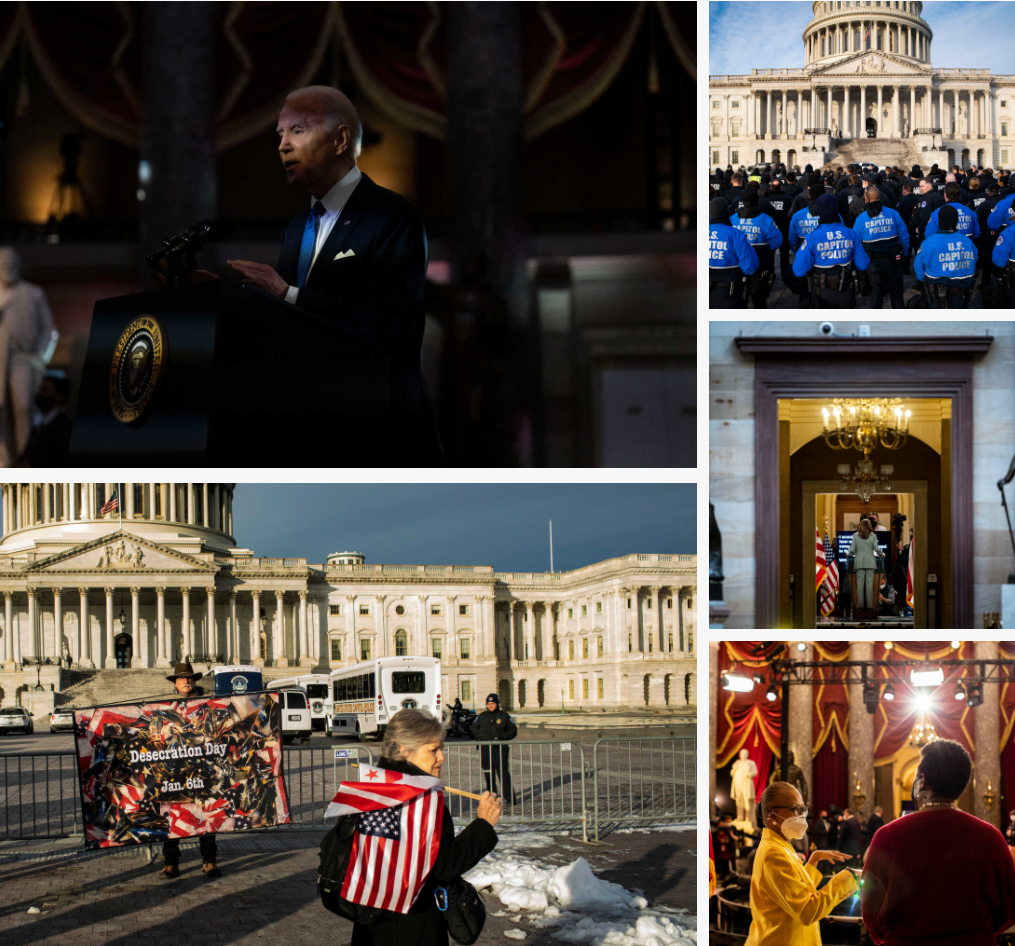
After the president accused Mr. Trump of spinning a “web of lies” and imperiling democracy, lawmakers began holding events to remember the Jan. 6 attack last year by a mob trying to keep Mr. Trump in office.

President Biden forcefully denounced former President Donald J. Trump for promoting lies and tearing down democracy because he could not stand the fact that he lost a free and fair election, accusing his predecessor and his allies of holding “a dagger at the throat of America.”

In his most sustained and scathing attack on the former president since taking office, Mr. Biden used the anniversary of the Jan. 6 mob assault on the Capitol to condemn Mr. Trump for waging an “undemocratic” and “un-American” campaign against the legitimacy of the election system that he likened to the actions of autocrats and dictators in faraway countries.

“The former president of the United States of America has created and spread a web of lies about the 2020 election,” Mr. Biden said, standing in the same National Statuary Hall invaded by throngs of Trump supporters a year ago. “He’s done so because he values power over principle, because he sees his own interest as more important than his country’s interest and America’s interest, and because his bruised ego matters more to him than our democracy or our Constitution. He can’t accept he lost.”

Without using Mr. Trump’s name, the president assailed the “defeated former president” for trying to rewrite history and for casting the attackers of a year ago as patriots. “Is that what you thought when you looked at the mob ransacking the Capitol, destroying property, literally defecating in the hallways, rifling through the desks of senators and representatives, hunting down members of Congress?” Mr. Biden asked. “Patriots? Not in my view.”

“Those who stormed this Capitol and those who instigated and incited and those who called on them to do so held a dagger at the throat of America and American democracy.”
Video

Biden: ‘I’ll Allow No One to Place a Dagger at the Throat of Democracy’
The president denounced former President Donald J. Trump for spreading lies about the 2020 election during a speech on the anniversary of the Capitol riot.

This wasn’t a group of tourists, this was an armed insurrection. They weren’t looking to uphold the will of the people, they were looking to deny the will of the people. They weren’t looking to uphold a free and fair election, they were looking to overturn one. They weren’t looking to save the cause of America, they were looking to subvert the Constitution.

The former president of the United States of America has created and spread a web of lies about the 2020 election. He’s done so because he values power over principle. Because he sees his own interest as more important than his country’s interest, than America’s interest. And because his bruised ego matters more to him than our democracy or our Constitution.

He can’t accept he lost. The third big lie being told by our former president and his supporters is that the mob who sought to impose their will through violence are the nation’s true patriots. Is that what you thought when you looked at the mob ransacking the Capitol? Destroying property, literally defecating in the hallways. Rifling through the deaths of senators and representatives. Hunting down members of Congress. Patriots? Not in my view. I did not seek this fight brought to this Capitol one year ago today. But I will not shrink from it either.

I will stand in this breach. I will defend this nation, and I’ll allow no one to place a dagger at the throat of democracy. We will make sure the will of the people is heard. That the ballot prevails, not violence. That authority in this nation will always be peacefully transferred.

According to a review by The New York Times of recent posts from right-wing groups on sites including Facebook, Twitter, Gab and Gettr, online chatter about celebrations and rallies for the anniversary of the Capitol riot has grown in recent weeks, but the posts have not attracted much buzz and appear unlikely to translate into sizable real-world efforts on Thursday.

In the posts, there has been little talk of violence and guns. The groups have mostly focused on positioning the rioters as heroes and martyrs and encouraged people to push local political leaders toward a far-right agenda. They have also called on supporters to think of long-term goals such as stopping mask and vaccine mandates.

Efforts to organize an anniversary protest in Washington on Thursday have also appeared to gain little traction online, according to The Times’s review.

“Stay out of Washington, it is nothing but a setup,” wrote an Ohio member of the Proud Boys on Telegram on Monday. “Federal agents are going to be there in disguise waiting to arrest anyone who shows up.”

Biden: ‘I’ll Allow No One to Place a Dagger at the Throat of Democracy’The president denounced former President Donald J. Trump for spreading lies about the 2020 election during a speech on the anniversary of the Capitol riot.CreditCredit...Al Drago for The New York Times

Mr. Trump fired back moments later with a written statement issued from his Mar-a-Lago estate in Florida. “This political theater is all just a distraction for the fact Biden has completely and totally failed,” Mr. Trump wrote. “The Democrats want to own this day of January 6th so they can stoke fears and divide America,” he added. “I say, let them have it because America sees through theirs [sic] lies and polarizations.”

Mr. Biden’s speech kicked off a commemoration that, instead of showcasing American unity, underscored just how fractured the nation remains a year after Mr. Trump’s refusal to accept defeat at the ballot box stirred backers to invade the Capitol, disrupt the counting of the Electoral College votes and send lawmakers scurrying for safety.


Mr. Biden and Democratic leaders have scripted a day of addresses, discussions and a candlelight vigil while Republican leaders stayed away, with many G.O.P. senators heading to Georgia for the funeral of their former colleague, Johnny Isakson. Mr. Trump originally planned a news conference at Mar-a-Lago to rail against the investigation into the attack but canceled to the relief of Republicans who considered it counterproductive.

With not a single Republican senator in the Senate chamber, Democrats took to the floor after Mr. Biden’s speech to continue assailing Mr. Trump, “the worst president in modern times,” as Senator Chuck Schumer of New York, the Democratic majority leader, put it.

“It was Donald Trump’s big lie that soaked our political landscape in kerosene,” Mr. Schumer said. “It was Donald Trump’s rally on the Mall that struck the match. And then came the fire.”

Over in the House chamber, the only Republican spotted on the floor for a moment of silence marking the anniversary was Representative Liz Cheney of Wyoming, one of the leading critics of Mr. Trump. She was joined in the front row by her father, former Vice President Dick Cheney, himself a former member of the House. Once the bête noire of the left, Mr. Cheney was greeted cordially by Speaker Nancy Pelosi and other Democrats, who have praised his daughter for her courage.


“It’s an important historical event,” Mr. Cheney told Jonathan Karl of ABC News. “You can’t overestimate how important it is.”

Earlier in the morning, his daughter castigated fellow Republicans for “looking the other way” rather than confront the serious threat represented by the Capitol attack.

“All of my colleagues, anyone who attempts to minimize what happened, anyone who denies the truth of what happened, they ought to be ashamed of themselves,” Ms. Cheney said on the “Today” show on NBC. “History is watching, and history will judge them.”

The House will sponsor an afternoon discussion led by Carla Hayden, the librarian of Congress, with the historians Doris Kearns Goodwin and Jon Meacham, to be followed later by reflections by lawmakers about their experiences on Jan. 6 and finally an early evening candlelight vigil on the steps of the Capitol.

The disparate approaches to the day reflect how much Jan. 6 has become interpreted through a political lens. Democrats view the storming of the Capitol as an existential threat to constitutional democracy unlike any in modern times. Most Republicans would rather focus on anything else, with some convinced that it is being used as a partisan weapon against them and others fearful of crossing Mr. Trump, who continues to wield outsize power within the party.

Feelings remain raw on Capitol Hill, a place of post-traumatic stress that has yet to fully recover from the psychological and political scars of an assault that led to at least seven deaths as well as injuries to 150 police officers. More than the usual acrimony over legislative differences, the legacy of Jan. 6 has exacerbated the toxic rift between members and staff aides on opposite sides of the aisle.

While Mr. Biden has hesitated to engage in a back-and-forth with his predecessor, he used his 20-minute speech to more directly blame Mr. Trump than ever before for encouraging the violence a year ago and then sitting in his private White House dining room watching television and “doing nothing for hours as police were assaulted, lives were at risk, the nation’s Capitol under siege.”

He offered his most extended rebuttal of the false claims that the 2020 election was somehow stolen, noting that repeated recounts, court battles and inquiries had turned up no meaningful fraud. He pointed out that Republicans did not challenge Republican victories for Congress and governor’s mansions based on the same balloting they claim was illegitimate in the presidential race.

Mr. Biden took on efforts to recast the narrative of what happened on Jan. 6, which some Republicans have dismissed as little more than a protest that got out of hand. “This wasn’t a group of tourists,” Mr. Biden said. “This was an armed insurrection. They weren’t looking to uphold the will of he people, they were looking to deny the will of the people.”

Mr. Biden also touched on voting rights legislation stalled in the Senate, although he has a separate speech on the subject scheduled for next week. Vice President Kamala D. Harris, who spoke before Mr. Biden, said, “We must pass voting rights bills that are now before the Senate.”

Republicans accused the White House and Democrats of politicizing the attack to promote legislation meant to benefit their own party and rejected Mr. Biden’s indictment of Mr. Trump. “What brazen politicization of January 6 by President Biden,” Senator Lindsey O. Graham of South Carolina wrote on Twitter following the speech.

Mr. Graham himself broke with Mr. Trump on that day a year ago, saying, “All I can say is count me out, enough is enough.” But it did not take long for him, like most Republicans, to fall in line behind the former president again.

In a series of tweets on Thursday, Mr. Graham denounced the violence of a year ago but not Mr. Trump. “President Biden and Vice President Harris’s speeches today,” he wrote, “were an effort to resurrect a failed presidency more than marking the anniversary of a dark day in American history.”

7.12.21

The Attack On Pearl Harbor December 7, 1941


Biden visits WWII memorial to mark Pearl Harbor anniversary.

On December 7, 1941, Japan staged a surprise attack on Pearl Harbor, decimating the US Pacific Fleet. When Germany and Italy declared war on the United States days later, America found itself in a global war.

THE ROOTS OF THE CONFLICT

While Japan’s deadly assault on Pearl Harbor stunned Americans, its roots stretched back more than four decades. As Japan industrialized during the late 19th century, it sought to imitate Western countries such as the United States, which had established colonies in Asia and the Pacific to secure natural resources and markets for their goods. Japan’s process of imperial expansion, however, put it on a collision course with the United States, particularly in relation to China.

To a certain extent, the conflict between the United States and Japan stemmed from their competing interests in Chinese markets and Asian natural resources. While the United States and Japan jockeyed peaceably for influence in eastern Asia for many years, the situation changed in 1931. That year Japan took its first step toward building a Japanese empire in eastern Asia by invading Manchuria, a fertile, resource-rich province in northern China. Japan installed a puppet government in Manchuria, renaming it Manchukuo. But the United States refused to recognize the new regime or any other forced upon China under the Stimson Doctrine, named after Secretary of State and future Secretary of War Henry L. Stimson.

The ineffectual Stimson Doctrine guided US policy in Asia for the next decade. On the one hand, the doctrine took a principled stand in support of Chinese sovereignty and against an increasingly militaristic Japanese regime. On the other hand, however, it failed to bolster that stand with either material consequences for Japan or meaningful support for China. In fact, US companies continued to supply Japan with the steel and petroleum it needed for its fight against China long after the conflict between the countries escalated into a full-scale war in 1937. But a powerful isolationist movement in the United States countered that the nation had no business at all in the international conflicts developing around the world. Even the Japanese military’s murder of between 100,000 and 200,000 helpless Chinese military prisoners and civilians and the rape of tens of thousands of Chinese women during the 1937 Rape of Nanking failed to immediately shift US policy.
The strong isolationist movement also influenced the initial US approach to the war in Europe, where by the end of 1940 Nazi Germany controlled most of France, Central Europe, Scandinavia, and North Africa, and severely threatened Great Britain. Prioritizing the war in Europe over Japan’s invasion of China, the United States allowed the sale of military supplies to Great Britain beginning in 1939. But neutrality laws and isolationist sentiment severely limited the extent of that aid prior to 1941.


“Each [nation] stepped through a series of escalating moves that provoked but failed to restrain the other, all the while lifting the level of confrontation to ever-riskier heights.”
David M. Kennedy, PhD


The war in Europe had another significant impact on the war in the Pacific because Germany’s military successes unsettled the other European nations’ Asian colonies. As Japan seized the opportunity to become the dominant imperial power in Asia, United States-Japan relations soured. As historian David M. Kennedy, PhD, explained, “Each [nation] stepped through a series of escalating moves that provoked but failed to restrain the other, all the while lifting the level of confrontation to ever-riskier heights.”


THE IMPENDING CRISIS

President Franklin Delano Roosevelt made one of those escalating moves in July 1940 when he cut off shipments of scrap iron, steel, and aviation fuel to Japan even as he allowed American oil to continue flowing to the empire. Japan responded by entering resource-rich French Indochina, with permission from the government of Nazi-occupied France, and by cementing its alliance with Germany and Italy as a member of the Axis. In July 1941, Japan then moved into southern Indochina in preparation for an attack against both British Malaya, a source for rice, rubber, and tin, and the oil-rich Dutch East Indies. This prompted Roosevelt to freeze all Japanese assets in the United States on July 26, 1941, which effectively cut off Japan’s access to US oil.

That move pushed Japan to secretly ready its “Southern Operation,” a massive military attack that would target Great Britain’s large naval facility in Singapore and American installations in the Philippines and at Pearl Harbor, thus clearing a path for the conquest of the Dutch East Indies. While diplomatic talks continued between the United States and Japan, neither side budged. Japan refused to cede any of its newly acquired territory, and the United States insisted that Japan immediately withdraw its troops from China and Indochina.

THE ATTACK

On November 26, 1941, as US officials presented the Japanese with a 10-point statement reiterating their long-standing position, the Japanese Imperial Navy ordered an armada that included 414 planes aboard six aircraft carriers to set to sea. Following a plan devised by Admiral Yamamoto Isoroku, who had earlier studied at Harvard and served as Japan’s naval attaché in Washington, DC, the flotilla aimed to destroy the US Pacific Fleet base at Pearl Harbor.

To catch the Americans by surprise, the ships maintained strict radio silence throughout their 3,500- mile trek from Hitokappu Bay to a predetermined launch sector 230 miles north of the Hawaiian island of Oahu. At 6:00 a.m. on Sunday, December 7, a first wave of Japanese planes lifted off from the carriers, followed by a second wave an hour later. Led by Captain Mitsuo Fuchida, the pilots spotted land and assumed their attack positions around 7:30 a.m. Twenty-three minutes later, with his bomber perched above the unsuspecting American ships moored in pairs along Pearl Harbor’s “Battleship Row,” Fuchida broke radio silence to shout, “Tora! Tora! Tora!” (Tiger! Tiger! Tiger!)—the coded message informing the Japanese fleet that they had caught the Americans by surprise.


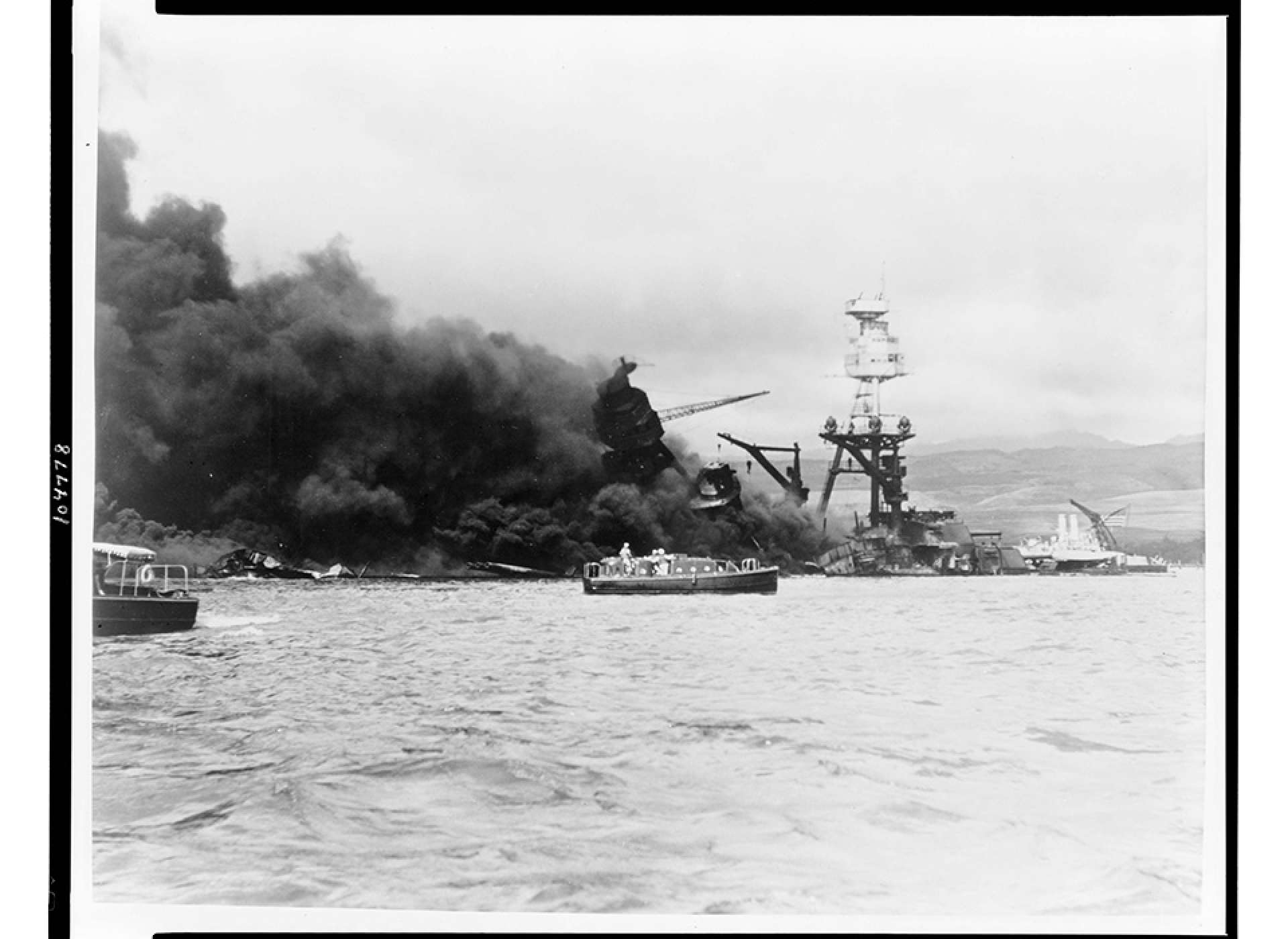
The USS Arizona in flames following the Japanese attack on Pearl Harbor, December 7, 1941. Image: Library of Congress: LC-USZ62-104778.


For nearly two hours, Japanese firepower rained down upon American ships and servicemen. While the attack inflicted significant destruction, the fact that Japan failed to destroy American repair shops and fuel-oil tanks mitigated the damage. Even more significantly, no American aircraft carriers were at Pearl Harbor that day. The Japanese, however, immediately followed their Pearl Harbor assault with attacks against US and British bases in the Philippines, Guam, Midway Island, Wake Island, Malaya, and Hong Kong. Within days, the Japanese were masters of the Pacific.

In Washington, a decrypted message had alerted officials that an attack was imminent moments before Fuchida’s planes took to the skies. But a communications delay prevented a warning from reaching Pearl Harbor in time. The Americans missed another opportunity when an officer discounted a report from an Oahu-based radar operator that a large number of planes were headed their way.

At the White House, Roosevelt learned of the attack as he was finishing lunch and preparing to tend to his stamp collection. He spent the remainder of the afternoon receiving updates and writing the address he intended to deliver to Congress the following day asking for a declaration of war against Japan. As he drafted and redrafted the speech, Roosevelt focused on rallying the nation behind a war many had hoped to avoid.

18.6.21

Joe Biden Just Had a Summit with Vladimir Putin and Nothing Crazy Happened

The circumstances surrounding his meeting with Vladimir Putin were such that Biden could come out of it with the world wondering why he’d bothered at all.

The triumph of Geneva is that it was not Helsinki.

Did Joe Biden finally exorcise the ghost of Helsinki? “I did what I came to do,” he declared on Wednesday, at the end of an afternoon summit with Russian President Vladimir Putin. Speaking to reporters in brilliant sunshine outside an eighteenth-century villa in Geneva, where the two had concluded several hours of discussion, Biden insisted that he left the meeting with a “genuine prospect” for improved relations with Russia. He also announced further talks, on nuclear arms and cyberwarfare, that may or may not lead to new agreements. Just as newsy as the meeting’s limited concrete outcomes was the image of an American President standing up to Putin in all the ways that Donald Trump—the last American President to meet Putin—never did.

Back in 2018, on a lovely summer day in Helsinki, in a press conference that will long be remembered as a most bizarre sellout of American interests, Trump had alternately praised his Russian counterpart and cowered to him. He said that he accepted Putin’s word over that of his own intelligence agencies about Russia’s election interference in 2016. He blamed the United States for bad relations with Russia. Putin stood smirking alongside him as he said all of these things.

Biden’s summit was carefully orchestrated to send a very different message. Most significantly, given Helsinki, there would be no joint press conference, no side-by-side appearance at which Putin could upstage Biden or provoke or taunt him. Biden would not meet alone with Putin, without a note-taker, as Trump had insisted on doing—who knows why—in 2018. And there would be no chatty lunch or informal socializing, as is often scheduled during such superpower summits.

The timing of the meeting in Geneva—after a round of meetings with Western counterparts in the United Kingdom and Brussels—also underscored Biden’s I’m-not-Trump approach. The President only met with Putin after days of mutual lovefests with Western allies; Trump ended up in Helsinki after a nato summit so contentious that he had forced the group into an emergency session and, at one point, even threatened to blow up the alliance. Biden, in contrast, arrived in Geneva representing a more publicly united front. Unlike Trump. And unlike Putin, for that matter, who has . . . Belarus? China, sort of? At a nato summit on Monday, the alliance released a lengthy communiqué that mentioned Russia sixty-two times, characterizing the country as a “threat” and cataloguing a variety of grievances and concerns about its actions in recent years.

Still, the many days of buildup also risked the summit seeming like a letdown. No matter how low Biden’s advisers sought to set expectations, Putin has engaged in a series of provocations in recent months—from sending more than a hundred thousand troops to the border with Ukraine to jailing Russia’s main opposition leader to unleashing crippling cyberattacks inside the United States—that progress of any kind seemed unlikely. Biden could still come out of it with the world and much of Washington wondering just why had he bothered with the summit in the first place.

As the capstone for Biden’s first overseas trip as President, the Putin meeting began with a photo op in a spectacular book-lined study in the sprawling Villa La Grange, on Lake Geneva. The smallest details were covered as breathless breaking news: What does it mean that Biden called the Russian leader a “worthy adversary” before the meeting? Why did Putin call Biden a “career man,” given that his own two decades in power make him Russia’s longest-serving leader since Josef Stalin? During a long wait for the two leaders to come out and actually say something, reporters pored over the staged photos in search of meaning; one sharp-eyed Mexican journalist even noted that the two delegations each had their own different brand of bottled water.

When Putin emerged to hold the first post-summit debrief with the press, it became clear that the pre-game Kremlinology was pointless. Putin was still the usual Putin, if a bit more restrained than usual. His default play has long been to rebuff all critical questions about Russia with criticism of the United States, and it should be stipulated that Putin remains world class in the art of whataboutism. Pressed by reporters, he answered questions about human rights in Russia by talking about the U.S. prison in Guantánamo, U.S. drone strikes on an Afghan wedding party, and shootings in U.S. streets. Later, he threw in references to Black Lives Matter protests, American support for a “bloodthirsty coup d’état” in Ukraine in 2014, and the U.S.’s withdrawal from various treaties in recent years. In fact, Putin insisted, “everything to do with the deterioration of our mutual relations was initiated not by us but by the U.S.A.” Eventually, and to no one’s surprise, he got around to mentioning the January 6th insurrection at the U.S. Capitol, offering up a pro-Trump version of events in which protesters were arrested “on what grounds, it’s not clear.”

Beyond that, there was little to be learned from Putin’s press conference. His opening statement was so brief that it suggested he did not want to talk about the meeting at all. True to form, he did not admit to carrying out cyberattacks, never mind agree to cease them. He revealed that the two countries had decided to return their ambassadors to their posts after months of hostilities, acknowledged that Biden had brought up human rights, and offered a sense that “professional,” “constructive” dialogue had taken place. His tone regarding Biden was cordial. It all seemed like the kind of post-summit press conference that might have taken place in a different time.


Biden was more forthcoming in his remarks. He had vowed in advance that he would talk tough to Putin, and he insisted afterward that he had done so. He said he promised “devastating” consequences if the jailed Russian opposition leader Alexey Navalny should die, and serious but unspecified retaliation if Russia continues its cyberattacks inside the United States. Biden said he told Putin that “human rights is going to always be on the table.” It’s “part of the DNA of our country.” Biden did not mention Trump or make explicit any comparison with his predecessor, who cared not at all about human rights; as is often the case, Biden did not have to.

Perhaps the most revealing moment of Biden’s press conference came at the end, as he was walking out. The President got testy at a shouted question from CNN’s Kaitlan Collins, about whether this could be called a successful summit given Putin’s obvious recalcitrance. “Why are you so confident he’ll change his behavior, Mr. President?” she asked. Turning back to confront her, Biden said, “I’m not confident he’ll change his behavior. When did I say I was confident?” The flash of anger, if nothing else, showed what most concerned Biden: that he might be portrayed as falling, once again, into Putin’s trap. Falling for Putin was what Trump had done, and Biden is clearly striving to be the un-Trump. No one was going to portray him as Putin’s dupe. “I’m not confident of anything,” Biden added. “I’m just stating the facts.”

When he got to the airport, Biden seemed a bit chagrined at his own display of temper. “I owe my last questioner an apology. I shouldn’t have been such a wise guy,” he told pool reporters who were waiting to board Air Force One. Donald Trump never would have said that, either.

So did Biden succeed at least in banishing the memory of Trump’s gross betrayal in Helsinki? It may prove easier to convince Putin that America has moved on than Republicans back in Washington, where the bizarre legacy of Trump has distorted the politics of Russia policy more than almost any other issue. For his part, Trump refuses to disavow Putin or anything about their Helsinki summit. Indeed, in a statement he issued before the Geneva meeting, Trump once again reminded the world of it. Helsinki, Trump said, was “great and very productive,” a meeting where he “won . . . the respect of President Putin and Russia.” As for his most shocking claim in Finland—that he would take Putin’s word over that of U.S. intelligence agencies regarding Russia’s interference in the 2016 election—Trump is still clinging to that one, too, presenting it as an easy choice between Putin and the “sleazebags” and “lowlifes” in America’s intelligence community. In April, in an interview with the Fox News host Sean Hannity, Trump practically rhapsodized about his relationship with Putin. “I got along great with President Putin,” Trump said. “I liked him. He liked me.” Trump does not want to move on from Helsinki; he still thinks he did great.

That, of course, did not stop many Republicans this week from attacking Biden about the Putin summit, as if Helsinki had never happened. The Trump confidant Lindsey Graham, the Republican senator from South Carolina, told Hannity that Biden was practicing “appeasement” of Putin. Mike Pompeo, Trump’s former Secretary of State, said on the same show that refusing to hold a joint press conference with Putin—as Trump had—was an admission of “enormous weakness” on Biden’s part. During the summit, three Republican senators—Ted Cruz, John Barrasso, and Ron Johnson—put out a joint statement that said Biden was “sending a message of weakness and appeasement to our adversaries, encouraging and emboldening them.”

Historical revisionism, it seems, is not confined to Trump’s efforts to turn his 2020 defeat into a victory, or the January 6th pro-Trump riot at the Capitol into a peaceful celebration of democracy. If nothing else, the hypocritical bashing of Biden for holding a summit with Putin is a reminder that, as much as Trump sycophancy is the new normal for the Republican Party, the old normal of attacking Democrats as soft on Russia is still around, too. Can they coexist? We live in a choose-your-reality era of politics. For Trump, Helsinki will live forever; for other Republicans, the Cold War never died. There’s an audience for both, I guess. 

So why not?

29.1.21

Mitch McConnell's Latest Threats To Obstruct The Senate Could Get His Ass Arrested—Literally


After caving on his demands that Democrats pledge, in writing, never to disturb the filibuster, Sen. Mitch McConnell descended into a series of increasingly histrionic threats to blockade the agenda that Americans just elected Joe Biden to implement. Among those threats was a warning that Republicans could prevent the Senate from operating by simply not showing up for work, which would deny Majority Leader Chuck Schumer the quorum necessary to carry out any business.

That’s a dangerous move, but not for the reason McConnell wants us to think. The reason it’s such a huge risk is that any Republican who tries this stunt could, quite literally, find themselves arrested and physically hauled back into the Senate chamber by law enforcement agents to do their jobs.

And it’s not just theoretical. It’s happened before. But first, a little background.

Unlike almost all of the rules the Senate operates under, which are crafted by senators themselves, the quorum requirement is written right into the Constitution: “a Majority ... shall constitute a Quorum to do Business” says Article I, Section 5. Normally that’s not an issue because the Senate simply assumes a quorum is in place unless a member “suggests the absence of a quorum,” in which case a roll call is ordered and work halts until a majority of senators have appeared on the floor (or the quorum call, as it’s known, is terminated by unanimous consent).

McConnell unsubtly warned that the right to demand a quorum call is especially potent when the Senate is divided 50-50, because, if Republicans ever insist on one, every single Democratic senator would have to return to the chamber to produce a majority—the vice president doesn’t count. Senators performing the people’s work elsewhere—say, running committee hearings, or meeting with constituents—would have to abandon what they’re doing to return to the floor. And if someone’s sick or out of town, that could make achieving a quorum impossible.

With this scenario in mind, McConnell glowered, “A scorched-earth Senate would hardly be able to function. It wouldn’t be a progressive’s dream. It would be a nightmare. I guarantee it.”

He’s right, though: It would be a nightmare—for him.

When a quorum is called, Senate rules don’t allow recalcitrant members to just sit in their offices playing Fortnite. They have to head to the chamber floor, and if they don’t, the consequences are severe. That helps explain why no one has tried to gum up the Senate’s operations by withholding a quorum since February of 1988, when Republicans staged a walk-out over a vote on a campaign finance measure after Democrats brought in cots in preparation for an all-night debate.

Majority Leader Robert Byrd demanded the Republicans return, and on a 45-3 vote, Democrats directed Capitol Police to apprehend the absentee senators, wherever they might be. The Los Angeles Times’ David Lauter recounted what happened next in vivid detail:


Armed with arrest warrants for all 46 Republicans, the Senate’s sergeant-at-arms, Henry Giugni, and his men began to search the corridors of the Capitol and the Senate office buildings. After checking several empty offices, they spotted Sen. Steve Symms (R-Ida.) but he fled down a hallway and escaped arrest. Then a cleaning woman tipped them that [Oregon Sen. Bob] Packwood was in his office, and Giugni—a burly former Hawaii vice officer—opened the door with a passkey.

Packwood tried to shove the door closed, but Giugni and two of his assistants pushed it open. The senator, who hurt his left arm in an accident two weeks ago and has been wearing a cast since then, tried to use his left hand to keep the door shut, bruising his knuckles in the process.

The humiliation for Packwood (who would later resign under threat of expulsion over allegations of sexual misconduct) did not end there: Lauter reported that he “was carried feet-first into the Senate chamber by three plainclothes officers.”

Is that the fate McConnell intends for his caucus, or for himself? We know he can ill afford bruised hands, though he probably doesn’t mind the bruised ego. But forcing this kind of spectacle would only highlight Republican obstructionism in the worst possible way, and it would only further radicalize Democrats in favor of curtailing the very thing McConnell is most desperate to protect: the filibuster. That would be McConnell’s true nightmare, and one of his own doing.

David Nir

22.1.21

Joe Biden’s Cancellation of the Keystone Pipeline Is a Landmark in the Climate Fight

Demonstrators gather in front of the White House to protest the proposed Keystone XL pipeline, in the summer of 2011.Photograph by Melissa Golden / Redux

In his first hours in office, Joe Biden has settled—almost certainly, once and for all—one of the greatest environmental battles this country has seen. He has cancelled the permit allowing the Keystone XL pipeline to cross the border from Canada into the United States, and the story behind that victory illustrates a lot about where we stand in the push for a fair and working planet.


To review: Keystone XL, a project of the TransCanada Corporation (now TC Energy), was slated to carry oil from Alberta’s tar sands across the country to refineries on the Gulf of Mexico. President George W. Bush approved the original Keystone pipeline, and it went into service, early in the Obama years, without any real fuss. A new XL version, announced in 2008, was larger and took a different course across the heartland. And, this time, there was opposition. It came first from indigenous people in Canada, who had watched tar-sand mines lay waste to a vast landscape. First Nations leaders, such as Melina Laboucan-Massimo and Clayton Thomas-Muller, along with Native-American leaders on this side of the border—including Tom and Dallas Goldtooth, of the Indigenous Environmental Network—put up strong resistance and joined forces with ranchers whose lands would be bisected by the pipeline. Organizers such as Jane Kleeb, in Nebraska, found small pockets of support within some of the “big green” environmental groups, much of it coördinated by the veteran campaigner Kenny Bruno. In the spring of 2011, the nasa climate scientist James Hansen helped orient the pipeline as a climate-related fight, pointing to the massive amounts of carbon contained in the Canadian tar-sand deposits and making the case that, if they were fully exploited, it would be “game over” for the climate. That brought the climate movement into the picture; a letter (full disclosure: I drafted it) went out in the summer of 2011, asking people to engage in civil disobedience outside the White House.


At first, it wasn’t clear how many would do so, in part because President Barack Obama was popular with environmentalists. But people—many of them wearing Obama buttons—began arriving in serious numbers. Before two weeks of protest, starting in late August, were over, 1,254 people had been arrested, in one of the largest nonviolent direct actions in recent years. A few months later, many times that number circled the White House perimeter, standing shoulder to shoulder, five deep. The big environmental groups quickly joined the fight. Even so, the experts said that there was no chance to stop the pipeline. (The National Journal polled its “energy insiders,” and ninety-one per cent said that TransCanada would soon have its permit.) But, in fact, the battle was over by mid-November, when Obama announced a delay, in order to consider the question more closely. As he consolidated support for his reëlection bid, he had apparently concluded that “Keystone” and “climate” were too closely linked, though it took him several years to officially reject the permits. Ever since that initial pause, it’s been a matter of holding on to that victory—in close votes in Congress, during the Obama years, in endless wrangling with financiers, and with brilliant maneuvering in the courts, after Donald Trump revived the pipeline during his first days in office. I’m very grateful for Biden’s action, but I had no doubt he would take it—even today, Keystone is far too closely identified with climate carelessness for a Democratic President to be able to waver.

The success in 2011 was, to some degree, a matter of timing. There was already growing concern about global warming, and Keystone proved to be the catalyst for the rapid expansion of the climate movement, which was soon fighting for such things as fossil-fuel divestment and renewable portfolio standards for solar power. The events of 2011 also showed that the fossil-fuel industry was not unbeatable, and it encouraged people to oppose the construction of just about every new fracking well and coal port and liquid-natural-gas terminal. Environmentalists have won many of these infrastructure battles, and they’ve added delay and cost to projects. (Who knows how many bad things were never even proposed in the wake of Keystone XL?) The wins continue: last fall, after an inspired decade-long campaign led by Michigan environmentalists, Governor Gretchen Whitmer announced that the state would close down a tar-sands pipeline through the Straits of Mackinac, in the heart of the Great Lakes. But there have been plenty of losses, too, and Biden will get to help decide the fates of two other critical projects that resemble KXL in many ways.


One is the Dakota Access Pipeline, the debate over which came to a boil with the protests at Standing Rock, during the final months of the Obama Administration; the other is Line 3, another tar-sands pipeline, whose expansion is planned to cross from Canada into Minnesota and which was recently approved by Governor Tim Walz. The most important outcome of the Keystone XL fight was that Obama imposed a de-facto “climate test” on all new large-scale infrastructure projects that require federal approval—and, if you apply the most basic version of that challenge to either of these projects, they fail instantly. Pressure is already building on Biden to do something about them; a letter last week from seventy-five indigenous women leaders demanded the cancellation of all three pipelines. His response to the Dakota Access and Line 3 pipelines will likely depend on the shifting balance of power between environmentalists, indigenous groups, and organized labor.


This surprises many people, who are used to thinking of the fossil-fuel industry as the main pressure group. But that industry is at its strongest during Republican Administrations. With Democrats in power, an equally important constituency is the building-trades unions of the A.F.L.-C.I.O., because they get the well-paid jobs involved in constructing these mega-projects; the unions were staunch proponents of Keystone XL from the start. (Jason Kenney, the premier of Alberta, has said repeatedly in recent months that he was counting on the unions to help TransCanada prevail in the endgame of the Keystone fight, not understanding American politics well enough to know that that particular ship had already sailed; it was as realistic as the company’s Onion-esque last-minute pledge to power the operation of the pipeline with renewable energy.) Line 3, for instance, is proceeding under Governor Walz, a Democrat, likely because it brings a lot of union jobs. “I got a lot of people who said that it’s been nearly a whole year since they went to work,” Royce Schulz, a union steward working on the project in Carlton County, told the Minneapolis Star Tribune, in December. “It couldn’t have hit at a better time, to get people back on their feet and making money again.”

A construction worker earning ninety thousand dollars is, correctly, a more sympathetic figure than an oil executive earning ten times that much. And labor is a key part of the progressive coalition. So, environmental activists (with rare exceptions, such as the always forthright Naomi Klein) have been reluctant to call out the building-trades unions, even when they offered Donald Trump their fulsome support in an effort to get projects like these approved. The A.F.L.-C.I.O. came out in favor of the Dakota Access pipeline in September of 2016, even after security guards used dogs against protesters. In response, the Labor Coalition for Community Action, which includes minority unionists, joined the Communication Workers of America, the nurses union, and other labor heavyweights to stand against the pipeline. The outcome of this fight within labor, and the wider progressive movement, will determine in large measure how aggressive Biden will be on climate-busting projects. If he allows the Dakota Access and Line 3 pipelines to proceed, he will dismay many core supporters, not to mention allow infrastructure that will be spewing carbon into the air for many decades to come. But perhaps this son of Scranton is uniquely positioned to solve this conundrum. What’s needed is a grand bargain, which replaces fossil-fuel-infrastructure jobs with jobs building solar panels, wind turbines, water pipes that don’t carry lead, and so on. These jobs need to be comparable in terms of pay; there has to be necessary retraining for workers; and someone has to figure out how to allocate this new work to existing unions, so that no one gets left out and that all kinds of Americans share in those jobs. It is, in other words, the messy work of a “just transition” that, in this moment of economic and climatic peril, can’t be dodged any longer.


There are instructive and hopeful lessons from the past. For many years, the combined power of unions and auto companies insulated Detroit from federal action on automobile mileage. Barack Obama managed to break that deadlock shortly after taking office when, in return for federal bailouts, he forced the industry to agree to much higher fuel-efficiency standards. One of the people who cut that deal was a young aide to the national economic adviser named Brian Deese; he is now himself the national economic adviser. The rest of Biden’s climate team has solid labor credentials, too—for example, Gina McCarthy, the new domestic climate czar, was the head of the Environmental Protection Agency under Obama, where she helped implement the mileage regulations. As the legislative director of the United Auto Workers explained to Congress, “The continuing recovery of the automobile industry in the United States has as its foundation the regulatory certainty of these tailpipe-emission standards, which is driving innovation in every company and in every vehicle segment.” A few days before Biden’s Inauguration, the team sat down with labor leaders for a formal “listening session.” The official readout was anodyne, but the effort itself was promising—if Biden sticks to his stance that all policy is climate policy, then much can be done. Even Joe Manchin, the conservative Democrat from West Virginia, who now may be the most powerful man in the Senate, given its fifty-fifty split, can perhaps be enticed with a series of proposals to cushion the irrevocable demise of the coal industry. Bernie Sanders now runs the Senate Budget Committee, which will have to look at any of these transition projects, and in the Senate he’s been both organized labor’s biggest booster and the most outspoken opponent of new fossil-fuel infrastructure.


Biden’s action on Keystone XL couldn’t be more welcome, but it’s cold comfort to the Native Americans camped out along the upper Mississippi trying to block Line 3. That battle looks hard right now, especially because the coronavirus pandemic is preventing people from joining them in large numbers. But the Keystone battle looked impossible at the start. When enough people demand action, vested interest and political convenience have to accommodate them. 

That’s how change works.
Bill McKibben