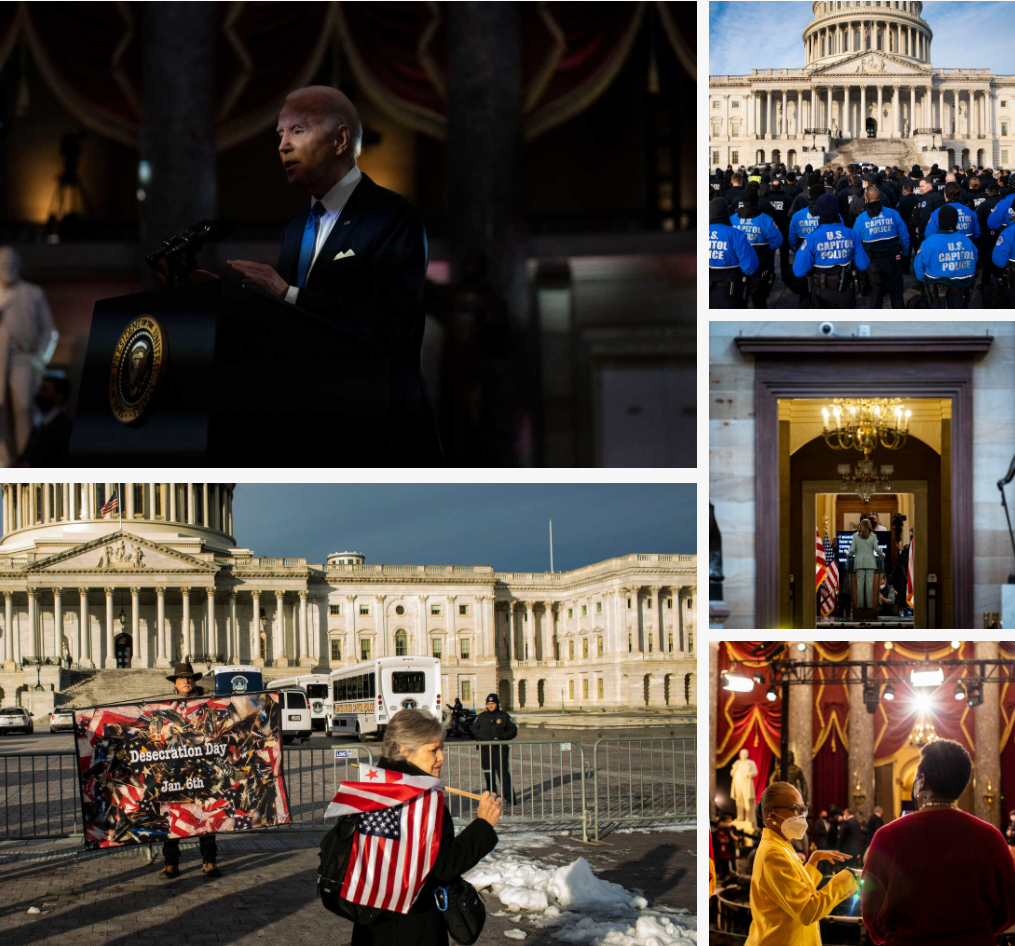
After the president accused Mr. Trump of spinning a “web of lies” and imperiling democracy, lawmakers began holding events to remember the Jan. 6 attack last year by a mob trying to keep Mr. Trump in office.
President Biden forcefully denounced former President Donald J. Trump for promoting lies and tearing down democracy because he could not stand the fact that he lost a free and fair election, accusing his predecessor and his allies of holding “a dagger at the throat of America.”
In his most sustained and scathing attack on the former president since taking office, Mr. Biden used the anniversary of the Jan. 6 mob assault on the Capitol to condemn Mr. Trump for waging an “undemocratic” and “un-American” campaign against the legitimacy of the election system that he likened to the actions of autocrats and dictators in faraway countries.
“The former president of the United States of America has created and spread a web of lies about the 2020 election,” Mr. Biden said, standing in the same National Statuary Hall invaded by throngs of Trump supporters a year ago. “He’s done so because he values power over principle, because he sees his own interest as more important than his country’s interest and America’s interest, and because his bruised ego matters more to him than our democracy or our Constitution. He can’t accept he lost.”
Without using Mr. Trump’s name, the president assailed the “defeated former president” for trying to rewrite history and for casting the attackers of a year ago as patriots. “Is that what you thought when you looked at the mob ransacking the Capitol, destroying property, literally defecating in the hallways, rifling through the desks of senators and representatives, hunting down members of Congress?” Mr. Biden asked. “Patriots? Not in my view.”
“Those who stormed this Capitol and those who instigated and incited and those who called on them to do so held a dagger at the throat of America and American democracy.”
Video
Biden: ‘I’ll Allow No One to Place a Dagger at the Throat of Democracy’
The president denounced former President Donald J. Trump for spreading lies about the 2020 election during a speech on the anniversary of the Capitol riot.
This wasn’t a group of tourists, this was an armed insurrection. They weren’t looking to uphold the will of the people, they were looking to deny the will of the people. They weren’t looking to uphold a free and fair election, they were looking to overturn one. They weren’t looking to save the cause of America, they were looking to subvert the Constitution.
The former president of the United States of America has created and spread a web of lies about the 2020 election. He’s done so because he values power over principle. Because he sees his own interest as more important than his country’s interest, than America’s interest. And because his bruised ego matters more to him than our democracy or our Constitution.
He can’t accept he lost. The third big lie being told by our former president and his supporters is that the mob who sought to impose their will through violence are the nation’s true patriots. Is that what you thought when you looked at the mob ransacking the Capitol? Destroying property, literally defecating in the hallways. Rifling through the deaths of senators and representatives. Hunting down members of Congress. Patriots? Not in my view. I did not seek this fight brought to this Capitol one year ago today. But I will not shrink from it either.
I will stand in this breach. I will defend this nation, and I’ll allow no one to place a dagger at the throat of democracy. We will make sure the will of the people is heard. That the ballot prevails, not violence. That authority in this nation will always be peacefully transferred.
According to a review by The New York Times of recent posts from right-wing groups on sites including Facebook, Twitter, Gab and Gettr, online chatter about celebrations and rallies for the anniversary of the Capitol riot has grown in recent weeks, but the posts have not attracted much buzz and appear unlikely to translate into sizable real-world efforts on Thursday.
In the posts, there has been little talk of violence and guns. The groups have mostly focused on positioning the rioters as heroes and martyrs and encouraged people to push local political leaders toward a far-right agenda. They have also called on supporters to think of long-term goals such as stopping mask and vaccine mandates.
Efforts to organize an anniversary protest in Washington on Thursday have also appeared to gain little traction online, according to The Times’s review.
“Stay out of Washington, it is nothing but a setup,” wrote an Ohio member of the Proud Boys on Telegram on Monday. “Federal agents are going to be there in disguise waiting to arrest anyone who shows up.”
Biden: ‘I’ll Allow No One to Place a Dagger at the Throat of Democracy’The president denounced former President Donald J. Trump for spreading lies about the 2020 election during a speech on the anniversary of the Capitol riot.CreditCredit...Al Drago for The New York Times
Mr. Trump fired back moments later with a written statement issued from his Mar-a-Lago estate in Florida. “This political theater is all just a distraction for the fact Biden has completely and totally failed,” Mr. Trump wrote. “The Democrats want to own this day of January 6th so they can stoke fears and divide America,” he added. “I say, let them have it because America sees through theirs [sic] lies and polarizations.”
Mr. Biden’s speech kicked off a commemoration that, instead of showcasing American unity, underscored just how fractured the nation remains a year after Mr. Trump’s refusal to accept defeat at the ballot box stirred backers to invade the Capitol, disrupt the counting of the Electoral College votes and send lawmakers scurrying for safety.
Mr. Biden and Democratic leaders have scripted a day of addresses, discussions and a candlelight vigil while Republican leaders stayed away, with many G.O.P. senators heading to Georgia for the funeral of their former colleague, Johnny Isakson. Mr. Trump originally planned a news conference at Mar-a-Lago to rail against the investigation into the attack but canceled to the relief of Republicans who considered it counterproductive.
With not a single Republican senator in the Senate chamber, Democrats took to the floor after Mr. Biden’s speech to continue assailing Mr. Trump, “the worst president in modern times,” as Senator Chuck Schumer of New York, the Democratic majority leader, put it.
“It was Donald Trump’s big lie that soaked our political landscape in kerosene,” Mr. Schumer said. “It was Donald Trump’s rally on the Mall that struck the match. And then came the fire.”
Over in the House chamber, the only Republican spotted on the floor for a moment of silence marking the anniversary was Representative Liz Cheney of Wyoming, one of the leading critics of Mr. Trump. She was joined in the front row by her father, former Vice President Dick Cheney, himself a former member of the House. Once the bête noire of the left, Mr. Cheney was greeted cordially by Speaker Nancy Pelosi and other Democrats, who have praised his daughter for her courage.
“It’s an important historical event,” Mr. Cheney told Jonathan Karl of ABC News. “You can’t overestimate how important it is.”
Earlier in the morning, his daughter castigated fellow Republicans for “looking the other way” rather than confront the serious threat represented by the Capitol attack.
“All of my colleagues, anyone who attempts to minimize what happened, anyone who denies the truth of what happened, they ought to be ashamed of themselves,” Ms. Cheney said on the “Today” show on NBC. “History is watching, and history will judge them.”
The House will sponsor an afternoon discussion led by Carla Hayden, the librarian of Congress, with the historians Doris Kearns Goodwin and Jon Meacham, to be followed later by reflections by lawmakers about their experiences on Jan. 6 and finally an early evening candlelight vigil on the steps of the Capitol.
The disparate approaches to the day reflect how much Jan. 6 has become interpreted through a political lens. Democrats view the storming of the Capitol as an existential threat to constitutional democracy unlike any in modern times. Most Republicans would rather focus on anything else, with some convinced that it is being used as a partisan weapon against them and others fearful of crossing Mr. Trump, who continues to wield outsize power within the party.
Feelings remain raw on Capitol Hill, a place of post-traumatic stress that has yet to fully recover from the psychological and political scars of an assault that led to at least seven deaths as well as injuries to 150 police officers. More than the usual acrimony over legislative differences, the legacy of Jan. 6 has exacerbated the toxic rift between members and staff aides on opposite sides of the aisle.
While Mr. Biden has hesitated to engage in a back-and-forth with his predecessor, he used his 20-minute speech to more directly blame Mr. Trump than ever before for encouraging the violence a year ago and then sitting in his private White House dining room watching television and “doing nothing for hours as police were assaulted, lives were at risk, the nation’s Capitol under siege.”
He offered his most extended rebuttal of the false claims that the 2020 election was somehow stolen, noting that repeated recounts, court battles and inquiries had turned up no meaningful fraud. He pointed out that Republicans did not challenge Republican victories for Congress and governor’s mansions based on the same balloting they claim was illegitimate in the presidential race.
Mr. Biden took on efforts to recast the narrative of what happened on Jan. 6, which some Republicans have dismissed as little more than a protest that got out of hand. “This wasn’t a group of tourists,” Mr. Biden said. “This was an armed insurrection. They weren’t looking to uphold the will of he people, they were looking to deny the will of the people.”
Mr. Biden also touched on voting rights legislation stalled in the Senate, although he has a separate speech on the subject scheduled for next week. Vice President Kamala D. Harris, who spoke before Mr. Biden, said, “We must pass voting rights bills that are now before the Senate.”
Republicans accused the White House and Democrats of politicizing the attack to promote legislation meant to benefit their own party and rejected Mr. Biden’s indictment of Mr. Trump. “What brazen politicization of January 6 by President Biden,” Senator Lindsey O. Graham of South Carolina wrote on Twitter following the speech.
Mr. Graham himself broke with Mr. Trump on that day a year ago, saying, “All I can say is count me out, enough is enough.” But it did not take long for him, like most Republicans, to fall in line behind the former president again.
In a series of tweets on Thursday, Mr. Graham denounced the violence of a year ago but not Mr. Trump. “President Biden and Vice President Harris’s speeches today,” he wrote, “were an effort to resurrect a failed presidency more than marking the anniversary of a dark day in American history.”


