Showing posts with label human rights. Show all posts

27.1.21

Jair Bolsonaro Could Face Charges in The Hague Over Amazon Rainforest


Since Bolsonaro took office in 2019, vast stretches of the rainforest have been destroyed and traditional communities threatened Photograph: Eraldo Peres/AP

Indigenous leaders and human rights groups accuse Brazilian president of crimes against humanity.

Jair Bolsonaro could face charges in the international criminal court (ICC) after being accused of crimes against humanity.

Indigenous leaders in Brazil and human rights groups are urging the court to investigate the Brazilian president over his dismantling of environmental policies and violations of indigenous rights, which they say amount to ecocide.

William Bourdon, a Paris-based lawyer, submitted a request for a preliminary examination to the tribunal in The Hague, Netherlands, on Friday. The chief prosecutor, Fatou Bensouda, will then determine whether there are grounds for an investigation against Bolsonaro.

There is no deadline for a decision but “it is a matter of great urgency”, Bourdon said. “We are running against the clock, considering the devastation of the Amazon.”

Since Bolsonaro took office in 2019, vast stretches of the rainforest have been destroyed and traditional communities threatened. Deforestation has soared nearly 50% in two years and has reached its highest level since 2008. Invasions of indigenous territories increased 135% in 2019, and at least 18 people were murdered in land conflicts last year.

Despite that, fines for environmental crimes dropped 42% in the Amazon basin in 2019, and the federal government cut the budget for enforcement by 27.4% this year, a report revealed.

“While the scenario is getting worse and worse, the government is reducing enforcement,” said Marcio Astrini, the executive director of Climate Observatory, the group of NGOs behind the report. “It is frightening to see that there is a coordinated attack on the climate, the forest and its people.”

The UN-backed court has mostly ruled on cases of genocide and war crimes since it was created in 2002. However, after facing criticism it decided in 2016 to assess offences in a broader context, which could include major environmental and cultural crimes.
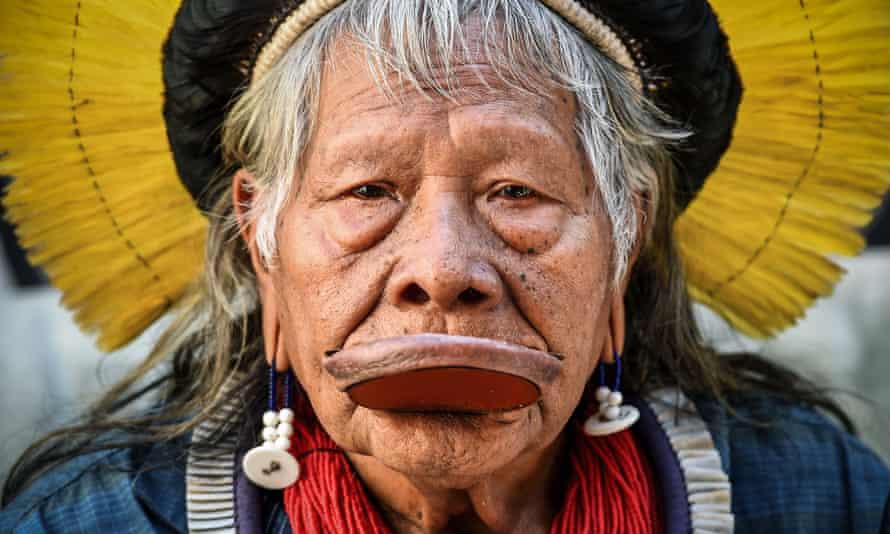
Raoni Metuktire, the leader of the Kayapo people, is well known for his fight for the preservation of the Amazon rainforest and indigenous culture. Photograph: Nicolas Tucat/AFP/Getty Images

Bourdon believes this case could lead to Bolsonaro standing trial for ecocide, a term defined as causing serious and lasting harm to the environment and people. The lawyer filed the case on behalf of indigenous chiefs Almir Suruí and Raoni Metuktire.

Several members of NGOs and lawyers from the US, Brazil and France also worked on the 68-page report describing what they claim are crimes against humanity. It includes cases of murder, forced transfer and persecution of indigenous people in Brazil.

Amazonian chief Raoni Metuktire: 'Bolsonaro has been the worst for us'


Raoni is renowned for his fight for the preservation of the Amazon rainforest and indigenous culture. The 91-year-old chief of the Kayapo people is currently isolated in his village at the Xingu indigenous territory due to the coronavirus pandemic.

Patxon Metuktire, his 35-year-old grandson, followed him in his quest for help in the international community over the past year: “My grandfather thought it was important to make the complaint because the chief of the nation should protect communities, but he is not doing so.

“People are feeling endorsed to commit crimes, as the president supports them,” Patxon added. “My grandfather believes the Brazilian population cannot make the president stop acting against the indigenous people. He keeps violating our rights, so this is our last resort. My grandfather is ready to testify and clarify anything for prosecutors if needed.”

Scientists have warned that Bolsonaro’s destructive policies could push the Amazon rainforest to an irreversible tipping point, turning swathes of the tropical forest into savannah. This would make it impossible to control climate change.

“Bolsonaro is not only a risk for indigenous peoples, he turned into a global problem, because what he does here has an impact on the planet,” said Sônia Guajajara, the leader of the Association of Brazil’s Indigenous Peoples. “He commits one crime after another against the peoples of the forest and against the environment.”

In November 2019, Brazilian activists delivered an “informative note” at the ICC arguing that Bolsonaro encouraged the genocide against indigenous people. More than a year later, the prosecutor’s office said it was analysing the case to determine whether it would open an examination.

Eloísa Machado, a member of Brazil’s Human Rights Advocacy Collective who worked on the legal action, welcomed the case brought by Bourdon. “Bolsonaro has his actions under analysis now, even if preliminarily,” she said.

Although the proceedings are still at an early stage, Machado said it was an important sign from The Hague: “It is an indication that the facts reported are serious and that the prosecutor’s office is sensitive to the issue.”


13.6.20

The Day I met James Baldwin at Harvard

Memo on James Baldwin: Digital Collections for the Classroom

Did I ever tell you about the time I met the writer James Baldwin? 

I was a junior at Harvard, majoring in English and French with an Africana focus. I lived in one of the dormitories or houses as we called them on campus. These houses were vibrant places; not simply a place to eat and sleep but a place where it was not unusual to connect with invited guests who were asked to share their knowledge with the community. They were run by House Masters, a term I now find curious, but then did not question. Interestingly, in recent times, these residential college directors have been renamed Faculty Deans. Often, it would be a married academic couple that resided on the compound and hosted events for the entire community. Academics, writers, artists, all passed through. Luminaries could be invited to speak to the whole campus or in some cases, as in the case of Baldwin, they would be invited by the House Masters to join us in a more intimate setting.


And so it was that one week in the spring of my junior year, I got a call from the masters of my house, an older white couple, who asked me to join them for dinner with none other than James Baldwin, the famous writer, civil rights activist and one of my heroes. After enthusiastically saying yes, I remember getting off the phone and rejoicing with my roommates at the thought of this opportunity. They made me promise to come back and tell them everything. At the time, none of us speculated as to why I was asked. Perhaps we all assumed that my concentration in Africana Studies (Black writers in French and English) was one possible reason. I had also worked with them and other Black women on campus to restart a Black woman’s service organization called the Association of Black Radcliffe women. That, too, we thought may have had something to do with it.

So when the day arrived that James Baldwin came to campus, I put on my best dress and took the elevator to the masters’ penthouse apartment like one going to see a true luminary. At the same time, I felt a sense of familiarity with the man whose books had made such an imprint on my life. Baldwin’s work was like an awakening. Nobody Knows my Name, Go tell it on the Mountain, his essays on his literary forays in France –helped me to understand my world. They made me proud of who I was. They were so deeply personal yet historical at the same time, and though it would be a long time before I found my calling as a historian and a writer, I read Baldwin’s poignant novels then as works of history.

I remember almost leaping out of the elevator with great anticipation. I rushed to the door and was warmly greeted by the hostess. I looked fervently around to see if I could spot him. Slim, in his early sixties but appearing more youthful, he sat at a giant candle lit table near windows overlooking the budding trees and flowers. It was spring, and it was not yet dark so you could see that everything was beginning to bloom again. I don’t remember the rest of the setting, but I do remember that against this beautiful backdrop, he was sitting alone. There were others milling around, but they were not sitting or standing directly next to him.

In that moment, it struck me that other than Baldwin, I was the only Black person in the room. I am not sure why it struck me as unusual, but perhaps I had gotten used to seeing many Black and brown faces on campus that somehow this stood out. I was part of one of the most multicultural classes in Harvard’s history. I rarely felt like “the only one” in most settings on campus, but that evening, I felt that right away. But I wasn’t going to let that be a problem. What did that matter? I was meeting one of my heroes.

I was about to make my way to the table where he was seated when the hostess took me by the arm….and ushered me to the kitchen.

“Come this way,” she said as she pointed to a tray of hors d’oeuvres that I was to carry.

This is the point where I wish I could report exactly what I said but I can’t. I can only report this feeling of being absolutely crushed in mind and spirit. I said something, quietly, to the effect of:

“Oh, but I thought I was invited to meet Mr. Baldwin, not to serve…”

I mean, there were jobs in the college like this for students like myself who worked their way through school with part time jobs, but this was not my job. There was nothing wrong with those jobs, but I worked in the box office of the campus theater. That was my job –selling tickets.

I tried to remember: when she called me the week before to invite me, had I missed something? Were there other students being asked to serve? No.

The strange thing was that up until this point, my dealings with the House Masters had always been cordial and respectful, not anything of note. Now here I was, here to meet James Baldwin, the only other Black person in the room, and I was being ushered to the kitchen.

Suddenly, the hostess caught herself and somehow turned it around and invited me instead to stay and have dinner with them. But it was too late. I was crestfallen.

And James Baldwin, ever the astute writer and observer of life, especially life in America, looked across the room and knew it.

He was far enough away that he could not have heard our exchange, but he felt it and he saw it for what it was and gave me the most knowing look with his large piercing eyes that I remember to this day.

The next thing I knew he was ushering me to his side, to his table. I was to sit next to him at dinner. I was to be his guest.

———

I almost never tell this story. In fact, in thirty years, I have told it only once in a private setting. I think, in my mind, I decided that since it all ended well ––that perhaps it was not such a bad day after all.

But it was.

Maybe I did not want this story to mar what was overall a phenomenal experience I had at Harvard. Nothing like that had ever happened before which ironically made it all the more difficult to accept. Harvard was not just a school. It was my home for four years, the way any place would have been where you made friends, you ate and slept and worked and played. I had great classmates, the Class of 1986. But it was more than that. I felt a connection to the place. The time worn red cobblestones beneath my feet; the smell of flowers that permeated the air in spring after cold Cambridge winters; the thrill of discovery of yet another little library tucked away in a building on the edge of campus with books that had the look, feel and musty smell of first editions. It was my home, and things like this don’t happen in your home.

Do they?


Besides, these were the years of President Derek Bok, a great visionary and believer in multicultural education and representation. It was a pioneering time, but for all of the great vision and all the hard work that brought me there, in that one gesture, my hostess took me back… back there.

Back to that place and that time where that is all I could reasonably expect – that any invite to her home was to serve, not to be served.

Even now, I don’t write in anger because I suppose she was, as we say sometimes, a product of her time, but I wonder as I write and think about the lasting impact of slavery in this country and in the Caribbean, how is it we don’t talk about trauma? Not just the trauma of the past but the repeated incidents of racism that threaten to bring it all back.

That is what I think about now. That is what my next book is about; that and how to heal that trauma.

But in the meantime, I can still see James Baldwin’s eyes—fixed on me and my predicament –which was also his predicament and the one he dedicated his life to writing about – those eyes that pulled me in and out of history.

That is my lasting memory.


Anne C. Bailey, author of The Weeping Time: Memory and the Largest Slave Auction in American History. (Cambridge University Press, 2020)