“Anytime I meet another female record collector on the Internet or in person, I immediately want to be their friend!” says Erin O’Dell, a record collector, blogger, and factory worker from Red Lion, Pennsylvania. “I feel like we’re often overshadowed by the male perspective and designated as the ‘that’s nice, dear’ of couples in memes and forums. We love to spin and crate dig, too. We exist. We are valid. We want all the vinyl!”
In a male-dominated music industry, O’Dell is part of an active and passionate community of women on Instagram sharing their love of vinyl and helping to promote gender equity. This loose-knit, global sorority of record collectors and music-industry professionals meet up daily on a vast network of like-minded souls, both men and women, to celebrate their favorite artists and albums. Some are earnest collectors who simply post a treasured album cover accompanied by a mini-blog, while others stage lavish tributes to artists and their works, donning makeup and costumes to replicate album art. One Italian Instagram account even curates professional-quality pinups replete with vintage portable record players and scantily-clad models that look like they stepped off the pages of a 1962 Esquire spread.
But the playful pinups belie a deeper sense of empowerment that these enthusiasts are finding through vinyl. “Music can lift and light a fire inside of you that you didn’t know could even burn,” says O’Dell, who writes the monthly Vinyl Femmes & RPMs column. Music-marketing exec Sunny Muehleman Blashe of Milwaukie, Wisconsin (aka @puttherecordon) feels similarly inspired. “I love being part of the vinyl community [on Instagram],” she says. “Everyone is so nice and supportive. I’ve made so many friends who have shared new ways to store my records, and learned about vinyl cleaning products and even new music. I love seeing what albums or artists make other people happy and adding that to my collection. I also love sharing my collection with others who are like me. It gives us time to discuss why we love the music and how it makes us feel.”
Instagram also is helping women find jobs, thanks to organizations like Women In Vinyl, an advocacy group that shares inspirational stories and creates role models for girls and women. The group’s board members include founder and self-confessed Black Sabbath fanatic Jenn D’Eugenio, sales manager at Furnace Record Pressing in Alexandria, Virginia; Jett Galindo, a mastering engineer at The Bakery studio in Los Angeles; Amanda McCabe, a member of the Universal Music Group’s Strategy and Tactics Team in Seattle; and Robyn Raymond, a lacquer cutter and owner of Red Spade Records in Ontario, Canada. “Women in Vinyl, by sharing stories of women working in the field and now with the podcast, is making the industry more accessible,” says D’Eugenio, who founded the organization in 2018 and hosts the group’s new WIV podcast. “It’s about educating the community, and hopefully inspiring people to take a chance and find a way to do something they love. It’s not exclusive to women, but it’s brought to you by women and features women who are leaders in the field—you can’t move an industry forward without innovation and you can’t innovate in a vacuum. Innovation comes from diversity and that comes from inclusion. The more diverse and inclusive the industry is the better it can become.”
One of those women is Mary House, a single mom, stage-3 breast cancer survivor, and owner of Curious Collections Vinyl Records & More in Bryan/College Station, Texas, who found a new life through vinyl. In 2016, she was in the middle of a divorce when her father suddenly died in a car accident. “You see, my dad was a collector, so my brother and I went to West Virginia and cleaned out his seven storage units, two of which were climate controlled and filled with vinyl,” she recalled on the Women In Vinyl website. “I loaded up a 26-foot moving truck, drove that bad boy from West Virginia to Texas, and unloaded its contents into the space that was my first location. Since then, we’ve moved into a 2600-square-foot space and expanded our inventory to include turntables, new vinyl, and posters, right alongside the large, previously owned vinyl selection. I started my own collection when I opened my store. I love finding fun colored versions of albums I love.”
The significance of using record collecting as a gateway to personal empowerment is echoed by Markie Schlake of Cincinnati, Ohio (aka @VinylGal), a “full-time mom” and part-time social-media manager who encourages her Instagram followers to welcome newbies. “Collecting vinyl can seem very exclusive. Nick Hornby’s High Fidelity tells you that,” she says. “But if our world has taught us anything, it’s that inclusivity is key. Include others who are new to collecting; don’t exclude them because they haven’t been collecting since childhood or use a cheaper player than you. We all start somewhere, after all. Include those from all walks of life, all occupations and stations. Music was meant to bring people together, and collecting should, too.”
The SoundBeamer 1.0 uses 3-D sensing module to track the position of your ears.
Spend a bit of time with a pair of high-quality wireless earbuds and you’ll soon discover how nice it is to not have to worry about any annoying cords. But what if you could listen to your favorite music without headphones entirely? A new audio device promises to give you the ability to do just that.
Noveto Systems has just unveiled the SoundBeamer 1.0, a new gadget that has the potential to revolutionize the way we listen to music, according to the Associated Press. That’s because you don’t need a pair of headphones or a speaker to listen to the device; instead, it “beams” music and sounds directly into your head.
The Isreali audio company is promising an entirely new way of experiencing sound with the SoundBeamer. Using a 3-D sensing module, the device, which looks like a chunky Bluetooth speaker, locates and tracks the position of your ears in real time and projects ultrasonic waves at them. This creates “sounds pockets” around both ears, in which you, and you alone, can hear full three-dimensional sound. While moving your head out of the beam’s path will cause the audio to disappear, the device has a setting that allows it to follow the movement of your head.
And, since you aren’t wearing headphones, you’ll also be able to clearly hear other sounds around you. Because of this, the company believes the tech will have practical uses both in the office and at home.
“This is what we dream of,” SoundBeamer product manager Ayana Wallwater told the AP. “A world where we get the sound you want. You don’t need to disturb others and others don’t get disturbed by your sound. But you can still interact with them.”
While Novetto officially launched the SoundBeamer last week, you won’t be able to get your hands on it just yet. The company is hoping a “smaller, sexier” version of the device to go on sale in time for next year’s holiday season.
The boys in the band, White, Simonon, Sheppard and Strummer
In 1983, The Clash sacked founder Mick Jones, hired three new members and tried to return to their punk rock roots. Cue two years of fighting and one of the worst albums ever made.
The official statement, released September 10, 1983, was brief and blunt: ‘Joe Strummer and Paul Simonon have decided that Mick Jones should leave [The Clash]. It is felt that Jones drifted away from the original idea of the group...’
If you had asked anyone in the know, they would have told you that The Clash were dead long before that axe fell. The band had divided into two camps – Mick Jones on one side and everyone else on the other. Strummer, Simonon and manager/svengali Bernie Rhodes constantly rowed with Jones over contentious issues like tour schedules, album lengths and The Clash’s musical direction.
Jones had also become obsessed with the New York hip-hop scene and was growing tired of his second banana role in the band. On-stage, Jones had reinvented himself as the Clash’s co-lead singer. Off-stage, he spent his time messing around with beatboxes and synthesisers while his Les Paul collection gathered dust in the corner.
On Jones’ insistence, a brief holiday break in 1982 had stretched into a nine-month indolence. Not only was nothing being worked on, but the boys were not on speaking terms. The Clash’s only activity in 1983 was a mini-tour leading up to an appearance at the mammoth, three-day Us Festival in California.
The Clash were a man short at the time. Drummer Topper Headon had been sacked the year before and his predecessor/replacement Terry Chimes signed up for the Combat Rock tour but chose not to stay on. Following a series of auditions, an astonishingly powerful and prodigious 23 year-old from Bath named Pete Howard came onboard to slam the cans. But Pete was soon to discover that this dream gig was more like a nightmare. The Clash’s ongoing, behind-the-scenes dysfunction was not going to make his job an easy one.
Pete: “After the auditions, they basically just said, ‘Go away and learn everything.’ Not ‘these songs’ – everything. We had some rehearsals in Notting Hill, and basically Mick wouldn’t turn up. If he turned up at all, he would turn up three hours after everyone else had. The tension between Mick and Joe was palpable.”
After the Us Festival, the band did very little. “I didn’t get a phone call for four months,” says Pete Howard. “And then all of a sudden I got this incredibly fucking vitriolic phone call from Joe, saying ‘I fuckin’ sacked the stoned cunt! Whose side are you on, mine or his?’ And I was like, ‘Uh-uh-uh… yours, Joe, yours!’”
The band wasted little time in replacing Mick. A series of auditions were held at The Clash’s rehearsal space, Lucky 8. The lucky applicant was 24 year-old Nick Sheppard, former guitarist for 70s punk act The Cortinas. Marathon rehearsals were held and over a dozen new Strummer songs were worked on. “It was more a back to basics approach, after the excesses of Mick’s last days,” says Sheppard, “[Joe’s new songs] were far more of an eclectic bunch of tunes than we ended up with. Lots of world music influences - Latin, African grooves – that kind of thing.”
However, ‘that kind of thing’ wasn’t what Rhodes had in mind for the new Clash. ‘Back to Basics’ was soon upgraded to ‘Back to Punk Rock,’ or ‘Rebel Rock’ as Joe rechristened it. After a couple weeks of rehearsals, another new guitarist, Gregory “Vince” White, was brought on board. The new Clash became a three-guitar band.
A middle-class boy from a wealthy family, ‘Vince’ was ‘punked’. “Vince’s real name is Greg,” says Sheppard, “but he was told that he had to change it because it wasn’t cool enough. Paul said, ‘Name me one cool guy called Greg.’ To which Vince instantly replied, ‘Gregory Isaacs’ [aka ‘the Cool Ruler’]. That shut everyone up!”
A rowdy new batch of face-punching rants was eventually chosen to be played on tour. Three Card Trick, Jericho, Are You Ready For War, The Dictator, Sex Mad War, Glue Zombie and This Is England displayed rockabilly, funk, reggae, surf and Brazilian influences, but were wrapped up in an iron-hard blanket of guitar aggro that strongly recalled second album Give ‘Em Enough Rope.
“I felt a similarity of intent between the new songs and that era, although it was never specifically mentioned,” says Nick. “I think the twin Les Paul sound lent itself very well to that style, and songs from that period translated very quickly to the new set-up. Bernie was adamant that we both play Les Pauls: he wanted the Pistols’ guitar sound.”
After rehearsals, Joe would subject his new band to marathon pub sermons. Strummer was a man on a mission – a mission to save the world from Ronald Reagan and Duran Duran. Combat Rock’s success had done nothing but bolster Strummer’s messianic complex. The mandate of the new Clash was nothing less than total revolution.
Seeking to secure The Clash name, a mini-tour was booked in Southern Calfornia in January ’84, a mere few weeks after the new line-up had been in existence. Despite touring without record company support, the dates received a substantial amount of press attention, adding to the pressure on Strummer to make it all work.
The credit or blame for the new Clash would fall solely on his shoulders, and he was touring with a band unaccustomed to large venues. Of the new members, only Howard had played to more than 200 people. And as if there wasn’t enough pressure to begin with, Mick’s zealous legal team harassed the new Clash at every turn, seemingly just out of spite.
“The pressure on Joe was big,” says Pete Howard. “I mean, fucking hell, Bob Dylan came back to see him after we played. And Joe – he was crying. There was a lot to take on. In that respect, I can understand why he had to see himself as being in fighting form. He believed in Bernie as his trainer very much like a boxer.”
Advertisement
Nick: “I always thought we should have done some commando-style secret club gigs before we played any halls or arenas. If you’ve never played those big stages, there’s a lot of adjusting to do.”
Without a record to promote and no corporate advertising, most gigs were not on the scale of the 1982 US tour. Except in San Francisco. There the new Clash played to a capacity crowd of over 10,000 gone-apeshit fans. San Francisco was chafing under Ronald Reagan’s rule and the new Clash were treated as conquering heroes. It should come as no surprise that a Clash-influenced punk scene emerged not long after in the Bay Area.
After California, the band flew to Europe and found that The Clash were superstars on the continent. They were front page news in the European music press and headlined larger venues than they were used to playing in the US and UK. Then, in late February, while preparing to play the first of two nights at Milan’s Palasport stadium, Joe received news that his father had died.
“I only saw my father once a year [after being sent to boarding school],” Joe had told the LA Times in December 1983. “He was a real disciplinarian, who was always giving me speeches about how he had pulled himself up by the sweat of his brow: a real guts and determination man. What he was really saying to me was, ‘If you play by the rules, you can end up like me.’ And I saw right away I didn’t want to end up like him.”
Strummer’s relationship with his family was strained. Joe once said that if he had seen his father more than once a year he “probably would have murdered him.” His only sibling, brother David, had succumbed to mental illness and committed suicide in 1971. In his increasingly volatile state of mind, this latest tragedy was the last thing Strummer needed.
“When we were in Milan, Joe was fucking mental,” remembers Howard. “He stayed up for about three days drinking bottle after bottle of brandy, and berating everyone around him for their weaknesses, and just really fucking losing it. We had a couple of days off or something, and we didn’t see him. And then he came back. We were all soundchecking and Vince was pissing and moaning saying, ‘I can’t hear my fucking guitar in the monitor.’ And it led to an argument. Bernie was going, ‘Look at you. You’re so fucking pathetic. You’re so middle-class, you’re so fucking weak.’ He said, ‘Look, this guy here’s just fucking buried his father, and you don’t hear him talking about it, do you?’ I remember that time very clearly as being among the worst.”
The Clash - New York City 1982
“I didn’t find out what had happened until the next day,” says Nick. “He didn’t know us that well, so I guess he didn’t feel comfortable sharing his hurt with us.”
In the UK, the pressure was even more intense. For the past four years, the press slagged The Clash for abandoning punk and now they were slagging them for returning to it. Though the NME admitted through gritted teeth that the tour was a ‘lightning sell-out’, long time Clash-basher Gavin Martin dismissed a Brixton date as ‘the heaviest and most orthodox rock show I’ve ever seen The Clash play.’
“After the first album, The Clash hardly ever got good press,” says Sheppard. “Have a look at the recent NME collection of Clash articles.”
The critics were also put off by the paramilitary ambience of the new Clash’s shows and what Lola Borg of Record Mirror described as their fans’ ‘total hero worship’. Strummer also had a beef with The Clash’s fans due to the revival of ‘gobbing’ ( the charming punk custom of honouring your favourite band by spitting on them). Strummer had contracted hepatitis in 1978 from a well-aimed gob, and following the death of his father he had no intention of humouring this repugnant ritual. After facing a nightly rain of phlegm, Strummer’s string snapped. Towards the tour’s end, he singled out a gobber and, well, threatened to kill him.
A bootleg of the Brixton Academy gig, March 16, 1984, captures his rage: “Are you a gobber? Have you spat on me? Well, get the hell of here then, you berk!” he shouts from the stage. “Listen! I’m prepared to murder someone tonight! I don’t give two fucks! I want some fucking human respect – when I clear my throat, I do it on the floor! I’m serious! I’m prepared to kill someone! I don’t give a fuck anymore! Blood – if you want it, let’s have it! Let’s get down to it! And fuck the lot of you!”
Following this drama, the band then returned to the US for a relentless two-month jaunt. Having experienced several difficult tours, Joe and management laid down the law to the new lads. Joe, obsessed with military metaphors, repeatedly referred to his band in interviews as his ‘new recruits’ and his ‘new platoon’. Bernie, for his part, saw himself as The Clash’s drill instructor.
Pete: “There was a lot of [the attitude that] when you’re on the road, that’s it. You don’t contact your fucking family. If you do, you’re a pussy. No girlfriends on tour, we don’t want women around. Bernie used to frequently talk about boxers not being allowed to fuck their wives before a fight. And I do understand where that comes from, because if you’re going to look at yourself in the world arena, then you have to be up for the competition.”
But Bernie was also more abrasive and abusive. “He’d ask questions like ‘What would you do with a million dollars?’ to which every answer proved you were an idiot,” says Nick. “I stared at his ‘new’ nose and said I’d have my ears pinned back. It was like being hauled into the headmaster’s office, and served as much purpose.”
Pete: “It was constantly, every day, ‘Right, tonight you’re going to wear sunglasses.’ And then after that show, it was like, ‘You look like a wanker in sunglasses. Never wear them again.’ I remember having an argument with [Clash road manger] Kosmo Vinyl once. I was saying, ‘This is like being in the fucking Moonies. You’ve got this fucking dwarf Buddha standing up there handing out dictums, and you have to follow them. I don’t think like that, I don’t want to live that way.’ And he just said, ‘That is how it is. You take it with Bernie or you don’t take it at all.’ And then he went on to tell the story about Bernie turning Joe from a nothing to a something. And he said, ‘If you don’t believe that Joe is an iconic figure, then that’s your issue. But most of the world who know of him do believe that, and Joe believes that Bernie made him that.’”
For all of his middle class pedigree, Vince White was the wildest card in the deck. Though picked primarily for his Townshend-like antics during his audition, Vince had the chops to back up his pose. But there was something feral about him, a hint of barely suppressed violence in his perpetual smirk. Bernie would soon discover he got more than he bargained for when he brought Vince aboard.
“Bernie was going out with this kind of crazy wild-child girl from Detroit who was probably a third his age,” says Sheppard. “We were all in a restaurant, everyone was there around the table. And this girl had been flirting around a bit for days. Anyway, she got up and went out. Then Vince, about two minutes later, got up and went out. And when they both came back in, [we knew] they’d been fucking in the car park. I don’t know if Bernie sussed it or not, but he didn’t give it away.
“My bedroom in the hotel was next to Bernie’s, and me and Nick could hear this argument beginning, so we basically brought everyone in, and we were all in my bedroom leaning against the wall, pissing ourselves laughing at Bernie, with that ‘ridiculouth lithp’ of his, going ‘You slag, you fucked my fucking bird? You slag!’ To be honest, my respect for Vince went up quite considerably after he’d done that. It was one in the eye from all of us, really.”
Nick: “Bernie brought Vince in as ‘The Punk’ and got what he asked for.”
As the tour progressed, Joe introduced subtler tracks from Sandinista! and Combat Rock into the set. Under the heavy duty discipline, the once-ragged band had matured into a raging, razor-sharp, rock’n’roll leviathan. “We were definitely a heavier, more hard rock proposition than the previous incarnation,” says Nick. “Our versions of Broadway, Magnificent 7 and Rock The Casbah didn’t mess about.”
The reviews praised the power of the band, but questioned the relevance of punk in 1984. Which is not to say punk wasn’t still in favour with the punters. The band’s entrance into the mainstream had brought a younger and more athletic audience whose approval was often displayed through acts of mayhem. Near-riots broke out at venues in Philadelphia, Chicago and Providence. But as the tour progressed, nerves began to fray. Like the original Clash, the new band soon discovered that Rhodes’ Spartan ideals didn’t apply to himself: he flew between gigs, while the band spent “three months in a fucking Greyhound bus because we were so fucking middle class that we were used to luxury”.
“[That sort of suffering] doesn’t make you into an elite, mean killing machine. It just makes you angry,” says Pete. “We were at a soundcheck at a gig and Bernie just said something that was just one thing too fucking far, and I just left and packed my bag. One of my biggest regrets is that I didn’t leave at that point because I would have liked to have fucked Bernie over, for him to have to cancel gigs. But he actually curled around my legs like a fucking cat: ‘You know, you’ve got to understand the pressures, we really value you being in it, blah blah blah.’ Two days later, he was being exactly the same all over again.”
The band had some good times, too. “We saw Black Flag in Atlanta. We had other great days off in Chicago, Kansas City and Detroit,” says Sheppard. “Shopping, eating soul food, watching protest marches, being taken out by great looking girls – I’ve had worse jobs, believe me.
“In Philadelphia, we stayed at the same hotel as The Grateful Dead. When I got on the bus in the morning neither Joe nor Kosmo had been to sleep, and Joe had this pillow of ‘hippy hair’: Kosmo had set up a Mohawk barber service in the Dead’s entertainment suite and cut mohawks all night!”
Paul Simonon, who had chafed under Mick’s excesses, enjoyed his time with the new Clash and acted as a mentor to them. Pete:
“Everybody was sort of muttering, ‘If Joe could get away from Bernie, then this thing could be really good.’ And Paul was very much of that party. He’d never really stick his neck out about it, but he was one of us mutterers who were going on about Bernie the whole time.”
The band returned from their US marathon, ready to go into the studio and do the album. But then came the news that Joe’s mother was diagnosed with terminal cancer. Right on the heels of his father’s death, the news sent Joe into an emotional tailspin and The Clash’s back was broken for good. Joe left the band to fend for themselves. A mini-tour of Italy in September was undertaken without Joe rehearsing with the band.
Joe’s sole preoccupation in the second half of 1984 was tending to his dying mother. The Clash withered without his involvement. Rhodes took advantage of Joe’s plight and finally seized his long-sought “complete control” of the Clash. He booked a studio in Munich to record a new Clash album, the notorious Cut The Crap.
Most of the backing tracks were assembled by anonymous studio musicians, using the very synthesisers and drum machines that led to Mick Jones’ dismissal. Pete Howard was replaced by some dolt with a drum machine, which was like replacing a Maserati with a Matchbox. When White and Sheppard were finally summoned to provide guitar overdubs, they were stunned to discover that the album was nearly complete.
Inevitably, Joe and Bernie soon fell out. Rhodes took the master tapes from the Munich sessions and disappeared. Boxed in by his new contract, Joe was powerless to stop him. He went so far as to track down Mick Jones in the Bahamas and beg him to rejoin The Clash, only to be rebuffed. The album was one of the most disastrous ever released by a major artist and a complete failure artisically and commercially. To get out of a depression, the band went on a ‘busking tour’ of the north of England in May ’85. Paul Simonon later called it one of the band’s best times, but it couldn’t last. Strummer called a band meeting in October. “We sat down, and Joe said, ‘It’s over’,” says Pete Howard. “He gave us a thousand pounds each. I said, ‘You followed Bernie’s advice, and this is where it got you.’ He said, ‘Yeah, I know.’”
In 1999, Joe tore himself out of his 10-year retirement, formed a new group and called them the Mescaleros with strong parallels with Clash II: the mix of new, Clash-like material and Clash favourites, along with the multi-guitar frontline, was taken right from Joe’s 1984 playbook. After an appearance in Australia in 2001, Joe hooked up Nick Sheppard and healed old wounds. “Joe apologised for what happened,” says Sheppard. “I told him I didn’t regret a moment. I know we were never the ‘classic’ Clash, but I’ve moved on, made some great music, and have a great life.”
Now playing with the highly regarded indie band Queen Adreena, Pete Howard never had the opportunity to square things with Joe. While recording a new album with the Mescaleros, Joe died in his home just before Christmas 2002. “Before he died, Joe said something in an interview. He said, ‘I felt really sorry for Pete, Vince and Nick, because you had a chemistry between four people that worked really well, and there was no way anyone could have replaced that.’
“And I felt somewhat exonerated by that. Because I was limping, mentally, for a while.”
Last Man Standing
Simonon and Bowie backstage at Shea Stadium, 1982
In 1999, bassist Paul Simonon – the only member of The Clash who was in the band from the beginning until the bitter end – spoke about the last days of The Clash.
“How did it feel after Topper left? A bit empty. I mean, we didn’t realise that you were supposed to go on holiday and have a break from each other. We just worked non-stop really, from day one onwards. Inevitably it’s gonna catch up on you. Me and Joe were just pretty much sick of waiting for Mick to turn up and problems with his reliability and we just said, ‘Well, sod it.’ And that was it – we just asked him to leave.
“But it was interesting in a way ’cos one time in rehearsal, Joe got a piece of chalk and drew a line on the floor and said, ‘On this side there’s the musicians, and on this side there’s the entertainers’. And it was Topper and Mick on one side and me and Joe on the other. It was like: so there’s a few wrong notes – who cares, really? We want to see some people jumping around, we wanna see some excitement, we wanna be entertained, not us all standing dead still getting it all right. You may as well listen to the record.
“I suppose the end really came when Mick was out of the group. ’Cos with drummers we always had this sort of: they were there, and then they weren’t. But when Mick was out that was a big change because the musician of the group had left.
“But then again, after Mick left, we had a pretty good time. We did loads of shows around America with these new guys, and we did the ‘Busking Tour’ which was really exciting [in May 1985, The Clash hitchhiked and busked around the north of England, at one point following Clash-copyists The Alarm from gig to gig]. Why did we choose the Alarm? Why not? Just to wind them up, really.
"It was just being playful. We didn’t ever speak to them – they were probably very pissed off. Their bouncers were trying to get rid of us, red paint was chucked at us – it just made it more exciting. It was the last thing we should have done, really, but we had a lot of fun – it was as exciting as the Anarchy tour. You didn’t know where you were going to go next or what was gonna happen and I really enjoyed that.
“I think the last show we played was probably in Greece at some festival and that was really great. We had three guitars by that point, so it gave me a bit more space in some ways. I’d been practising break-dancing for some reason and in the middle of The Magnificent 7, I took the bass off and started spinning around. We were just so comfortable on stage by that point, it didn’t matter – it just mattered that people got a good show.” (Interview: Scott Rowley)
“The main thing is do unto others as you would have them do unto you,” the saxophonist Sonny Rollins says.
“Sure, everybody knows it, but nobody lives by it.”
The legendary saxophonist, approaching ninety, discusses civil rights, jazz, and creative change.
The gains and revolutions, both political and musical, of the past sixty years can be measured in many ways, but few methods are more insightful than tracing the path of Sonny Rollins, a tenor saxophonist whose life is a portrait, which is to say a reimagining, of American freedom. When Rollins was twenty-seven, in 1958, he released “Freedom Suite,” one of the first recordings in postwar jazz to acutely protest racial injustice and demand civil rights. The liner notes, written by Rollins, are no less resonant today: “America is deeply rooted in Negro culture: its colloquialisms; its humor; its music. How ironic that the Negro, who more than any other people can claim America’s culture as his own, is being persecuted and repressed, that the Negro, who has exemplified the humanities in his very existence, is being rewarded with inhumanity.”
For Rollins, who is eighty-nine, the pandemic, the protests, and the President are familiar features of an ongoing civil-rights movement which Rollins bore early witness to. Much has changed, and much has not. “I don’t think things will change in this country,” Rollins told me last week, by phone, from his home, in Woodstock, New York, two days after George Floyd’s death and five days before National Guard units deployed tear gas on protesters outside the White House, clearing the way for the President to lift a Bible, fix a wooden smile, and pose for the cameras.
The occasion of my call with Rollins was not the death of Floyd. It was not the compounding crises of police violence and militarized assaults on constitutionally protected assembly. But these themes are scarcely separable from our conversation’s original focus: Rollins’s music and memory; the wish to hear if he’s O.K.—if he’s safe and settled, spared of a virus that has claimed his compatriots Henry Grimes, Ellis Marsalis, and Lee Konitz—and firmly aware that he is not just admired and loved but heard. This interview has been edited and condensed.
How are you doing? I want to hear what life is like for you right now, especially during this pandemic.
This is O.K. for me because I am trying to live in a different world, besides the world of the illness. I’m trying to live in a world of the spirit wherein I am concentrating on things such as the golden rule. This is my big thing; I am trying to live by it. The main thing is do unto others as you would have them do unto you. Sure, everybody knows it, but nobody lives by it. We live in a world where it’s about “I’ve gotta get mine, and—too bad for you—I’ve gotta get mine first.”
Six years ago or so, you were diagnosed with respiratory issues. You told Hilton Als at the time that it limits your breathing and you get fatigued. How are you now?
My breathing seems to be O.K. My main problem is that I can’t blow my horn anymore. I’m surviving, but my problem is I can’t blow my horn.
How does it feel not to be able to blow your horn?
[Laughs] Well, that’s where living in the spirit world comes in. It felt pretty bad. I had a rough time getting through it, because I like blowing my horn. When I had to stop, it was quite a traumatic deal for me.
Do you see this pandemic bringing into focus certain meanings in life? Do you sense changes with all the distancing?
For one thing, I’m ninety years old in a few months, so that’s no big deal, living. I’m not trying to live. I’ve lived all this time, way beyond any of my compatriots. The universe doesn’t owe me anything as far as the length of my life is concerned.
I lived through 9/11. I was right in my apartment six blocks from the World Trade Center when I heard a plane come in—pow. And then another plane hits. We all came downstairs. I had to be evacuated the next day. So, by that, no, I don’t think this pandemic means anything.
Look, people will turn around and do the same thing. If everything is straightened out next week, people are gonna live the same way they’re living now. They’re not going to give a fuck about the golden rule or anything else besides what’s comfortable for them.
That’s all people do. I don’t expect this pandemic to mean anything. People will go back to the way they are—most people. There might be a few who might try to get the bigger picture of what this pandemic might mean, but I thought that was going to happen at 9/11, and, indeed, it did, for about three months. Everybody was nice to each other, kind to each other. For three months. And then it came back down: “Me first.”
That brings to mind your album “Without a Song: The 9/11 Concert.” You’ve shown real strength and contributions to the world in response to crisis and trauma. What lessons might you have for younger musicians, such as Akwetey John Orraca-Tetteh, who are processing trauma and trying to stay focussed on their music?
It’s not about your music—it’s about what makes your music your music. You’ve got to have a feeling like that. You have to have a reason for your music. Have something besides the technical. Make it for something. Make it for kindness, make it for peace, whatever it is. You know what I mean?
I do. You’re very clearly describing it, and you’ve said that art outlives technology and the political moment, that art survives the material life of our bodies.
Exactly.
Can we talk Presidents? Starting with Lester Young. I say “President” because everyone calls him Pres. Do you think we should write Lester Young in as President this November? Do you think he’d make a better fit than the current occupant of the Oval Office?
[Laughs] Well, I don’t really know the present occupant personally, but I knew Lester Young personally, and I would go with Lester Young. His music speaks for itself, and he’s a human being whose personality, whose humanity, made his music what it was. A great musician, but also a great person.
One of the first records you got was Lester Young’s “Sometimes I’m Happy.” On the subject of happiness, what gives you happiness?
I’ve been blessed to do music all my life. I didn’t get where I wanted, but I was always trying to get there. I had a career, people knew me, liked me, so I can’t be sad about it, but it’s still one of these things that I have to really keep on top of.
You mention self-criticism in almost every interview. I’d like to ask what your relationship to self-criticism is today, but also to self-acceptance, self-praise, self-compassion. How do they relate?
I focus much more on the negative side. I understand that people appreciate me, and I’m so happy about that, but, as for myself? No. I could have done more. If I had my druthers, I would have started playing earlier, done what my mother wanted me to do, which was play piano, instead of playing stickball on the streets of New York.
If you hadn’t played stickball, you wouldn’t have seen W. E. B. Du Bois walking the neighborhood, like you’ve said. You wouldn’t have joined the parades for him or Paul Robeson, or rallied outside for the Scottsboro Boys in exactly the same way. Would you really take back stickball?
[Laughs]
If you put it that way, it’s a pretty hard choice. My grandmother was the one who was an activist in my family. I was a little boy and marching with her down Lenox Avenue, in Harlem, for W. E. B. Du Bois and Paul Robeson and the Scottsboro Boys, having an idea of civil rights. I wouldn’t want to not have that. I’m very proud that I was able to get that feeling, to be educated and understand how important that was.
How do you see movements for civil rights, racial justice, and social change today? Have you been hearing about or watching the protests in response to police violence and the death of George Floyd?
I’ve been following it. I hear people saying it’s different because there’s a great many more white people involved than in other demonstrations, and it’s not only black people protesting. As many white people protesting as there were black people. This would be a first for me. I’ve seen a million protests all my life. If this can happen in my lifetime, it’ll be great. It’s very encouraging.
Black people have been marginalized forever in the United States. It’s part of our history as a nation, so I don’t know how to exist without, in some way, making people realize, Hey, black people have been marginalized and brought here as slaves. They actually built America, by having all this “free” labor. Black people built America as slaves. Everybody realizes that, I think.
Was it change or not change when President Obama gave you the National Medal of Arts, in 2011? Do you see awards like this carrying special meaning or progress?
It meant something to me personally. It gave me some vindication about all the times I was marching down Lenox Avenue with my grandmother, talking about freeing the Scottsboro Boys, who were convicted of raping a white woman in the South. The award gave me vindication. I felt O.K. by getting that, but that’s for myself. You know what I mean?
I do, and I want to tell you that Anthony Davis just won a 2020 Pulitzer Prize for his operatic tale of racial injustice and the march for progress, called “The Central Park Five,” which has historical echoes to the Scottsboro Boys.
Exactly.
Anthony’s cousin is the great Thulani Davis, the pioneering librettist and interdisciplinary artist who has done important work. Powerful voices continue to be heard. Can you tell me about some innovators who are women who have shaped your musical style, spirit, or thinking?
I have to go back to Billie Holiday. Billie Holiday was such a seminal figure in my life. Everything about her. What a courageous woman she was.
You recorded a version of Billie Holiday’s “God Bless the Child,” in 1962.
It’s a great song. I just hope I did it a little justice, because it’s such a great inspiration.
As we talk about women who’ve inspired you, I want to ask about contributors to our public understanding of jazz, and if any of these names prompt a memory: Val Wilmer, Angela Davis, Sherrie Tucker, Sally Placksin, Michelle Mercer, Ingrid Monson.
Oh, yeah, I’m very familiar with Angela Davis. She was persecuted and jailed. She used to do yoga just to keep herself together.
You’ve also studied yoga at ashrams in India, which Alice Coltrane had done when she was living in Los Angeles. It’s been ten or fifteen years since Alice passed, and you and I talked for an article about her then. You said, “I’m sure Alice would look at this, passing on, as a transition to another realm.” Do you still see it that way?
Absolutely. People who have an Eastern view of life, we don’t think of this life being “I lived and died, and it’s all over.” People come to me and say, “Sonny, what’s Heaven like?” I tell ’em, “Look, man, don’t ask me stupid things like that.” Live your life right now, and try to understand it’s bigger than what’s in front of you.
You named your 1998 album “Global Warming,” and music crowds listened but climate crowds didn’t. I wish more people listened. You had the great drummer Idris Muhammad, who also recorded with Pharoah Sanders.
Idris was a very accomplished musician and human being. I heard Pharoah play, and I enjoyed it very much, at Ornette’s funeral, at the Riverside Church. Pharoah played something solo. It really touched me.
The future of jazz is concerning in this pandemic. It’s a music of collaboration and improvisation on bandstands and backstage, not isolated at home. The Jazz Foundation of America is doing heroic work with fund-raisers, but how can the music move forward?
Jazz has got to retain its integrity, its spirituality. It’s got to mean something. That’s No. 1. There are a lot of great players thinking that way in the music. It’s all good. I don’t think we should lament the fact that, Oh, we can’t play in the club anymore. That’s passing. We’ll be able to, as musicians, play serious jazz. I think that will prevail. I can’t prophesize, but I have a strong intuitive feeling that it will be stronger than ever and have another shot at trying to turn this world around.
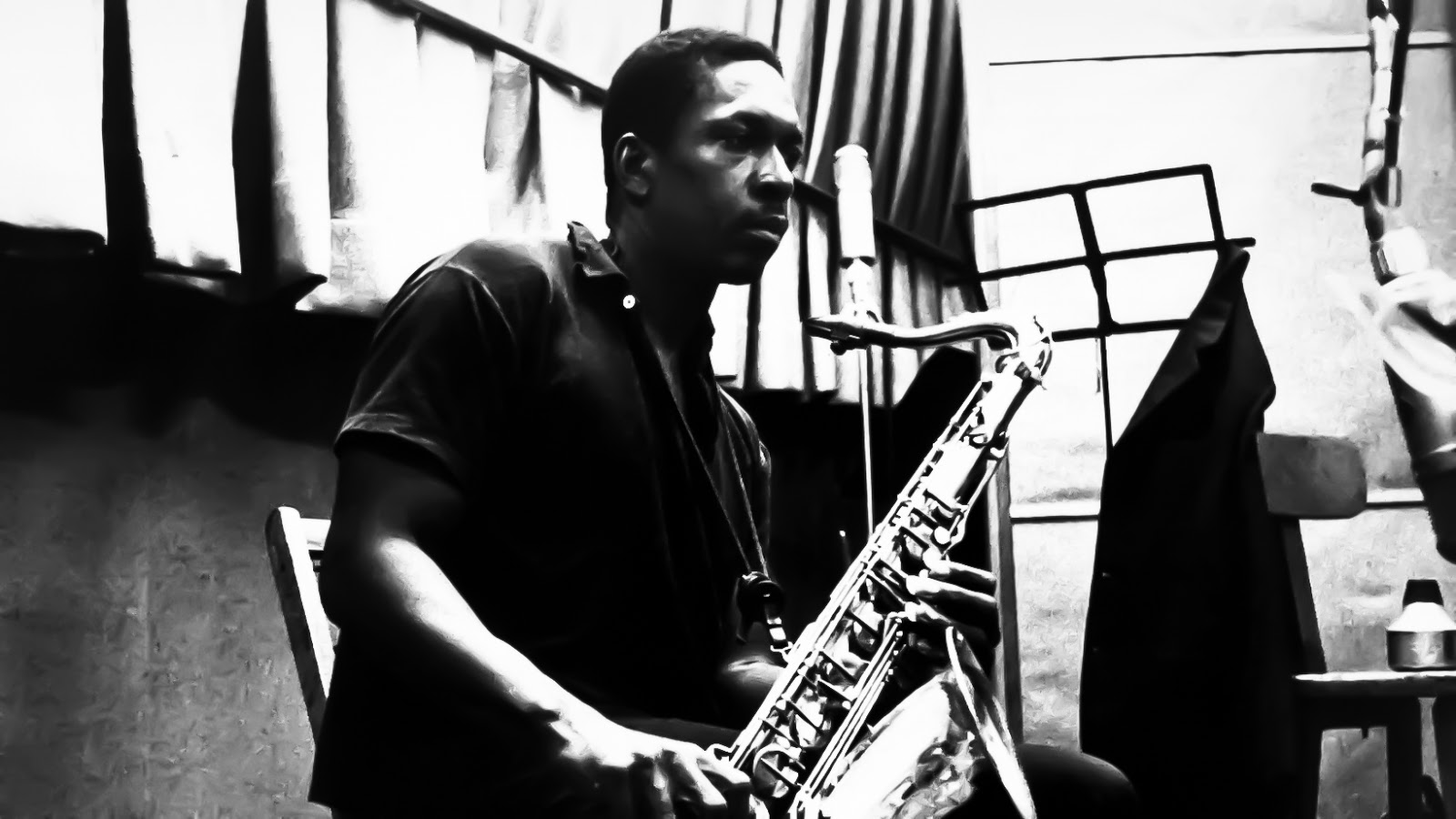
John William Coltrane (September 23, 1926 – July 17, 1967) was an American jazz saxophonist and composer. Working in the bebop and hard bop idioms early in his career, Coltrane helped pioneer the use of modes and was at the forefront of free jazz. He led at least fifty recording sessions and appeared on many albums by other musicians, including trumpeter Miles Davis and pianist Thelonious Monk.
As we flit between existential anxiousness and soulfulness within a chosen sanctuary, the American jazz legend is never too far away.
Something of a film noir-esque opening – like a spy drifting, all suave, into the folds of a foreign city – introduces itself. A shy shimmer of cymbals and the nonchalance of a bass line that’s really too cool to care, follow, before the saxophone erupts in a cocktail of delicacy, nostalgia, and mirth devoid of adulteration. This current existence of solitude, as it turns out, has a soundtrack.
In my hometown of Pune (officially; though I prefer Poona), as I flit between moments of existential anxiousness and a more prevalent mood of soulfulness within a chosen sanctuary, John Coltrane is never too far away. The American jazz hero and his saxophone are accents on most days – peppering a conversation with the quiet murmur of a guest at a party; infusing life into interludes of silence; injecting sharp bursts of drama and expectancy into such life-changing predicaments as “Do we have enough bread?” and yes, serving as the genesis to words, whether written or imagined.
The song usually playing the role of catalyst in all this is Acknowledgement– Part 1 of Coltrane’s delicious manna of faith and deliverance, A Love Supreme. Within the nearly eight minutes of Acknowledgement, life flourishes. It’s tender, it’s forceful; it’s stylish, it’s sober; it captures the meditative spirit of being in the here and now with the ease of a monk who knows the scripts by heart… mostly though, it evokes lands in the topography of its language – the curves of desire in a measured treble; the immensity of the Sahara in a flattened fifth – arousing in me horizons and far-off flavours that are currently mere figments of longing.
Perhaps it’s the song’s all-embracing stillness that weds it to the life anchored. Hell, the title itself is a sort of Buddhist teaching. I accept. I acknowledge. I allow. A Love Supreme and the days ally their cadences. With my writing, whether dancing with poetry or struggling to rescue a piece of fiction from the edges of nowhere, the words flow too in the lingua of jazz riotousness – a stanza framed to perfection; a stanza torn asunder; a character left flailing in the wind for love and other mirages.
If I may be allowed a cheat, it’s Coltrane’s India – performed live at the Village Vanguard, New York
that raises its hand. In the wildness of its textures and in the cacophony of its perfections, it reminds me of how my land was, and perhaps always will be yet.
And that’s what jazz is, so vital to this surreal point in history – an invitation to dream, to believe, a prayer for the rapture that is life.
Perhaps all of this is acknowledgement enough.
Siddharth Dasgupta is a poet and novelist. He is currently finessing two completed books
a novel, anchored to the act of memory; and a collection of poetry.
It’s difficult to imagine whole genres of popular music.
New Wave, techno, industrial, hip-hop—existing without Kraftwerk’s blueprint.
Florian Schneider-Esleben, one half of the German electronic band Kraftwerk, died from complications of cancer, a few days after his seventy-third birthday. Schneider-Esleben was famously enigmatic—obscure in a mischievous and impish way—and he had not performed live with Kraftwerk since 2006. (He left the band in 2008.) Until Sony Music, the band’s label, confirmed Schneider-Esleben’s death on Wednesday morning, many of his fans didn’t know he was sick at all.
There’s something perversely comforting about otherworldly figures departing this astral plane without warning. It feels less like a loss than a kind of reclamation: stardust to stardust. In 1970, an era in which the guitar was still understood as the primary medium for masculine emoting, Schneider-Esleben and his musical partner, Ralf Huetter, founded the Kling Klang Studio, in Düsseldorf, and started Kraftwerk, a musical project that relied on tape finagling, aggressive overdubbing, and the deliberate manipulation of traditional instrumentation via oddball electronic devices. Their first two releases—“Kraftwerk,” from 1970, and “Kraftwerk 2,” from 1972—are gorgeous and bizarre experimental rock records. Already, the band was fusing a kind of primal, proto-punk insouciance with a more measured and cerebral approach to music-making. In many ways, this remains Kraftwerk’s most remarkable achievement: writing songs that somehow sound both careful and totally brazen.
By 1974, when Kraftwerk released its fourth album, “Autobahn,” Schneider-Esleben and Huetter had acquired a small arsenal of analog synthesizers, including the Minimoog, the ARP Odyssey, the EMS Synthi AKS, the Farfisa Professional Piano, and a gaggle of mysterious, bespoke machines that made damp and repetitive drum sounds. I didn’t hear “Autobahn” for the first time until twenty-some years after its release—by then, what Kraftwerk had invented had trickled down, generously informing two decades of popular music. But the album still felt revelatory, if not insane. “Wir fahren, fahren, fahren auf der Autobahn,” Huetter sings in a quiet, almost deadpan voice. “Autobahn” is the first Kraftwerk song to feature lyrics; Huetter’s vocals are processed through an early Vocoder. “We drive, drive, drive on the highway.”
I can’t think of another song that better approximates the soft, giddy feeling of something new suddenly opening up. The song’s first few movements—the album version is almost twenty-three minutes, in total—make me feel as if I have just crested a long hill. Kraftwerk wrote often about motion—the band was interested in ideas of repetition, inertia, speed—which might be part of why its records feel so transporting. To anyone who feels a desire to briefly depart Earth, I say cue up “Autobahn,” close your eyes, and prepare to gently dissociate.
Kraftwerk would release six more albums between 1974 and 2003, including “Trans-Europe Express” and “The Man-Machine,” idiosyncratic masterpieces that continue to resonate broadly and deeply. It’s difficult to imagine whole genres of popular music—New Wave, techno, industrial, hip-hop—existing without Kraftwerk’s blueprint. Once a person starts attempting to untangle the band’s legacy, it becomes hard to know when and where to stop. Kraftwerk’s studio albums have been sampled liberally (by Jay-Z, Afrika Bambaataa, Coldplay), but its influence feels even more diffuse and profound. Artists such as David Bowie, Madonna, Kanye West, Radiohead, Nine Inch Nails, Iggy Pop, Joy Division, Depeche Mode, Daft Punk, Björk, even Ariana Grande—anyone who has plugged in a keyboard, or downloaded a sample, or electronically massaged a bit of sound—owe a considerable debt to the band’s audacious use of synthesizers, and the way it both erased and highlighted the chasm between a computer and a human being.
In 2014, when Kraftwerk received a Lifetime Achievement Award at the Grammys, the Recording Academy described the band’s music as sounding “as mechanized as a Ford assembly plant.” Most of Kraftwerk’s songs relied heavily on drum machines and centered around repetitive, sometimes mesmeric beats. There might be a familiar sound mixed in (some flute, a guitar, violin), but, then again, maybe not. It’s striking, even now, how much of Kraftwerk’s music was unprecedented. Refining some established mode—working carefully to extend a history—is, of course, a lovely and valid way to make art. But there’s something heroic about disregarding history and inventing an entirely new path. It’s hard enough to see uncharted territory, let alone set forth into it—who wouldn’t admire the guts required?
There is a video of Kraftwerk appearing live on television, in October, 1978. The band—a quartet at that point—is dressed in red shirts, black neckties, and charcoal-gray slacks, with white face makeup and dark lipstick. They’re positioned in front of synthesizers, and are standing so perfectly still that, at first, it seems as if they are mannequins. Huetter is the first to move, then Schneider-Esleben. “We are the robots,” they sing, rolling the “R”s. The performance is an extraordinary bit of theatre—funny, weird, transfixing, prescient. It is especially wild to consider it in its proper context—1978 was the apex of disco in America, a year in which the Bee Gees’ “Night Fever” was lodged at No. 1 for eight weeks, and teen-agers everywhere were memorizing the soundtrack to “Grease.” Schneider-Esleben holds what looks like a flute, but he never raises it to his lips. The band returns for a second performance, of “Radio-Activity.” Again, they barely move their bodies. The idea that what makes music powerful is rawness or performing it with humanity—well, that suddenly feels irrelevant. The song fades out as the camera zooms in on some kind of gauge. It takes a moment for a viewer to understand what she has just beheld.