Showing posts with label jazz. Show all posts

28.2.21

Bossa Nova: The History Behind Brazil’s Quiet Revolution


In the early 60s, Brazil initiated a quiet musical revolution by exporting the silky sound of bossa nova to the rest of the world.

1964 was a significant year for pop music. It not only witnessed the meteoric rise of the long-haired, guitar-toting beat groups, led by such pace-setting bands as The Beatles and The Rolling Stones – who started a trend of songwriting self-sufficiency – it also marked the arrival on the world stage of a new kind of jazz-infused music that blended sinuous, caressing melodies with subtle syncopated rhythms. The sound originated in Brazil and was called “bossa nova,” a description that translated into English as “new trend.”

Girl From Ipanema

The song that lit the touch-paper for the bossa nova explosion in the US and the rest of the world was called “The Girl From Ipanema,” sung by Astrud Gilberto in a wispy but beguiling girlish voice, and which reached No.5 in the US pop singles chart in the summer of 1964.

The song transformed Astrud into an international star, even though it wasn’t solely hers – “The Girl From Ipanema” was a collaboration between her then-husband, singer and guitarist João Gilberto, with jazz tenor saxophonist Stan Getz, and it featured on the 1963 Verve album Getz/Gilberto. An amateur singer, Astrud had been drafted in during a moment of last-minute spontaneity to sing opposite her husband, but her presence proved utterly spellbinding. The much shorter single version of the song edited out João’s vocals almost completely, spotlighting, instead, his young wife, who would go on to make records under her own name from 1965 onwards.
After the phenomenal success of “The Girl From Ipanema,” bossa nova fever gripped the US. Many musicians – particularly jazz ones – were attracted by the music’s delicate melodies, lush harmonies, and slinky syncopation, and began recording authentic Brazilian material as well as reconfiguring standard songs using bossa nova-influenced rhythms.

The Birth Of Bossa Nova

Bossa nova’s story really began in 1958, in Brazil. One of its key architects was Antônio Carlos Jobim (1927-1994), a classically-trained Rio De Janeiro-born pianist who also played the guitar, sang, and wrote songs. He had risen to fame in Brazil as the composer of music for a 1956 play, Musicas De Orfeu Da Conceição (which inspired the influential 1959 movie Black Orpheus), and as that decade progressed, he helped to fuse elements of jazz with indigenous Brazilian music to create what became known as the bossa nova sound.

Among the first singers to record Jobim’s bossa nova material were Elizete Cardoso (who recorded an entire album of his songs), Sylvia Telles, and, most significant of all, João Gilberto. Between 1959 and 1961, Jobim worked on Gilberto’s first three albums in Brazil, helping to establish the quiet-voiced singer/guitarist as a new star in his native country.

But Gilberto’s fame soon spread outside of Brazil. By 1961, American musicians visiting the country – among them flutist Herbie Mann and guitarist Charlie Byrd – had played alongside Brazilian musicians and enjoyed a first-hand experience of the burgeoning bossa nova movement. Back in Washington, DC, saxophonist Stan Getz saw Byrd’s band live, heard them play some bossa nova tunes he liked, and requested they record an album together.

Bossa Nova Comes To America

Aided by producer Creed Taylor, Getz and Byrd were recorded in All Souls Unitarian Church, in Washington, DC, and the results were released as Jazz Samba on Verve Records in April 1962. Its success (it spent 70 weeks on the US pop album charts, peaking at No.1) was aided by its high-flying single, a blissful version of Jobim’s “Desafinado,” which made No.15 on the US Hot 100 in November 1962 and later won a Grammy. Jazz Samba not only helped to sow the seeds of North America’s love affair with Brazilian music, it also gave new impetus to Stan Getz’s career. Indeed, the saxophonist would continue to record bossa nova songs on a regular basis right up until his death, in June 1991.

America’s awareness of bossa nova music was heightened by a concert held at Carnegie Hall at around the same time as Jazz Samba’s release, on Wednesday, November 21, 1962. The auditorium was packed to the rafters with almost 3,000 attendees, including many jazz musicians curious to hear the exciting new music up close. They witnessed bossa nova’s prime progenitors – Jobim, Gilberto, Luis Bonfá, Sérgio Mendes, Carlos Lyra, and others – performing with Getz, Byrd, and pianist and soundtrack composer Lalo Schifrin.

The Bossa Nova Explosion

The concert’s critical and commercial success inspired a raft of jazz musicians who were excited by the improvisational possibilities that bossa nova presented. Dizzy Gillespie, Quincy Jones, Wes Montgomery, Cannonball Adderley, Jimmy Smith, and Oscar Peterson are just some of the big names that embraced the seductive sound of Brazilian music in the 60s. Even some of the most famous pop groups of that era were inspired by the hip sound that had first emanated from Rio’s beach cafes; groups such as The Beatles (“And I Love Her”), The Kinks (“No Return”), and The Beach Boys (“Busy Doin’ Nothin’”) brought a bossa nova flavor to some of their songs, while a plethora of big-name singers covered Brazilian material. Two vocal giants, Frank Sinatra and Ella Fitzgerald, devoted whole albums to Antonio Carlos Jobim’s songbook.

The Importance Of Antonio Carlos Jobim

Both Sinatra and Fitzgerald recognized that Jobim was a musical giant whose stature as a songwriter rivaled the North American greats that they so admired, like George Gershwin and Cole Porter. Indeed, Jobim was responsible for writing so many of bossa nova’s key songs, including “The Girl From Ipanema,” “Desafinado,” “One Note Samba,” “Photograph,” “Insensatez” (AKA “How Insensitive”), “Corcovado,” and “Meditation.”

The composer also enjoyed a long and distinguished recording career, and his success helped other Brazilian musicians find an international audience with their music – among them pianist Sérgio Mendes (who scored substantial US hits with his group Brasil ’66 in the late 60s), organist Walter Wanderley, guitarist Luis Bonfá, singer-songwriter Gilberto Gil, and chanteuse Elis Regina, who recorded a duets album with Jobim in 1974.

The Enduring Appeal Of Bossa Nova

Summing up the appeal of bossa nova music, Sérgio Mendes told this writer in 2019: “I think it’s very sensual, it’s very romantic, and you can also dance to it. Those three components make it very, very beautiful. And it has great melodies – melodies that you can remember.”

Indeed, it does. With its hushed intimacy, poetic lyrics, alluring melodies, and mesmerizing rhythms, bossa nova music continues to cast a spell 60 years after it first came into the world. It possesses an ineffable quality that just seems to epitomize coolness, transcend time, and transport the listener to another place.

Carlos Alves de Sousa

26.2.21

50 Years Ago: Miles Davis Fuses Jazz and Rock on 'Jack Johnson'


Jack Johnson, released on Feb. 24, 1971, might be the closest Miles Davis ever came to putting out a rock album. But to leave it there is to understate the magnificent accomplishment and importance of the record, which shows Davis at his most titanic, most relentless and most focused on establishing a foundational American music.

The genesis of the project - which was later retitled A Tribute to Jack Johnson - is deceptively simple: In 1970, Davis was asked by boxing manager and impresario Bill Cayton if he wanted to score a documentary about boxer Jack Johnson.

A kind of sorcerer in his own right, Johnson was more than the first African American to hold the world heavyweight boxing title, which he did from 1908-15; he was also, like Davis, a larger-than-life cultural icon and rebel. His exploits were legendary, perhaps none more so than his bout with recently retired ex-champion James J. Jeffries in the so-called "fight of the century" in 1910.

Jeffries was at that point undefeated and came out of retirement in his own words "for the sole purpose of proving that a white man is better than a Negro."

More than 20,000 people, mostly white, showed up to watch the fight, which was staged in an outdoor ring specially built for the purpose in Reno. Johnson didn't just beat Jeffries; he dominated him so thoroughly that Jeffries noted, remarkably, afterward: "I could never have whipped Johnson at my best. I couldn't have hit him. No, I couldn't have reached him in 1,000 years."

From there, Johnson continued onward, becoming perhaps the most famous Black person on the planet. He refused to take marching orders from anyone and enjoyed a lavish lifestyle with his boxing earnings. He loved jazz, fast cars, good food and beautiful women, and no one was going to tell him to be quiet about these things. This refusal to kowtow to the conventions of a racist society proved so frustrating that eventually the powers that be conspired to take him down. He was convicted by an all-white jury on trumped-up charges under the Mann Act (often used as a tool against African Americans) in 1913. After going into exile for seven years in Europe and South America, Johnson eventually returned to America in 1920 to serve a one-year sentence, after which he continued to live large until his death in 1946.

This was the kind of man Davis could get behind. And what kind of recording session would befit a legend of Johnson's magnitude? A sprawling, almost mythical one, in which Davis continued his own artistic journey and created a fitting tribute to the famed boxer. In 1969, Davis told Rolling Stone that he could create "the greatest rock 'n' roll band you ever heard." With Jack Johnson, he was going to prove it.

Davis' journey to that point is as legendary as Johnson's. After dropping out of Julliard, he had gotten his start playing in Charlie Parker's pioneering bebop quintet in the late '40s. By the '50s, he had a heroin addiction (which he overcame), was living large himself and had also begun to compile his own staggering catalog. He released more than 20 albums during that decade for the smaller Prestige, Blue Note and Debut record labels.


At the same time, in the late '50s and into the '60s, he began recording for Columbia, producing classic albums like 'Round About Midnight, Kind of Blue and Sketches of Spain that cemented his reputation as one of the greatest musicians in American history. Throughout it all he remained a restless innovator, never content to stay still. He moved through bebop, hard bop, cool jazz and even more experimental modes. Eventually he became fascinated by the possibilities of electric music, particularly jazz and funk. He jammed with Jimi Hendrix and was particularly impressed by a Jan. 1, 1971, performance by Hendrix and the Band of Gypsys at the Fillmore East.

Six weeks after that show, in February 1971, Davis was in the 30th Street Studio in New York City, recording what would become Jack Johnson. To call the sessions sprawling is an understatement. They ran on and off through early June. The lineup of musicians who sat in was astounding: Steve Grossman and Wayne Shorter on sax. Chick Corea, Herbie Hancock and Keith Jarrett on electric piano and organ. Sonny Sharrock and John McLaughlin on guitar. Ron Carter and Michael Henderson on bass. Billy Cobham and Lenny White on drums. And more.

The recording technique was pure Davis: sorcery, experimentation and an assault on all musical boundaries. Musicians wandered in and out. If you were in the building for another reason and Davis wanted you, he ushered you into whatever jam session happened to be taking place.

The genesis of one of the songs on the album, "Right Off," provides a great example. "The first time I met Billy Cobham was in the studio," remembered McLaughlin. "Miles was busy in the control room with [producer] Teo Macero, and ... I started a jam in E, just for fun. Billy joined in, then Michael Henderson started playing bass and we took off! Within a minute, Miles ran in with his horn and went on to play in a way I’d never heard before." The liner notes to the extended, five-CD The Complete Jack Johnson Sessions continues the story: "By chance, Herbie Hancock had arrived unexpectedly and started playing on a cheap keyboard."

The result of all this is an album comprised of two heavyweight tracks. "Right Off" runs 26:53, "Yesternow" clocks in at 25:34. Both were compiled by Macero out of several different studio sessions, as well as some unaccompanied solo work done by Davis the previous fall.

"Right Off" opens with a hard-driving groove that wouldn't be out of place on a Sly & the Family Stone or George Clinton record. Cobham's drum work is driving, while McLaughlin's guitar is snaky, violent magic. Davis comes in, playing almost against this at first, as if he's the jazz guy who can corral these rock 'n' rollers. And then, slowly, he builds into a series of long wailing riffs, matching McLaughlin's rock energy. As he does, the song takes on a life of its own. It passes into a mournful center section in which Davis reaches back to a sound akin to Kind of Blue's – as if he's trying to stitch together rock, jazz and his own musical history in a single song – before moving into a serious funk groove and then finding again its original hard funk drive, featuring some of the nastiest work of McLaughlin's career.

"Yesternow" opens contemplatively, with Davis playing in a direct but searching way, making one wonder if he's trying to work through the implication of the life of his subject and the song's title - that the "yesterday" and the "now" may not be so far apart. This almost mournful tone builds slowly but steadily, with Sharrock laying down thin, chord-based slabs on the guitar and drummer Jack DeJohnette keeping things aligned but still spacey. The song then slowly modulates into an overlaid series of musings, getting funky at moments and balladic at others, with clarinetist Bennie Maupin zigging and zagging in and out, and Corea laying down slender flagstones on the electric piano for the others to stand on.

And always, over all of this, is Davis, leading the others, cajoling them, pushing them forward with his relentless energy and innovation. He proves, among other things, that when he wanted to, he could absolutely put together a great rock 'n' roll band.

Jack Johnson represents a high-water mark for Davis, a perfect representation of the way he refused to drown from his own musical ability. This is summed up by an audio clip of actor Brock Peters portraying Johnson, which closes out "Yesternow": "I'm Jack Johnson, heavyweight champion of the world. I'm black. They never let me forget it. I'm black all right – I'll never let them forget it." It's an idea that might well stand for Davis, too.

Carlos Alves de Sousa

7.1.21

Luis Martelo, of Taunton, wins bronze at Global Music Awards

The trumpeter Luís Martelo, based in Taunton, has been awarded Bronze in the Global Music Awards which is the equivalent to the Grammys for independent musicians.


Trumpet player Luis Martelo has scooped a top accolade at a major international awards ceremony. Luís Martelo has this week won a bronze medal at the Global Music Awards in the United States, equivalent to the Grammys for independent musicians.

Luís was nominated for his solo show Chorando Saudade in two categories in the worldwide contest - best Latin jazz soloist and best instrumentalist, receiving bronze in the latter.

He has carved out a successful career in Portugal, where he was a band player in the army, and in bands and orchestras in the United Kingdom.

He has recorded for several well-known artists in studio sessions and a number of soundtracks for Hollywood films such as Uber Time.

He has performed internationally as a soloist, was nominated for the best theatre musician 2020 by the Cinderella Awards and has been invited to play and teach in masterclasses and international festivals including the VGBRASS festival in Croatia in June this year.

About Martelo

Award-nominated Trumpeter Luís Martelo studied trumpet at the Conservatoire of Music in Coimbra, The Trinity College of Music - London, and at the University of Évora (Classical Music) with the Teacher Pedro Monteiro.

A former Army trumpet player in Portugal, Martelo has played in the Symphonic Army Band and The Military Band of Évora.

Nominated for the Best Theatre Musicians 2019/2020 by the Cinderella Awards, Martelo has played in bands and orchestras all around Portugal, from north to south; from big bands to classical orchestras and concert bands; as principal Trumpet, soloist and guest artist, including:
Banda Filármonica Lyra Barcoucense
Banda de Mourão
Banda de S.João da Madeira
Banda de Portel
Banda de Nsa Sra de Machede
Big Band da Vidigueira
Banda dos Bombeiros Voluntários de Alvito
The Magic Jazz Band (Co-founder)
Banda da Pampilhosa do Botão
Orquestra clássica da Universidade de Évora
and many more.

Alongside his busy performance schedule, Martelo has completed a number of masterclasses and courses, such as:
The 1st and 2nd Brass Masterclass in Taveiro (Portugal)
The 1st Chamber Music course in Fermentelos (Portugal)
The Advanced Wind Band Masterclass of John Packer in Taunton
The Advanced Wind Band Masterclass 2019 and 2020 in Wellington

And in 2019, completed a year-long Online Course with the Brazilian Trumpeter and international Soloist Flávio Gabriel.

During his extensive musical education & career, Martelo has also been taught by a multitude of illustrious brass musicians, notably: Fernando Vidal (Trumpet, Ex Portuguese Army principal trumpeter and conductor), Pedro Monteiro (Trumpet, Gulbenkian Orchestra and Portuguese Symphony Orchestra, Hot Club Portugal-Big Band), Sergei Nakariakov (One of the best trumpet players ever, Russia/Israel), Lechner (Trumpet, international Soloist), Louis Dowdeswel (Yamaha Artist, Lead Player), and Paulo Viveiro (Latin Grammy Winner 2 times, international trumpet soloist, Seu Jorge trumpeter, Brazil).

Now based in England, Martelo is the Principal/Soloist Trumpet of the Taunton Concert Band, Lead Trumpet of the Deane Big Band, Lead trumpet of the Bertie's Big Band, Solo Trumpet of the Postmodern Jukebox UK, Trumpet and Founder of "Lady and the Tramps" and one of the most sought after freelance trumpeters for studio sessions.

Martelo has recorded for many Band’s tracks and albums, and made horn section arrangements.

Recently, he has recorded with Postmodern Jukebox UK, recorded the new single from the band Nederveen called Father, and the new single from the Irish Singer Marie Therese, from Dublin.

Alongside these achievements, Martelo has also recorded for many other projects and live virtual shows as a guest as the Gignify.tv Classical music virtual Festival 2020 and was invited by Philip Schartz, the principal Trumpet of the BBC National Orchestra of Wales, to join the orchestra as a freelance from now on!

Whilst in England, Martelo has already played Lead Trumpet with Groove-a-Licious (funk/soul band), 1st trumpet/soloist with the Wednesday Classical Orchestra,Lead trumpet/soloist with the Tone Big Band, 1st Trumpet with the Somerset County Orchestra, Trumpet with the Big Noise Street Band, freelance with The Motown Gold Band from Earcandy (Award-winning Band), the Regal Theatre pit orchestra, has played two times live at the BBC Radio, played as a guest the Rite of Spring from Stravinsky with the Brunel Symphony orchestra, and The Golden Coast Big Band from North Devon

Notably, Martelo was declared the winner of the PTrumpet HyTech, offered by Warwick Music UK - 2019.

Finally, Martelo teaches Trumpet and works in his music studio where he produces, composes and records. Recently Luis brought to the market his first trumpet method and is finishing his new Trumpet album called "Latin Soul" with the British producer Martin Selwood.

Carlos Alves de Sousa

12.6.20

Sonny Rollins on the Pandemic, Protests, and Music

“The main thing is do unto others as you would have them do unto you,” the saxophonist Sonny Rollins says. 
“Sure, everybody knows it, but nobody lives by it.”


The legendary saxophonist, approaching ninety, discusses civil rights, jazz, and creative change.

The gains and revolutions, both political and musical, of the past sixty years can be measured in many ways, but few methods are more insightful than tracing the path of Sonny Rollins, a tenor saxophonist whose life is a portrait, which is to say a reimagining, of American freedom. When Rollins was twenty-seven, in 1958, he released “Freedom Suite,” one of the first recordings in postwar jazz to acutely protest racial injustice and demand civil rights. The liner notes, written by Rollins, are no less resonant today: “America is deeply rooted in Negro culture: its colloquialisms; its humor; its music. How ironic that the Negro, who more than any other people can claim America’s culture as his own, is being persecuted and repressed, that the Negro, who has exemplified the humanities in his very existence, is being rewarded with inhumanity.”

For Rollins, who is eighty-nine, the pandemic, the protests, and the President are familiar features of an ongoing civil-rights movement which Rollins bore early witness to. Much has changed, and much has not. “I don’t think things will change in this country,” Rollins told me last week, by phone, from his home, in Woodstock, New York, two days after George Floyd’s death and five days before National Guard units deployed tear gas on protesters outside the White House, clearing the way for the President to lift a Bible, fix a wooden smile, and pose for the cameras.

The occasion of my call with Rollins was not the death of Floyd. It was not the compounding crises of police violence and militarized assaults on constitutionally protected assembly. But these themes are scarcely separable from our conversation’s original focus: Rollins’s music and memory; the wish to hear if he’s O.K.—if he’s safe and settled, spared of a virus that has claimed his compatriots Henry Grimes, Ellis Marsalis, and Lee Konitz—and firmly aware that he is not just admired and loved but heard. This interview has been edited and condensed.

How are you doing? I want to hear what life is like for you right now, especially during this pandemic.

This is O.K. for me because I am trying to live in a different world, besides the world of the illness. I’m trying to live in a world of the spirit wherein I am concentrating on things such as the golden rule. This is my big thing; I am trying to live by it. The main thing is do unto others as you would have them do unto you. Sure, everybody knows it, but nobody lives by it. We live in a world where it’s about “I’ve gotta get mine, and—too bad for you—I’ve gotta get mine first.”

Six years ago or so, you were diagnosed with respiratory issues. You told Hilton Als at the time that it limits your breathing and you get fatigued. How are you now?

My breathing seems to be O.K. My main problem is that I can’t blow my horn anymore. I’m surviving, but my problem is I can’t blow my horn.

How does it feel not to be able to blow your horn?

[Laughs] Well, that’s where living in the spirit world comes in. It felt pretty bad. I had a rough time getting through it, because I like blowing my horn. When I had to stop, it was quite a traumatic deal for me.

Do you see this pandemic bringing into focus certain meanings in life? Do you sense changes with all the distancing?

For one thing, I’m ninety years old in a few months, so that’s no big deal, living. I’m not trying to live. I’ve lived all this time, way beyond any of my compatriots. The universe doesn’t owe me anything as far as the length of my life is concerned.

I lived through 9/11. I was right in my apartment six blocks from the World Trade Center when I heard a plane come in—pow. And then another plane hits. We all came downstairs. I had to be evacuated the next day. So, by that, no, I don’t think this pandemic means anything.

Look, people will turn around and do the same thing. If everything is straightened out next week, people are gonna live the same way they’re living now. They’re not going to give a fuck about the golden rule or anything else besides what’s comfortable for them.

That’s all people do. I don’t expect this pandemic to mean anything. People will go back to the way they are—most people. There might be a few who might try to get the bigger picture of what this pandemic might mean, but I thought that was going to happen at 9/11, and, indeed, it did, for about three months. Everybody was nice to each other, kind to each other. For three months. And then it came back down: “Me first.”

That brings to mind your album “Without a Song: The 9/11 Concert.” You’ve shown real strength and contributions to the world in response to crisis and trauma. What lessons might you have for younger musicians, such as Akwetey John Orraca-Tetteh, who are processing trauma and trying to stay focussed on their music?

It’s not about your music—it’s about what makes your music your music. You’ve got to have a feeling like that. You have to have a reason for your music. Have something besides the technical. Make it for something. Make it for kindness, make it for peace, whatever it is. You know what I mean?

I do. You’re very clearly describing it, and you’ve said that art outlives technology and the political moment, that art survives the material life of our bodies.

Exactly.

Can we talk Presidents? Starting with Lester Young. I say “President” because everyone calls him Pres. Do you think we should write Lester Young in as President this November? Do you think he’d make a better fit than the current occupant of the Oval Office?

[Laughs] Well, I don’t really know the present occupant personally, but I knew Lester Young personally, and I would go with Lester Young. His music speaks for itself, and he’s a human being whose personality, whose humanity, made his music what it was. A great musician, but also a great person.

One of the first records you got was Lester Young’s “Sometimes I’m Happy.” On the subject of happiness, what gives you happiness?

I’ve been blessed to do music all my life. I didn’t get where I wanted, but I was always trying to get there. I had a career, people knew me, liked me, so I can’t be sad about it, but it’s still one of these things that I have to really keep on top of.

You mention self-criticism in almost every interview. I’d like to ask what your relationship to self-criticism is today, but also to self-acceptance, self-praise, self-compassion. How do they relate?

I focus much more on the negative side. I understand that people appreciate me, and I’m so happy about that, but, as for myself? No. I could have done more. If I had my druthers, I would have started playing earlier, done what my mother wanted me to do, which was play piano, instead of playing stickball on the streets of New York.

If you hadn’t played stickball, you wouldn’t have seen W. E. B. Du Bois walking the neighborhood, like you’ve said. You wouldn’t have joined the parades for him or Paul Robeson, or rallied outside for the Scottsboro Boys in exactly the same way. Would you really take back stickball?

[Laughs]

If you put it that way, it’s a pretty hard choice. My grandmother was the one who was an activist in my family. I was a little boy and marching with her down Lenox Avenue, in Harlem, for W. E. B. Du Bois and Paul Robeson and the Scottsboro Boys, having an idea of civil rights. I wouldn’t want to not have that. I’m very proud that I was able to get that feeling, to be educated and understand how important that was.

How do you see movements for civil rights, racial justice, and social change today? Have you been hearing about or watching the protests in response to police violence and the death of George Floyd?

I’ve been following it. I hear people saying it’s different because there’s a great many more white people involved than in other demonstrations, and it’s not only black people protesting. As many white people protesting as there were black people. This would be a first for me. I’ve seen a million protests all my life. If this can happen in my lifetime, it’ll be great. It’s very encouraging.

Black people have been marginalized forever in the United States. It’s part of our history as a nation, so I don’t know how to exist without, in some way, making people realize, Hey, black people have been marginalized and brought here as slaves. They actually built America, by having all this “free” labor. Black people built America as slaves. Everybody realizes that, I think.

Was it change or not change when President Obama gave you the National Medal of Arts, in 2011? Do you see awards like this carrying special meaning or progress?

It meant something to me personally. It gave me some vindication about all the times I was marching down Lenox Avenue with my grandmother, talking about freeing the Scottsboro Boys, who were convicted of raping a white woman in the South. The award gave me vindication. I felt O.K. by getting that, but that’s for myself. You know what I mean?

I do, and I want to tell you that Anthony Davis just won a 2020 Pulitzer Prize for his operatic tale of racial injustice and the march for progress, called “The Central Park Five,” which has historical echoes to the Scottsboro Boys.

Exactly.

Anthony’s cousin is the great Thulani Davis, the pioneering librettist and interdisciplinary artist who has done important work. Powerful voices continue to be heard. Can you tell me about some innovators who are women who have shaped your musical style, spirit, or thinking?

I have to go back to Billie Holiday. Billie Holiday was such a seminal figure in my life. Everything about her. What a courageous woman she was.

You recorded a version of Billie Holiday’s “God Bless the Child,” in 1962.

It’s a great song. I just hope I did it a little justice, because it’s such a great inspiration.

As we talk about women who’ve inspired you, I want to ask about contributors to our public understanding of jazz, and if any of these names prompt a memory: Val Wilmer, Angela Davis, Sherrie Tucker, Sally Placksin, Michelle Mercer, Ingrid Monson.

Oh, yeah, I’m very familiar with Angela Davis. She was persecuted and jailed. She used to do yoga just to keep herself together.

You’ve also studied yoga at ashrams in India, which Alice Coltrane had done when she was living in Los Angeles. It’s been ten or fifteen years since Alice passed, and you and I talked for an article about her then. You said, “I’m sure Alice would look at this, passing on, as a transition to another realm.” Do you still see it that way?

Absolutely. People who have an Eastern view of life, we don’t think of this life being “I lived and died, and it’s all over.” People come to me and say, “Sonny, what’s Heaven like?” I tell ’em, “Look, man, don’t ask me stupid things like that.” Live your life right now, and try to understand it’s bigger than what’s in front of you.

You named your 1998 album “Global Warming,” and music crowds listened but climate crowds didn’t. I wish more people listened. You had the great drummer Idris Muhammad, who also recorded with Pharoah Sanders.

Idris was a very accomplished musician and human being. I heard Pharoah play, and I enjoyed it very much, at Ornette’s funeral, at the Riverside Church. Pharoah played something solo. It really touched me.

The future of jazz is concerning in this pandemic. It’s a music of collaboration and improvisation on bandstands and backstage, not isolated at home. The Jazz Foundation of America is doing heroic work with fund-raisers, but how can the music move forward?

Jazz has got to retain its integrity, its spirituality. It’s got to mean something. That’s No. 1. There are a lot of great players thinking that way in the music. It’s all good. I don’t think we should lament the fact that, Oh, we can’t play in the club anymore. That’s passing. We’ll be able to, as musicians, play serious jazz. I think that will prevail. I can’t prophesize, but I have a strong intuitive feeling that it will be stronger than ever and have another shot at trying to turn this world around.


Learn more about the musician here

Daniel King

4.6.20

The Art of Solitude: In these surreal times, John Coltrane’s jazz is an invitation to believe

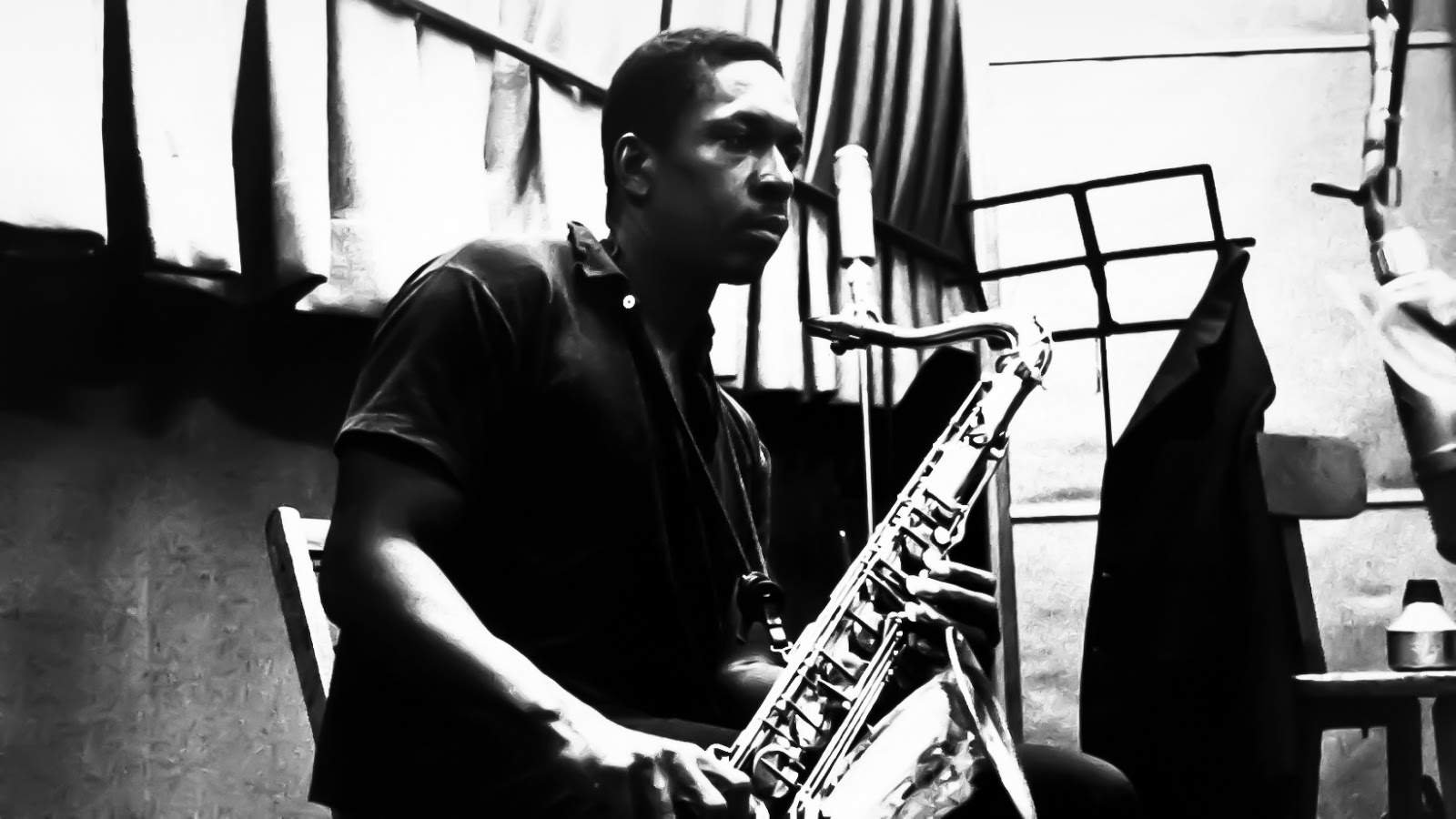
John William Coltrane (September 23, 1926 – July 17, 1967) was an American jazz saxophonist and composer. Working in the bebop and hard bop idioms early in his career, Coltrane helped pioneer the use of modes and was at the forefront of free jazz. He led at least fifty recording sessions and appeared on many albums by other musicians, including trumpeter Miles Davis and pianist Thelonious Monk.

As we flit between existential anxiousness and soulfulness within a chosen sanctuary, the American jazz legend is never too far away.

Something of a film noir-esque opening – like a spy drifting, all suave, into the folds of a foreign city – introduces itself. A shy shimmer of cymbals and the nonchalance of a bass line that’s really too cool to care, follow, before the saxophone erupts in a cocktail of delicacy, nostalgia, and mirth devoid of adulteration. This current existence of solitude, as it turns out, has a soundtrack.

In my hometown of Pune (officially; though I prefer Poona), as I flit between moments of existential anxiousness and a more prevalent mood of soulfulness within a chosen sanctuary, John Coltrane is never too far away. The American jazz hero and his saxophone are accents on most days – peppering a conversation with the quiet murmur of a guest at a party; infusing life into interludes of silence; injecting sharp bursts of drama and expectancy into such life-changing predicaments as “Do we have enough bread?” and yes, serving as the genesis to words, whether written or imagined.

The song usually playing the role of catalyst in all this is Acknowledgement– Part 1 of Coltrane’s delicious manna of faith and deliverance, A Love Supreme. Within the nearly eight minutes of Acknowledgement, life flourishes. It’s tender, it’s forceful; it’s stylish, it’s sober; it captures the meditative spirit of being in the here and now with the ease of a monk who knows the scripts by heart… mostly though, it evokes lands in the topography of its language – the curves of desire in a measured treble; the immensity of the Sahara in a flattened fifth – arousing in me horizons and far-off flavours that are currently mere figments of longing.

Perhaps it’s the song’s all-embracing stillness that weds it to the life anchored. Hell, the title itself is a sort of Buddhist teaching. I accept. I acknowledge. I allow. A Love Supreme and the days ally their cadences. With my writing, whether dancing with poetry or struggling to rescue a piece of fiction from the edges of nowhere, the words flow too in the lingua of jazz riotousness – a stanza framed to perfection; a stanza torn asunder; a character left flailing in the wind for love and other mirages.

If I may be allowed a cheat, it’s Coltrane’s India – performed live at the Village Vanguard, New York 
that raises its hand. In the wildness of its textures and in the cacophony of its perfections, it reminds me of how my land was, and perhaps always will be yet.

And that’s what jazz is, so vital to this surreal point in history – an invitation to dream, to believe, a prayer for the rapture that is life.

Perhaps all of this is acknowledgement enough.

Siddharth Dasgupta is a poet and novelist. He is currently finessing two completed books 
a novel, anchored to the act of memory; and a collection of poetry.