Pablo Ruiz y Picasso has been the most talked-of and written-about artist on earth. Commercially he has become the costliest painter alive and aesthetically he has remained the most influential. His pictures, like hand-painted gilt-edged stocks, have followed a rising graph of their own; he has influenced a generation of painters who copied what they understood of him and he has influenced a public which has bought him without always understanding any part of him. When he first came to Paris, as a Spanish youth of nineteen, he dressed as a laboring man because of poverty and a preference for the picturesque. Even in recent years, when seen sitting prosperous and unoccupied in a Left Bank café, he has retained a look of sombre isolation and of a man devoted to work. Miss Gertrude Stein’s friend, Miss Alice B. Toklas, says a friend of hers said Picasso looks like a handsome bootblack.
He is a Spanish bourgeois. He was born in Málaga, October 25, 1881. His mother’s people were silversmiths, originally from Genoa; his father, of Basque origin, became drawing teacher at the estimable Barcelona Academy of Fine Arts, which, had it known what the son was in future to paint, would not have thought it fine or art. Young Pablo’s connection with his father’s institution was that of a passing prodigy who at the age of fifteen completed in one day the competitive art examination which older students were given a month for. A few months later he was received at the Madrid Academy for a year; then, three years later, in 1900, he went to Paris, centre of European art.
Impressionism, the great nineteenth century iconoclastic art movement, which the public had greeted with jeers, was then on its highly respectable way out. Cubism, the twentieth century’s new revolutionary art formula, which the public was also to hoot at, was almost on its way in, though Picasso, who was to lead Cubism, didn’t know it yet. He was still busy painting like the Impressionist Toulouse-Lautrec. Picasso finally settled in Montmartre at 13 Rue Ravignan in a ramshackle edifice resembling a Seine laundry boat and nicknamed Le Bateau-Lavoir. Those were heroic Montmartre days, since a handful of imaginative, important artists were, in poverty, hatching their fabulous future. Though he was unsociable, Picasso’s talent eventually placed him with the other talented unknowns with whom he belonged—with the minor poet Max Jacob, first to discover and make a cult of Picasso; the major poet (then editor of a physical-culture magazine) Guillaume Apollinaire, first to write of Picasso; the struggling painters Derain, Braque, Matisse, Modigliani, Juan Gris, Van Dongen, and Marie Laurencin. Other friends were Frédé, art-loving innkeeper of the uproarious Lapin Agile, who used to bring his pet donkey to parties; innocent Douanier Rousseau, about to marry for the third time; and Picasso’s model, the beautiful Fernande Olivier. Everybody was, or acted, young; everybody borrowed money from everybody else, and owed money for paint and rent; everybody quarrelled, made love, drank, ate risotto because it was cheap, and worked like a steam engine. Picasso carried a revolver, kept a tame white mouse in a table drawer, couldn’t afford even the luxury of painting on his walls—as he had when a student in Spain—pictures of the furniture he lacked. When he didn’t have white paint for his pictures, he painted with blue; when he ran out of new canvas, over the portrait of a crippled flower-seller he painted the big red harlequin that later figured in the Rouart collection; when he lacked linseed oil, he painted with lamp oil. He always kept on hand a supply of lamp oil because he worked at night so people couldn’t bother him.
At one time he was so poor that he and Max Jacob occupied the same bed in turns. Jacob, who besides being a cultivated poet was an impoverished novelty-shop clerk, slept at night while Picasso worked; when Jacob got up in the morning to let Picasso go to bed, the floor would be carpeted with drawings, which Jacob had to walk on and from which his footprints later had to be cleaned by art experts, since every early Picasso fragment eventually became so valuable that it could be sold. These first few Paris years in Picasso’s young twenties were viewed as a period of art, partially happy and entirely human, and were thus rare for him. At this time he painted his sad groups of the blue-colored Blue Period (after pleasant trips home to Spain) and his precious, romantic, rosy-tinted Rose Period figures (after a journey to Holland, which he found gloomy and didn’t like). This was also the feverishly fecund Harlequin Period, during which he painted the tumblers, harlequins, and jugglers whom he admired at the Médrano Circus; when he sympathetically painted the beautiful thin skulls of the poor, topped by gay clowns’ hats; when he portrayed the spangled acrobat, his wife, and male child, posed like a new Holy Family in lovely disguise. This was Picasso’s only art period of sentimental and sociological sensibility, and he probably didn’t mean it to be either. He was simply a young painter who was painting.
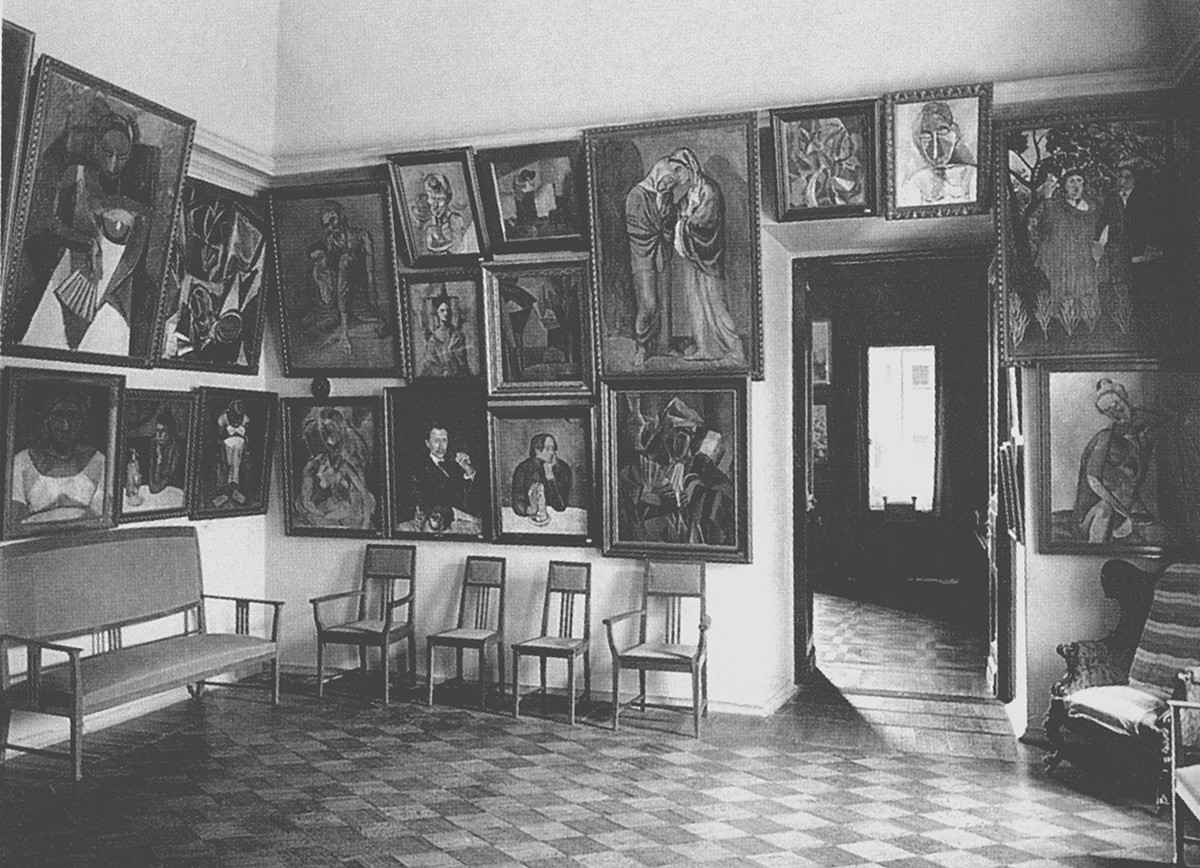
The first picture Picasso ever sold was bought the day after he arrived in Paris in 1900 by a Mademoiselle Berthe Weill, who ran a bric-a-brac shop and bought anybody’s first picture at any time. The next year, Vollard, the great eccentric art merchant, gave Picasso an obscure little exhibition called “Scènes des Courses et des Cabarets” and bought some pictures which, as was his habit, he hid in his cellar, where they brought Picasso no renown. Soulié, a mattress dealer on the Rue des Martyrs, also bought Picassos, apparently for a horse dealer with leanings toward art speculation. The art merchant Sagot, who kept his pictures in an old pharmacy and gave artists handouts of stale medicines, also purchased Picassos—at cruelly low prices. Once, when Picasso refused 700 francs (then $140) for three big paintings, Sagot offered 500 francs and, to Picasso’s helpless, hungry fury, got them the day after for 300. Picasso was then alone in his spirited resistance to the art merchants’ racket. As a chorus girl traditionally hopes for a butter-and-egg man, so in France the poor, unknown artist must hope to be kept by an art merchant, to whom he cedes a long term contract for his future at a low price. Even when a beginner, Picasso refused to do this, as he also refused to manifest group solidarity and show his pictures at the Salon des Indépendants. In purchasing Picasso as a discovery, Russian, German, and American collectors were ahead of the French, who had also been slow in taking to Impressionism. The first collector to buy Picasso was Shchukin, the rich Russian industrialist whose Picassos now hang in the Soviet Museum of Modern Western Art in Moscow. The expatriate German collector-merchant Kahnweiler was another early buyer.
However, just before this time, Gertrude Stein, rich in enthusiasm but modest in means and then about as unknown as a writer as Picasso was as a painter, began her famous and eclectic Picasso collection and her friendship with him, which, through squabbles and over years, have been two of the most important personal elements in the Picasso legend. For her first Picasso, she and her brother Leo paid Sagot 150 francs and all three quarrelled about the picture’s merits. It was the early, exquisite, conventional nude, “A Little Girl with Basket of Flowers.” Miss Stein, who was already ripe to prefer stranger sights in art, thought the girl looked classically flat-footed; Sagot suggested they guillotine the girl and keep only the head. After Miss Stein became friends with Picasso she bought directly from him; she says that from 1906 to 1909 the Stein family controlled the Picasso output, since no one else wanted it. By 1919 she could no longer offer to buy at 100 francs pictures that were worth thousands, so Picasso gave them to her. In 1906, she posed eighty times for his portrait of her, after which he wiped the face off, saying he couldn’t “see” her any more, and then finished the likeness in Spain, where he couldn’t see her at all. He also gave her this portrait because, as he later said, at that time in his career the difference between a gift and a sale was, after all, negligible. He also said, when friends complained that the portrait didn’t look like her, that someday she’d look like the portrait. This has never happened, and became less likely than ever to happen when she cut her hair, which upset Picasso more than any of her other friends because his portrait showed her with her hair long. The 1906 Stein portrait was a boundary mark; it showed that the gay, romantic period was definitely at an end, that the intellectual, serious search for Cubism was now on.
Why Cubism had to be invented still puzzles a large public. At the time, the poet Apollinaire, in his famous essay on the subject, said that Cubism was “a search for a new composition with formal elements borrowed not from the reality of vision but from the reality of conception”—words which bewildered Parisians no less than the paintings themselves. More bluntly defined, Cubism was apparently an effort scientifically to give painting not two but three dimensions, these to be attained, in theory anyhow, by depicting the subject—whether an apple or a man—as if it or he consisted of visible geometric facets. Thus, in practice, the Cubist portrait of a handsome man looked like a still life of beautiful building blocks. Cubism also was probably an early prophetic Zeitgeist reflection of the non-naturalistic machine-age civilization. In any case, Cubism marked the point in modern art where the artist and public no longer saw eye to eye no matter what both were looking at; when the artist, indeed, began deliberately painting what he did not see and what no one else could check up on.
Who, from what source, at what date, and with what picture, invented Cubism, which Picasso at any rate was to dominate, is still a delicate dispute. The first authentic example of Cubism, modern museum men say, was done in 1907 by Picasso—his big painting “Les Demoiselles d’Avignon.” Miss Stein says Picasso’s three 1908 pictures of some cubelike cottages in Spain were “the real beginning of Cubism.” She also says that some African Negro masks (whose exotic angularity also reportedly aided in formulating Cubism) were perhaps shown by the sculptor Maillol to the painter Matisse, who then showed them to the painter Picasso, though there was also the tradition that Picasso first saw the masks through the painter Derain. She says still further that probably the name “Cubism” was invented by Apollinaire. Jean Cocteau says Cubism was a name invented by Matisse to deride a south-of-France picture by Braque in the 1908 Indépendants show; Apollinaire says that the Negro sculpture “which was destined to influence new French art” was discovered by Vlaminck and that the friendship between Picasso and Derain in 1905 “gave birth to Cubism, which at first was, above all, a sort of impressionism of the forms which Cézanne had envisioned toward the end of his life.” Picasso himself simply and plurally says, “When we made Cubism we didn’t mean to make Cubism but to express what was in us.” Although the French public at first said only that Cubism was crazy, a leading art merchant added, “I am now buying Picasso not because I have any taste for him but because he will be worth a lot of money someday.” By 1910, Cubism was a regular French studio school, with Jean Metzinger as its first academic theorician and Gleizes, Delaunay, and Léger as faithful exponents. Picasso’s precise early version of Cubism was so much copied that he called one of his best impersonators “the louse that lives on my head.” One night, at the beginning of the World War, Picasso and Miss Stein were taking a walk when they saw a camouflaged truck for the first time. He was amazed by its resemblance to Cubist art, and, in the tone of a man who has just been plagiarized, said, “Why, it is we who invented that!” Later, when a new field uniform for the French army was being discussed, he told Cocteau, “If they want to make an army invisible at a distance, all they have to do is dress the men as harlequins.”
After the war, when the alien Kahnweiler’s scholarly Cubist collection, which had been seized by the French government, was sold for low prices by an anti-Cubist auctioneer (whose head Braque punched, to teach him about modern art), Cubist paintings, like any commodity in a bear market, slumped. Now the New York Museum of Modern Art’s recent Cubist acquisition, “Les Demoiselles d’Avignon,” has just been valued by art experts at $20,000, the highest figure any contemporary canvas, even by Picasso, has reached. When, years ago, the collector Shchukin first saw the picture, he wailed that its ugliness marked the end of modern French art. Many people still think the historic young ladies from Avignon are a frightening lot.
By 1912, for those painters who had struggled in Paris to create the new art, the big moment had passed, because prosperity was creeping up on them. Poverty had united Picasso and his comrades; success separated them. He moved from Montmartre to the nicer Left Bank, and they, too, went their more comfortable ways.
From 1896 down through 1939 (according to experts, when they can agree), Picasso’s pictures fall into about twenty-six styles, most of them such typical Picassos that they look as if they had been painted by twenty-six different men. No other painter of his stature has ever offered so many completely differentiated versions of himself as Picasso. For forty years he has been in a constant fit of metamorphosis. Starting in his youth as the most gifted graphic artist of his time—i.e., the one most able to delineate likenesses of things or people in the grand manner—he has spent his years detailing unlikenesses in an increasingly varied and cerebral manner. He has also, his classicist enemies maintain, debauched the aesthetic tradition of Europe by the power of his painting personality and has made ugliness the style. When a painter fails to settle down into one matured mood, critics usually figure he hasn’t found himself. Picasso is deemed to have found himself two dozen times over and, among his special public, has made much of his reputation precisely on his restless, drastic mutations—which he silently invents in his own seasons and which only his devotees garrulously explain throughout the years. Assuming that Picasso (or anyhow part of Picasso) will be considered a master two hundred years from now, collectors and experts in the twenty-second century will have a hard time identifying a Picasso as easily as they identify, for instance, a Titian today, except for the fact that Picasso usually carefully and legibly signs his pictures with his name, often adding the year in roman numbers, plus the month and day on which the picture was completed. However, modern French experts say that all Picasso’s styles, no matter how different, and whether autographed or not, have one recognizable entity, a thing they call le signe, meaning the graphic “line” peculiar to him which they count as a signature in itself.
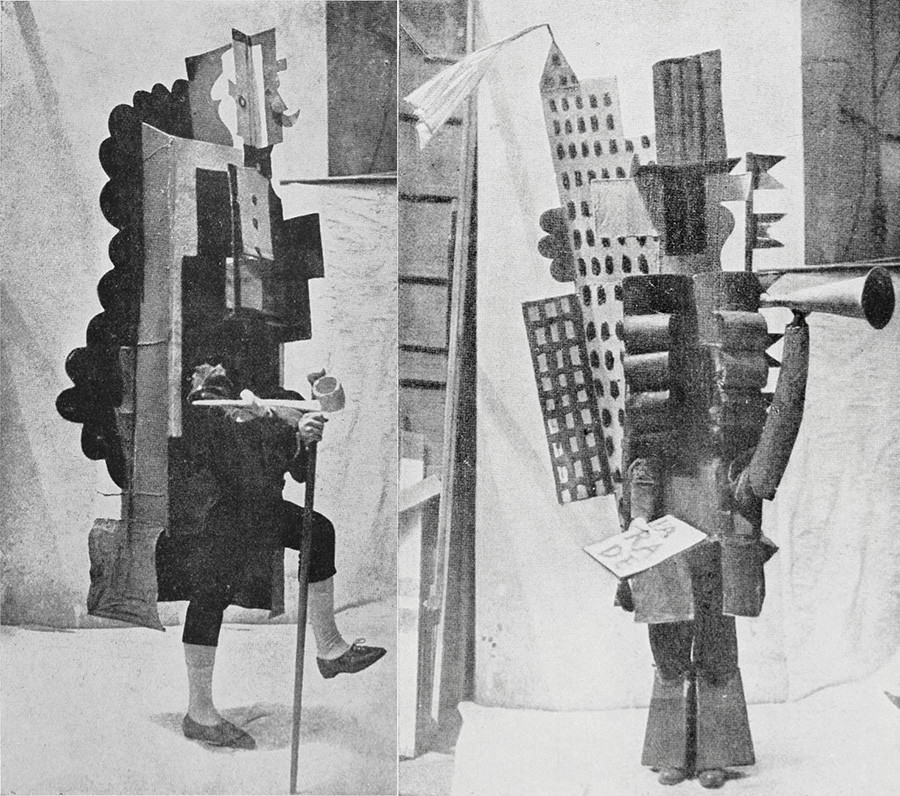
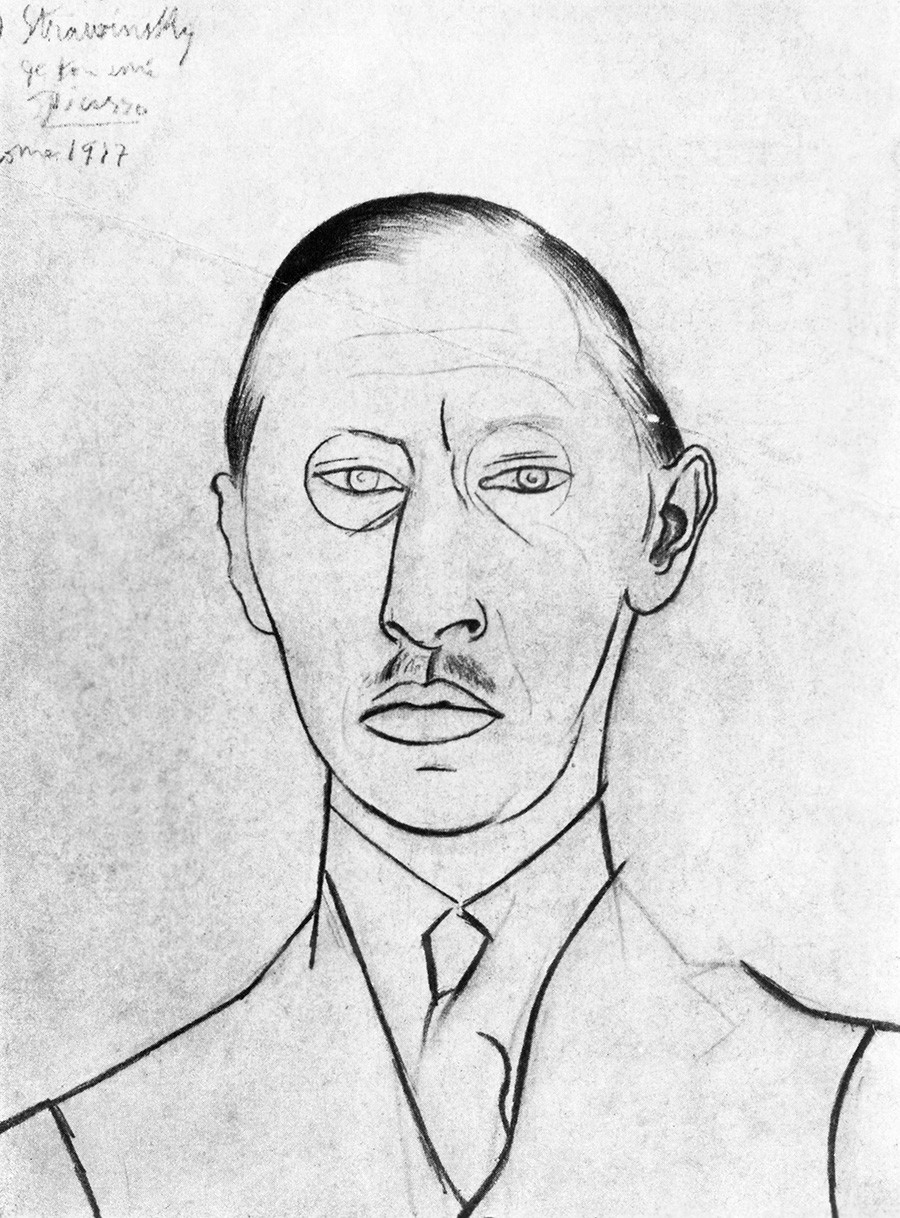
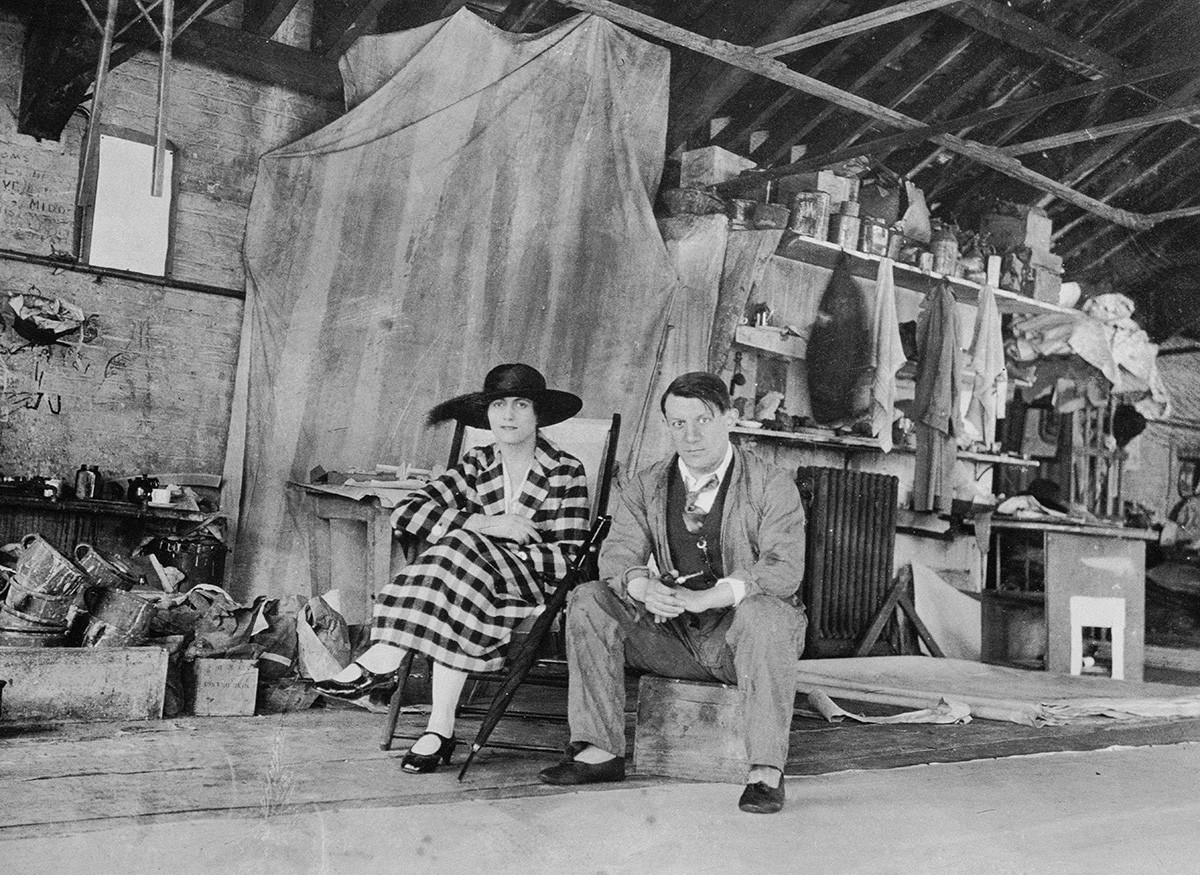
To the public, out of his twenty odd periods the most intelligible and appreciated are the melancholy Blue (1901-04); the picturesque Harlequins, Clowns, and Saltimbanques (1905); the sentimental Rose (1905-06); the Analytical Cubism, especially because of the fine, fertile, popular compositions featuring bits of guitars and newspapers (1909-12); and the Classic Figures (first part of the 1918-25 style). The faces and eyes of three women also date and differentiate some of his works. The almond-eyed French Fernande Olivier is visible through the romantic Rose Period. The second feminine, straight-eyed face is that of the Russian ballet dancer Olga Koklova, whom Picasso married in the Paris Russian Church in 1917. Through her, the Spaniard in Picasso was temporarily exotically influenced by the new popularity of anything Slavic; Picasso was the first of the big painters to shock aesthetes by descending to the task of making some of Diaghilev’s Russian Ballet stage sets—for “Parade,” “Tricorne,” “Pulcinella”—and the cruel, truncated décors for the ballet “Cuadro Flamenco.” The enlarging domestic influence of Madame Picasso marked the early 1920 period of gigantic female nudes, sometimes also attributed to the influence of Greek sculptures or just to big French women bathing on the Juan-les-Pins beach. A typical and tender 1923 line-edged classic portrait of Picasso’s wife eventually won the Carnegie Institute art prize in 1930. In 1927, when some experts consider Picasso terminated his many experiments with Cubism, he painted a final Cubist portrait of his son, Pavlo, dressed as a harlequin. Picasso’s marriage was ended by divorce in 1937. Since then the profile of Dora Maar—a profile usually painted with two handsome sloe eyes and both handsome nostrils visible—as marked Picasso’s recent deliberately deformed and decorative curvilinear portrait work. Dora Maar is a Yugoslav of good family who shortened her name from Markovitch and is now a well-known professional photographer in Paris.
A complete list of Picasso’s various artistic activities and periods is a lengthy affair, since it also comprises periods classified as Negro, realist, abstract, monochrome, planes, papier collé, pointillism, neo-Impressionism; a period of neo-Renoirism called “Homage to Renoir” (at which old Renoir took umbrage), classicism, heroicism, an adult or second Roseism, imitations of his own Cubism, rectilinear forms, sumptuous still lifes, portraits in which people look like still lifes of machinery, surrealism, sculpture, fantasies molded from wire, tin, or pressed paper, the so-called unheimlich or unpleasant manner, enormous natures mortes, and sleeping women. In 1933 he had a period known as the Relâche Period because during it he did not paint at all. Then came bullfights, extraordinary legendary man-animal figures, and finally the Spanish war and his much-discussed mural of the bombed city of Guernica.
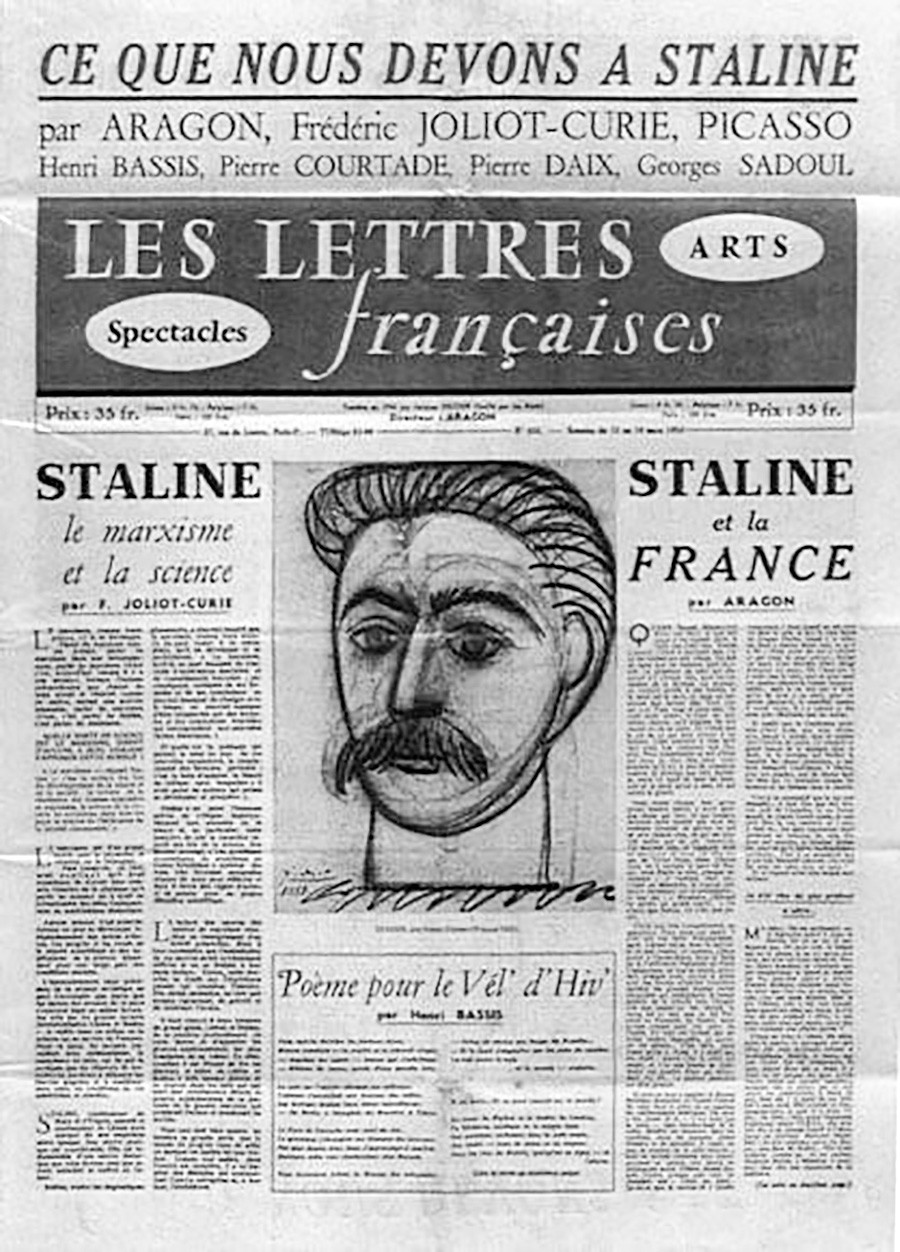
The Spanish war profoundly affected Picasso, theretofore politically indifferent. His patriotism, previously visible principally in the nostalgic Spanish shadows of his Blue Period, became passionately republican. He refused to shake Italians by the hand because they were bombing his land; his broadsheet, “Songes et Mensonges de Franco,” he sold in postcard format for charity; he gave “Guernica” for propaganda to the Spanish Pavilion in the Paris Exposition; in optimism, he gave big sums to the Spanish government to buy planes; and finally, in defeat, he gave money to the Spanish refugees in the French border camps. The Spanish war furnished a terrible, trite human tableau which distracted Picasso for the first time from a preoccupation with his own visions. Since the Spanish war ended, the only show of Picasso’s paintings in Paris (at the Galerie Rosenberg, his official merchant since the first World War) displayed nearly nothing but peaceful, pretty flowers.
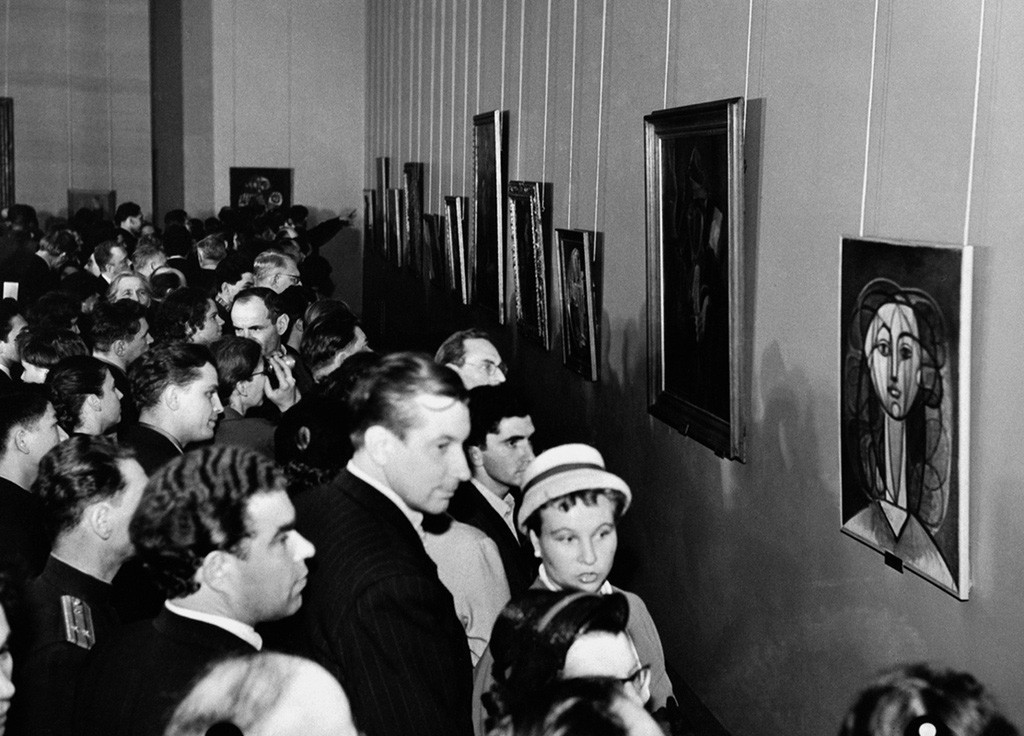
The first major retrospective show of his works ever held in Europe took place in Paris in the spring of 1932 at the Galerie Georges Petit. It was followed by an even larger show in the autumn at Zurich. “Picasso, Forty Years of his Art,” the current retrospective at the Museum of Modern Art here, is the biggest Picasso exposition yet assembled, covers work from 1899 through 1939, and includes three hundred and sixty items, of which one hundred and fifty are canvases. About twenty drawings and originals of book illustrations from private European collections failed to arrive at the last minute owing to the difficulties of shipping since the war. Two of the Gobelin tapestries, as well as a rug Picasso designed, are also shown. He has interested himself in modern crafts, thinks an artist should apply himself to anything stimulating that turns up, has made patterns for linoleums and tile mosaics, and at one time experimented with painting pictures in furniture paint.
According to correct Spanish usage, Picasso should (and occasionally did in his early days) sign his pictures Pablo Ruiz, which is his real name; his father’s name was Ruiz, his mother’s was the Picasso. In the Spanish formula which combines both parents’ names for the child—i.e., Pablo Ruiz y Picasso—the mother’s name is written last. It was her name that Pablo Picasso chose to be known by.
Being an iconoclast, Picasso believes painters should paint in comfort and that French studios are either too hot in summer or too cold in winter. He paints at his ease in a pair of bourgeois Paris apartments at 23 Rue La Boëtie. He and some selected paintings live in the downstairs flat, his palettes and other canvases live upstairs. Though he no longer paints exclusively at night, he is a restless man, always working at or fiddling with something, and his output is tremendous. There are thousands of Picasso canvases now in collections, private hands, or commercial circulation in Europe and America. He also owns stacks of his work which he has never offered to sell; when war broke out in September he stored some of his most valuable canvases in steel safe-deposit closets in a bank. Because he hates sweeping or having things moved, the dust in his atelier is epic, as is the confusion caused by drawings on chairs, sculpture in the corners, paint tubes on the floor, and an assortment of the pretty rubbish painters, like little girls, pick up—lengths of frayed, colored velvet, odd old boxes, stray pieces of once fine furniture from earlier periods.
Because he can never make up his mind what to do with his belongings, Picasso has gradually accumulated five different dwelling places. These he has taken on not as a well-organized man expanding into new forms of life but as somebody irresolute who has hired havens. He has a small weekend house at Le Tremblay; a country property, Boisgeloup, near the medieval Norman town of Gisors; for summer painting he recently acquired his friend Man Ray’s modern penthouse at Antibes. Picasso’s newest Paris dwelling—if he can ever decide to move in—will be on the Rue des Grands-Augustins, where several years ago he rented two floors in the magnificent seventeenth-century mansion which was formerly the town house of the Ducs de Savoie. The place is said to be a noble architectural curiosity, with broken floor levels, nests of small rooms, and sudden great salons. In anticipation of eventual residence, the painter long since installed modern necessities and what he calls his Maginot Line—a grille which cuts across the staircase leading to his front door and would prevent visitors from reaching his doorbell. Friends say he hates hearing his doorbell ring but hates it more when it doesn’t ring at all. Wherever he lives, he lives simply, eats out a lot in small restaurants, and, in the modern intelligentsia French style, as a rule not only entertains his friends but even sometimes writes poetry not at home but in a corner café. His poetry is in the association-surrealist manner.
Picasso’s domestic entourage consists principally of a chauffeur named Marcel and a factotum named Sabartés, who is a friend of long standing and a compatriot. Picasso clings to his well-worn Spanish connections, and has painted portraits of Sabartés, who, in turn, has written articles about the painter. Among those close to Picasso, his despotism, indecisions, hermetically sealed character, and energetic talents arouse a curious loyalty. The painter’s chauffeur can, in a pinch, give the dates of his master’s canvases. Today Picasso’s car, incidentally, has the look of a second-hand elderly Hispano of the kind that seats seven bolt upright, but when he bought it brand-new, at great cost, it seemed like a chariot for Picasso’s brief experiment with luxury.
As a man, Picasso is complicated and more confusing to others than he is to himself. He says that if one took the tendency one likes least in oneself and strengthened it, one would probably have one’s true character. He is indecisive and dominant; he makes promises because people seem to like promises, but he never keeps them. By procrastination he lets circumstances overtake him and solve him along with themselves. Because he is a Spaniard, he takes cruelty for granted, either in art or life. Since he is short, physical strength fascinates him. He greatly admires boxers. He himself has boxed, on two isolated occasions, with Derain and Braque, both big men and amateurs of the sport. He’s fond of animals, has owned kittens, a St. Bernard, a Mexican hairless, and an Afghan hound. His pets are run on the principle that they must look after themselves. He suffers from cold, used to wear a coat that hung to his heels, likes only the hot Spanish climate, and formerly complained that the chillier French landscape smelled of mushrooms. He is not a concertgoer; when young he said he knew nothing of music and didn’t understand it. He is kind to young painters, visits their expositions, hears their questions out, and gives no advice. He would rather be praised by them than by the art critics.
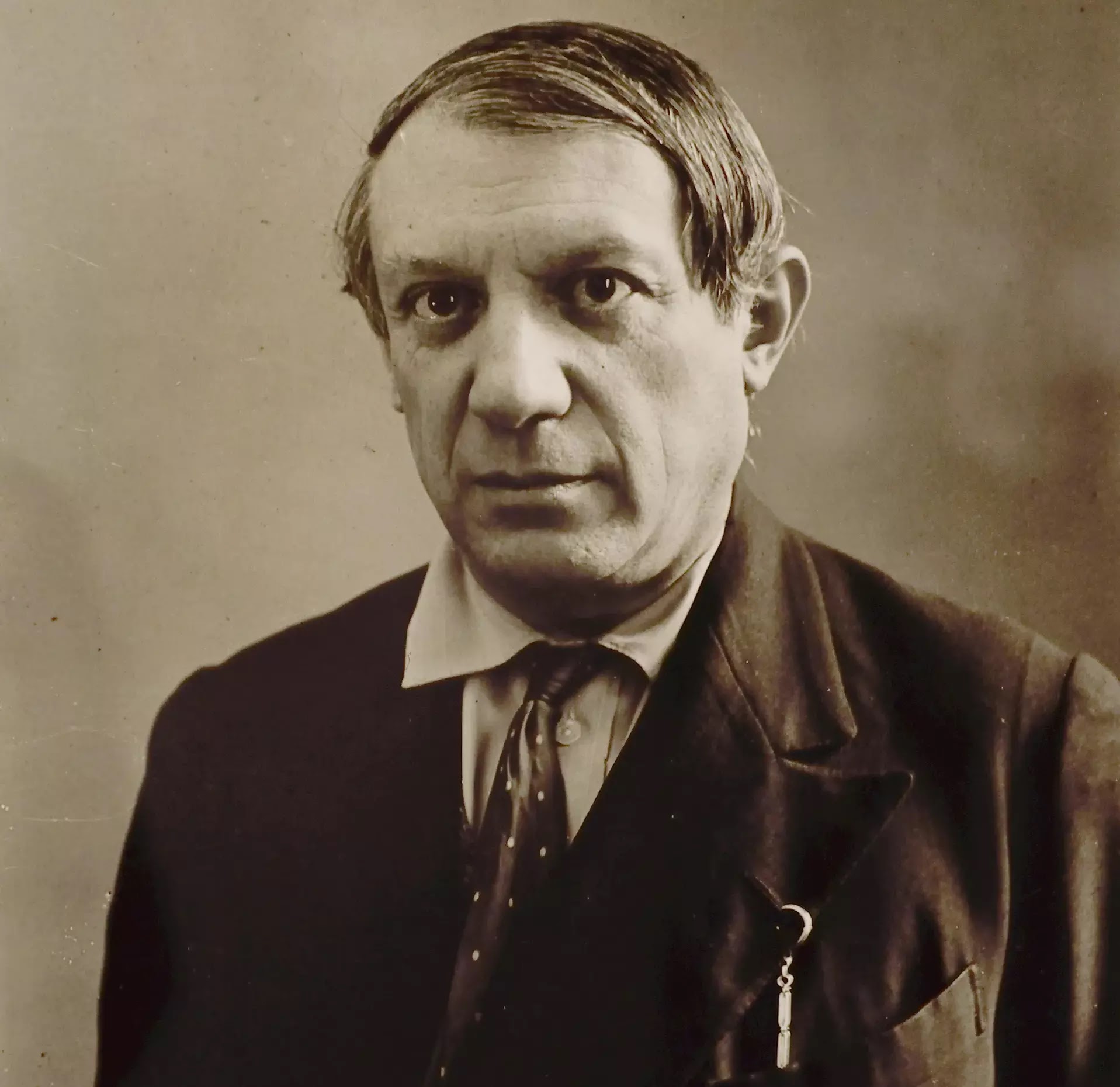
In speech he is discursive except on big topics; then he eagerly treats himself and the listener as if they were two problems entitled to a solution. Miss Toklas says his conversation is flabbergasting and that he is invariably willing to be proud, even at a sacrifice. Racially and constitutionally, he is a tragic-minded man, sad, sarcastic, with malice in speech taking the place of wit. His most-quoted phrases are usually too libellous to print. When he quarrels with friends, the reconciliations have to be arranged in the complicated Latin manner. He is a hypochondriac who has a little kidney trouble. He has small, handsome hands and feet which please him, and a rebellious, pendent lock of hair which, as the French say, cuts his forehead like a scar. His eyes are remarkable; he has a wild little right eye like a Spanish bull’s and a kinder, larger, and more human left eye. When he enters a room his brown glance seems to register everything in it in a sudden inclusive flash, like a photographer’s lens taking a group photograph. Once, when he was looking at some Rembrandt etchings, the owner said it was as if Picasso’s stare would pull the lines off the paper, the way the sun’s heat dries up the pattern of moisture on an old leaf.
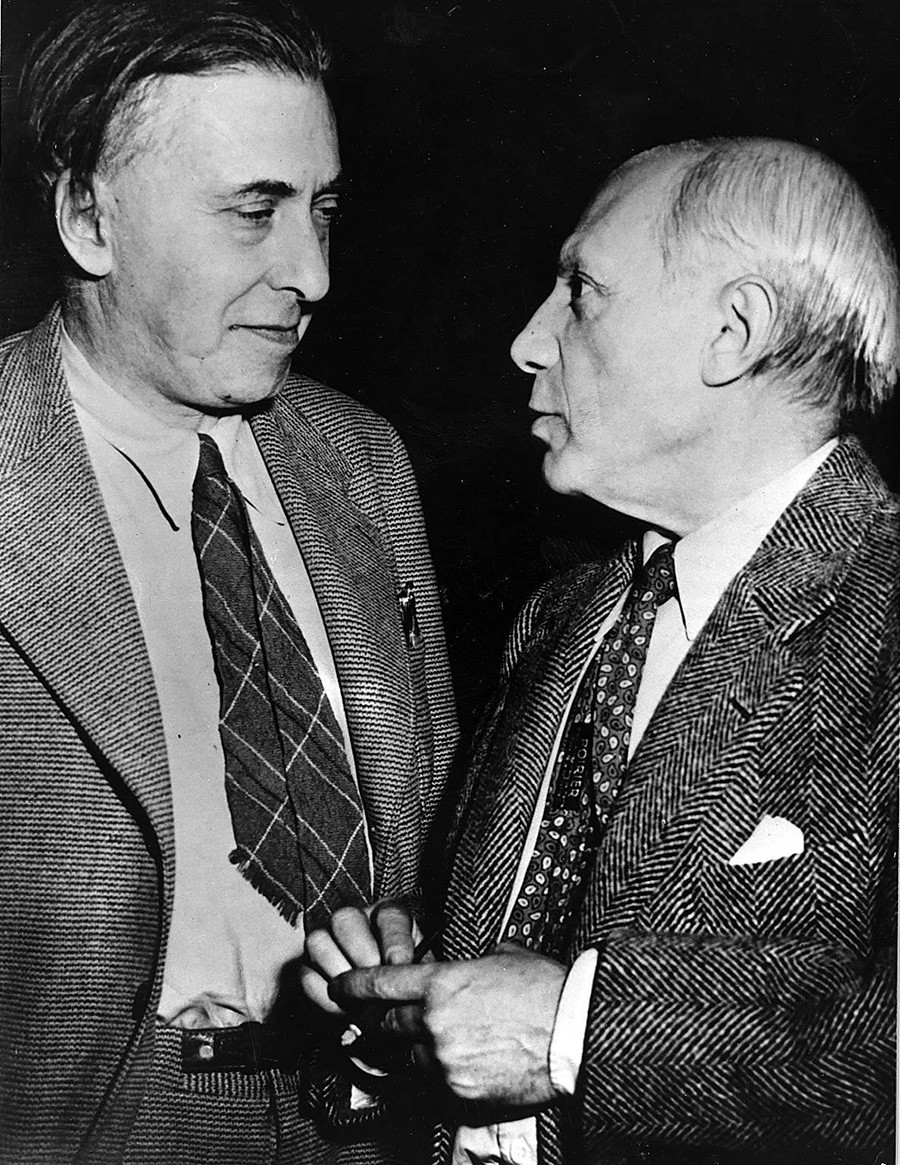
There was a period in the nineteen twenties when, whirled along by the fashionableness of the postwar Russian Ballet, Picasso frequented that mixed artistic, monied, demi-aristocratic, semi-mondain Paris circle called le beau monde, where he was a welcome figure, since personalities were the rage. In the last two years, Picasso has been principally seen in public at the St. Germain-des-Prés café tables of the Flore. The small group most often seen with him include serene Paul Eluard, the surrealist poet; Madame Apollinaire, and the Cahiers d’Art editorial group, who are the painter’s art publishers. Even in a crowded café there is a feeling of dominance, abundance, and experience concentrated in the dark presence of Picasso. In his absence, what he may be doing or has done is a source of apparently stimulating speculation to his devotees. Is he painting or is he only drawing today? Did he wear his new gay tie yesterday? What did he say last week and who wrote it down—for his group first, and for posterity second? For many admirers, and with his multiple professional achievements as warrant, Picasso emanates the aura of genius in which they like to reside, though all they get out of it is proximity.
He is generous to his poor friends; he offers them gifts in kind rather than money, perhaps out of respect for Iberian standards of friendship, perhaps out of respect for cold cash. He gives hams, wine, invitations to dinner, and, above all, he gives his valuable drawings, which the friends can sell when they are in distress. Though he once refused to sign a series of new etchings because he wasn’t satisfied with it, for a poor friend with a once-signed old etching which dealers declared was a forgery, Picasso re-signed “Picasso, Picasso, Picasso” all over the margin. Because he asks—and gets—the highest prices, his enemies say he is money-mad. What he says about this is, like everything he says, full of common sense. “I am anti-commercial,” he says, meaning that he is against the merchant-inflated art market, “but I am interested in money because I know what I want to do with it.” When he sells a new picture these days the price is usually around $5,000. If its period becomes popular, the chances are that its value will increase, although not indefinitely, at the rate of a hundred per cent a decade. A good Picasso of the Harlequin or Rose Period, for instance, now brings about $15,000. Since Picasso himself says that he has painted in his lifetime about four thousand pictures, an efficiency expert could compute that he turns out an average of two pictures a week.
He says a painting has an integral life of its own when it is being worked on; thus he was not surprised when he started painting a portrait of the poet Jean Cocteau and it turned into a picture of some girls rolling hoops. “I act with paintings the way I act with things,” he says. “I make a window the way I look through a window. If the open window isn’t any good in my picture, I paint a curtain and close the window the way I would in a room.” He also says, abstrusely, that before he came along painting had been the sum of additions but his painting is the sum of destructions. When an intrepid American lady asked him what his painting was supposed to mean, he answered, “Madame, on ne parle pas au pilote.” Usually all he will say is that a painting means whatever the person looking at it sees for himself. Picasso can, if he chooses, still draw perfectly in the academic manner. When somebody said he drew better than Raphael, he said that might be all very well but what he would prefer to hear was that he had a right to draw as he pleased even if it was the opposite of Raphael. He has a detached attitude about the future of his work. Of a painting of his which he considered bad but which he had sold, he said calmly, “Time will sort all those things out. . . . A picture lives by its legend, not by anything else.” One of the strangest pictures in the Picasso legend is one belonging to the Spanish painter Zuloaga; it is a Picasso painted in his teens. It is of a pretty Harrison Fisher type of girl with pink cheeks and a stylish hat.
Picasso is his own type of genius. “Work,” he says sombrely, “is a necessity for man. Man invented the alarm clock.”
Janet Flanner
.jpg)