Showing posts with label #lomography. Show all posts

20.9.25

SHARED LIGHTS – 35 Years of United Photo Press


SHARED LIGHTS – 35 Years of United Photo Press
International Photography Exhibition
6–31 October – Estúdio de Criação Artística, Largo do Corpo Santo, Funchal, Madeira Island

United Photo Press (UPP) commemorates 35 years of creative excellence with the international photography exhibition “Shared Lights”. Following its debut at the Museu de Eletricidade in Funchal, the exhibition embarks on the next stage of its itinerant journey, taking residence at the Atelier of the Estúdio de Criação Artística, under the auspices of the Department of Culture of the Funchal City Council, from 6 to 31 October.

Featuring a curated selection of iconic and previously unseen works by photographers from around the globe, Shared Lights celebrates the collaborative ethos and visual diversity that have been hallmarks of UPP since its inception in 1990. Light—the fundamental element of photography—is explored here as a metaphor for knowledge, memory, and shared experience, illuminating connections across generations and continents.

The exhibition’s mobility amplifies its cultural reach, forging a closer bond between the art of photography and the Madeiran community, as well as international visitors. Entry is complimentary, offering audiences an immersive and enriching artistic encounter.

In conjunction with the exhibition, UPP will unveil its commemorative 35-year anniversary book, presenting a dialogue between historical and contemporary images. Moreover, in partnership with the Madeiran Association Arca d’Ajuda, the exhibition will feature the submissions and award-winning works from the VI Photographic Marathon.

This initiative is proudly supported by the Funchal City Council, the Parish of São Martinho, the Museu de Eletricidade do Funchal, and the Madeiran Association Arca d’Ajuda, underscoring UPP’s enduring commitment to both the local community and the global dissemination of photographic art.


About United Photo Press
Founded in 1990, United Photo Press is an international association uniting photographers, journalists, artists, and content creators, with a recognized presence across multiple continents. Over three and a half decades, UPP has championed exhibitions, publications, and artistic projects worldwide—from New York to Japan, from Russia to Madeira—establishing itself as a benchmark of creativity, technical rigor, and innovation in contemporary photography.

Press Contact
United Photo Press
Communications & External Relations Office
info@unitedphotopress.net

31.7.25

Flying in 1939: A Low‑Altitude, High‑Risk Adventure


Did you know that in 1939, air travel was less about convenience and more about courage?

Imagine boarding a sleek Douglas DC‑3 or perhaps a Boeing 307 Stratoliner—then among the very few aircraft approaching true comfort. Most planes still flew below 13,000 ft, in unpressurized cabins where the roar of piston engines was deafening—engine noise alone reached nearly 120 dB during takeoff, akin to a rock concert.
Cabin insulation was minimal, so passengers often wore coats and gloves, feeling the chill of altitude despite onboard heating efforts. Air‑sickness was common; discreet bowls rested under seats, and stewards even offered chewing gum to ease ear‐pressure during climbs and descents.
Weather turbulence could cause sudden drops—hundreds of feet with little warning—and without seat‑belts or cabin safety standards by modern criteria, flying required nerves of steel.
Yet for those brave—or rich enough—air travel held undeniable allure. Flights were significantly faster than boats or trains, especially for long distances or remote regions, where rough terrain and unreliable ground transport ruled.
Airlines strove to impress with luxury touches: plush upholstered seats, swivels, reclining berths on overnight journeys, even onboard lounges for the elites.
Stewards, often male early on and later pioneering female flight attendants, delivered meals—cold fried chicken, elegantly composed sandwiches—on fine dishware, helping allay passengers’ anxieties.
Despite that, aviation was still evolving. The Boeing 307 Stratoliner, which took its first flight in mid‑1939 with a “supercharged cabin” pressurization system, marked the dawn of high‑altitude travel—allowing flights above much of the turbulent weather, but it would be years before such technology became common.
In short: flying in 1939 was a raw but thrilling experience—bumpy, noisy, chilly, and potentially dangerous. Still, it paved the way for the modern age of aviation, transforming flight from daring novelty into the global mobility we know today.
Nevertheless, courage and curiosity drove people into the skies, and these bold flights laid the groundwork for the safer, smoother air travel we take for granted today.


Gary Parrs

14.7.25

Shared Lights: 35 Years of United Photo Press

Founded in 1990, United Photo Press was born from the desire to bring together diverse perspectives on the world—capturing life, culture, and the hidden stories in the most unexpected corners of everyday life. Thirty-five years later, in 2025, we celebrate a journey defined by a wealth of visions and by the creation of a truly international community of photographers—both amateur and professional—united by the commitment to tell stories with light.

This path—shaped by encounters, images, and creative persistence—inspired the title of our commemorative project: “Shared Lights.” An expression that symbolizes the collaborative spirit and the ongoing exchange of visual perspectives that define United Photo Press’s DNA. Here, every photograph is more than a record—it is an act of sharing, a spark cast into the shared space of memory and imagination.

To mark this milestone, United Photo Press is preparing the simultaneous launch of a commemorative book and an exhibition, which will feature both iconic images from our extensive archive and previously unseen works, recently captured by members of our network. It will be a celebration of the technical evolution of photography over these decades, but above all, a tribute to its human power—the ability to see, feel, and tell the world through the lens.

Symbolism: Photography, at its core, depends on light—whether natural, reflected, projected, or even imagined. The word “lights” evokes both the technical materiality (the light entering the lens) and the poetic dimension: light as a metaphor for knowledge, memory, hope, and discovery.

Collective Memory: Over 35 years, each captured image is a fragment of history—a flash that records a fleeting moment. These photographed “lights” become part of a collective memory that pulses from North to South of Madeira and beyond regional borders.

United Community: United Photo Press has never been just a name; it has always been a gathering place for sharing. Every issue, every contest, every exhibition—whether physical or digital—marked a convergence of photographers from different generations and styles.

Institutional Collaboration: The act of “sharing” also reflects our partnerships with Associação da Arca da Ajuda, Câmara Municipal do Funchal, Freguesia de São Martinho, and Museu de Eletricidade do Funchal. It proves that this project is rooted in the local community while projecting outward, maintaining a cohesion that has endured for three and a half decades.

To ensure the exhibition is once again the result of a living anthology, we invite current members, alumni, and guests to contribute:

Open theme linked to the concept: Photographs exploring notions of “light” (literal or metaphorical) and “sharing” (encounters, communion of gazes, solidarity, tradition or innovation).

Portraits revealing the “inner light” of people who have contributed to the Madeira community or to the local photography scene.

Records of emblematic places—especially public spaces, historic buildings, urban or rural landscapes where natural light highlights textures and colors.

Sequences (diptychs or triptychs) in which each image “passes the torch” to the next, symbolizing generational succession within United Photo Press.

Formats & Techniques: Any (analog, digital, mixed) so long as the images convey the ideas of “light” and “sharing.” Each member, alumnus, or invited guest may submit up to 10 high-resolution images, accompanied by a brief text (max. 150 words) explaining how their photograph engages with the central concept—or, alternatively, the project that follows the CV introduction as in previous publications. For the exhibition (mandatory for alumni and guests), each author selects up to 3 images for large-format printing.

By choosing a title that highlights “Shared,” we reinforce that this is not just another anniversary but a continuously renewing cycle. Every member who submits an image adds their “light” to the collective archive. Hosting the exhibition at the Museu de Eletricidade—a place where light was generated and transformed for years—creates a symbolic bridge: the light that powered local industry now fuels the artistic creativity of photographers.

“Bring your light. Share a fragment of history that represents your vision—from the most intimate portraits to landscapes rich with memories. Together, we will illuminate United Photo Press’s 35-year journey and inspire new chapters in Madeira photography.”

With this title and concept, we aim not only to honor the past but to spark each member’s creative contribution, ensuring that the exhibition and book genuinely reflect a community that, for 35 years, has photographed and shared lights and stories.

info@unitedphotopress.net

www.unitedphotopress.com

17.4.25

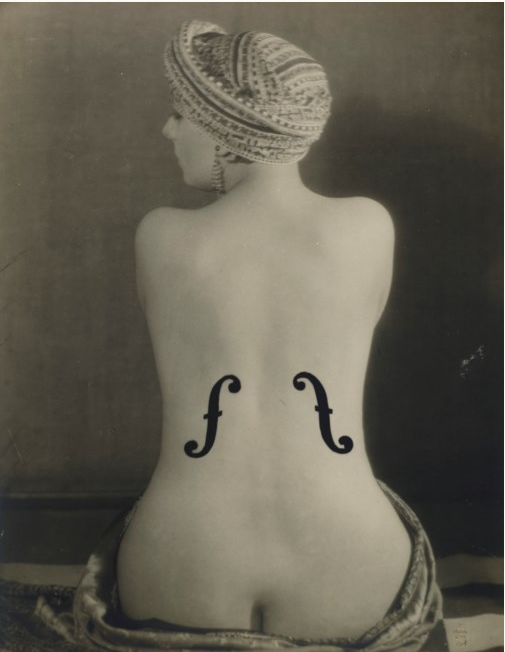
The most expensive photograph in history is once again of Man Ray and sold for 12 million

Le Violon d’Ingres (1924), by Man Ray, in a period test
Rosalind Gersten and Melvin Jacobs/Christie’s Collection

It depicts a woman whose bare back evokes the shape of a violin. We can’t see her arms or legs, and only her profile reveals the identity of the model, Kiki de Montparnasse, singer, painter and lover of Man Ray, the artist to whom we owe Le Violon d’Ingres (1924), one of the most celebrated photographs of the 20th century.

A copy vintage of this work, which we immediately associate with its author and the surrealist movement, of which he is one of the main references, was sold this Saturday at an auction in New York for 12.4 million dollars (12 million euros, which already includes the fees that the transaction involves), greatly exceeding the most optimistic estimate, which was set at seven million.

Le Violon d’Ingres (silver gelatin print measuring 48.5 x 37.5 cm) was one of the lots that had generated the most expectations around the prestigious Christie’s auction and was part of the surrealist art collection of Rosalind Gersten and Melvin Jacobs.

According to the American art magazine Art News It took ten minutes, under the watchful supervision of the auctioneer, Adrien Meyer, for two of the auctioneer’s photography specialists, Darius Himes and Elodie Morel, on the phone with two bidders, to settle the dispute. Morel and the collector he represented ended up winning, setting the price at 10.5 million dollars (10.1 million euros) and drawing applause from the room.

This portrait of Kiki de Montparnasse, one of Man Ray’s muses, is what in the specialized world is called an “original photographic copy”, since it was made at the same time as the artist created the corresponding negative, which makes it very rare and therefore particularly valuable to any collector or museum.

The Jacobs, executives linked to the fashion world and with friends in the surrealist circle, which also included Marcel Duchamp, René Magritte, Max Ernst and Dorothea Tanning, bought Le Violon d’Ingres directly to Man Ray (1890-1976), in 1962, and they never abdicated it. Rosalind outlived her husband (Melvin died in 1993), eventually dying in 2019, aged 94. It fell to the heirs to sell the couple’s collection.

The auction offer of this iconic work by the American artist, which on the eve of his visit to Darius Himes square, he called “something unprecedented in the art market”, set a new record for photography and by a wide margin. The former belonged to Andreas Gursky, the German photographer who in 2011 saw one of the proofs of his The Rhine II (1999) to be sold for 4.3 million dollars (4 million euros). Gursky then broke the record previously held by Man Ray, author of Noire et Blanche (1926), sold four years earlier for three million (2.8 million euros).

“At once romantic, mysterious and mischievous, this image has captured everyone’s minds for nearly 100 years,” said Christie’s specialist Himes, quoted in a statement in which, weeks earlier, the prestigious auctioneer had publicized and promoted the sale of the portrait. unique by Kiki de Montparnasse.

With copies in the collections of the Pompidou Center in Paris, one of the most important museums of modern and contemporary art in the world, and in the J. Paul Getty Museum in Los Angeles, Le Violon d’Ingres it is a work built in stages: the artist photographed the model, then printed the resulting negative and, on the proof that gave rise, drew the typical openings of the violin, in pencil and ink, a type of ink. Only later did he pick up the camera again to record the result, which gave rise to a new negative and the proofs that would lead to the title of the one that was now sold at auction.

Le Violon d’Ingres it is, according to some art historians, a tribute by Man Ray to one of his favorite painters, the Frenchman Jean-Auguste Dominique Ingres, who liked to play the violin in his spare time. The model’s pose, they note, is also reminiscent of that of the women who appear in two famous paintings by Ingres: Le Bain Turkish (the one in the center wearing a turban, playing a stringed instrument) and la baigneuse.

20.8.23

CALL ALL ARTISTS to Participate in the L.I.V.E. S international Exhibition


CALL ALL ARTISTS to Participate in the L.I.V.E. S Exhibition

Dear Artists,

We are thrilled to invite artists from all around the world to participate in the L.I.V.E. S (Living, Inspiring, Visualizing, Expressing, and Sensing) exhibition. Organized by UNITED PHOTO PRESS, this international and captivating photographic exhibition will be held from September 21st to October 21st at the Museum of Electricity in Funchal, Madeira Island, in partnership with the local association, Arca d'Ajuda.

The L.I.V.E. S exhibition aims to explore the richness and complexity of human lives through a captivating collection of photographs. We believe that art has the power to transcend boundaries, connect people, and evoke deep emotions. As such, we are reaching out to artists of all backgrounds, genres, and styles, inviting them to share their unique perspectives and contribute to this remarkable showcase of visual storytelling.

Located in the heart of the picturesque Madeira Island, the Museum of Electricity offers a stunning backdrop for this inspiring exhibition. The exhibition space has been carefully designed to provide a vibrant and immersive experience for both artists and visitors. Each photograph will be meticulously curated to create a narrative that reflects the diversity and beauty of the human experience.

Participating in the L.I.V.E. S exhibition will not only give you the opportunity to showcase your artistic talent on an international platform but also connect with fellow artists from around the globe. It is through such collaborations and exchanges that we can foster a greater appreciation and understanding of different cultures and perspectives.

To submit your work for consideration, please send a email at info@unitedphotopress.net for complete the submission form. The deadline for submissions is August 31st, 2023. Our expert panel of curators will carefully review all entries and select a diverse range of artworks that best capture the essence of the exhibition's theme.

We look forward to receiving your submissions and joining us in celebrating the power of photography to portray the complexity of human lives. Together, let us create an unforgettable experience that transcends borders and leaves a lasting impact on all who attend.

Should you have any further questions or require additional information, please do not hesitate to contact us at info@unitedphotopress.com

United Photo Press team


19.8.23

Heartfelt Thanks for Celebrating World Photography Day


Heartfelt Thanks for Celebrating World Photography Day

Dear Members of United Photo Press,

I hope this message finds you in great spirits. On the occasion of yet another successful celebration of World Photography Day, I would like to extend my sincere gratitude to each and every one of you. Your unwavering dedication to the art of photography and your collective efforts in commemorating this special day have truly made a significant impact.

Year after year, we come together as a community to celebrate the magic of capturing moments through the lens. The power of photography to tell stories, evoke emotions, and freeze time in a single frame is nothing short of extraordinary. It is this shared passion that unites us as members of United Photo Press.
The success of our celebration wouldn't have been possible without your creativity, enthusiasm, and commitment. From organizing exhibitions to hosting workshops, sharing your insights and techniques, and showcasing your remarkable works, you have all contributed to making World Photography Day an event to remember.

As we reflect on the beauty and significance of photography, let's also reflect on the strength of our community. United Photo Press is more than just a gathering of photographers; it's a family that supports, inspires, and nurtures each other's growth. Together, we have created a platform that fosters learning, creativity, and camaraderie.

Here's to the countless frames that tell stories, the emotions that transcend time, and the connections that bridge distances. Your contributions, whether big or small, play an integral role in the continued success of our collective journey.

Once again, thank you for your dedication, hard work, and shared love for photography. Let's continue to capture the world one click at a time and look forward to many more years of celebrating World Photography Day together.

Munich, 19 August 2023
Warmest regards,
Carlos Alves de Sousa
United Photo Press

12.5.23

Art Is Now a Crime in Russia

Zhenya Berkovich has directed more than a dozen plays. Last year, her production of a play co-written with her now co-defendant won top honors at Russia’s leading theatre festival.


The arrests of a director and a playwright in Moscow signal a new chapter in the Putin regime’s eradication of dissent.

On May 5th, a Moscow court placed two women, the thirty-eight-year-old Zhenya Berkovich and the forty-three-year-old Svetlana Petriychuk, under arrest for an initial term of two months.

About a year earlier, I was startled to realize that Berkovich was still in Russia. Most of my extended circle had left in the days and weeks following the beginning of the full-scale invasion of Ukraine, in February, 2022. Russian authorities had brutally disbanded protests, passed a set of laws banning antiwar speech, hounded independent media out of the country under threat of arrest, and banned Facebook. Those who stayed took a newly standard set of precautions, including “locking” their Facebook accounts so that only their “friends” could see their activity. Berkovich spent ten days in jail for protesting the invasion and then kept posting openly, publishing poems, and writing about her reactions to the war and her frustrations with her teen-age daughters, both of whom she had recently adopted.

I didn’t know her well. We met perhaps a decade ago, when I was still living in Moscow, and Berkovich, freshly graduated from the famed Moscow Art Theatre School, was involved in the production of a play based on interviews with people whose grandparents had been Stalin’s henchmen. The play was staged at the Sakharov Center, which was shuttered by the government last week. I had also seen one of the first plays that Berkovich directed, “The Man Who Didn’t Work,” which was based on an activist’s notes of the courtroom proceedings in the trial of the poet Joseph Brodsky. Soviet citizens were required by law to be engaged in productive work. Brodsky was found guilty of “malicious parasitism” and sentenced to internal exile and mandatory labor. (The play was staged at Memorial, a human-rights and history organization that was shut down by the government last year.)

In the play, a judge demands of Brodsky, “What did you ever do to benefit the motherland?”

“I wrote poetry,” Brodsky responds. “That is my work. I am certain that every word I’ve written will benefit many generations of people.”

. . . . “Tell the court why you didn’t work.”


“I worked. I wrote poetry.”

“Answer the question. Why didn’t you labor?”

“But I labored. I wrote poetry.”

“Why didn’t you study that at an institution of higher learning?”

“I thought . . . I thought it was a gift from God.”

I took my older kids to see both plays. For years afterward, Yolka, who was ten or eleven when she first watched them, would return to the one about Brodsky. When I was writing this column, I asked what had stuck with them, and Yolka texted back, “I remember it seemed a little too related to how it was in Moscow at the time.” Back then, this response would have sounded hyperbolic. Russia was cracking down on dissent, but poets weren’t going to jail for writing poetry.

Berkovich directed roughly a dozen more plays. Last year, her production of a play written by Petriychuk—now her co-defendant—won top honors at the Golden Mask, Russia’s leading theatre festival. The name of the play, probably best translated as “Finist, the Brave Falcon,” is a reference to a Russian fairy tale about an elusive male love object who has the ability to turn into a bird or a feather. The play is based on the stories of young Russian women who met isis fighters online, converted to Islam, married the men in virtual ceremonies, and went, or tried to go, to Syria to join the fight with their husbands. Many of the women were later arrested and prosecuted in Russia, and the play made use of the transcripts of their police interviews. It was a subtle, tender, and slightly absurdist portrayal of loneliness and the longing for love. The production opened with the cast singing, in English, “Somewhere Over the Rainbow.”

Before the Russo-Ukrainian war, I didn’t know that Berkovich wrote poetry. The first poem that caught my attention went viral in the Russian blogosphere about a year ago, as Russia was staging its annual grand celebration of victory in the Second World War. In the poem, the ghost of a man who fought in the war visits his grandson in present-day Russia and asks him not to make use of his image or legacy. “We don’t need you to be proud of us / Nor to be secretly ashamed of us. / All I ask is that you / Make it so I am finally forgotten,” the grandfather pleads.

But then I’ll forget how we looked for that painting
In the Russian Museum
How I woke up wet
And you dressed me
How we read Prishvin together
And looked for the North and South Poles in the atlas
How you explained why planes
Leave a white stripe in the sky.
How you gave me
A magnifying glass.
That’s all right, the grandfather says
As he disappears.
None of that did you any good.

In times of crisis, Russians write poetry, and this was one of many poems making the rounds. Gradually, though, I realized that Berkovich was probably the poetic voice of this period. One after another, her poems, posted on Facebook, put words to the agony of wartime. Many of them had the form of litanies.

Needed: clothes for a woman
Age seventy-nine
From a city that no longer exists.
A T-shirt, size M, for Mariupol,
A jacket, size L, for Lysychans’k.
A bra with a B cup,
For Bucha and Borodyanka.

So began one poem. Another listed imaginary—but typical—cases of Russians getting arrested.
Andrey Alexandrovich Lozhkin
63 years old
A dentist

He raises a blindingly white sheet of paper overhead
His beard is flying in the wind
Everyone will be looking for him until morning
By then he no longer has a poster or a beard or any hope of getting out . . .
Daniil Yegorovich Milkis
24 years old
A student, a nerd


He “likes” a joke on someone else’s Instagram
He has a girlfriend named Sonya and an inarticulate beard
He will send the ring with his lawyer
Sonya will say yes
He will talk about god and won’t be allowed to sit down in court
He’ll get four years and eight months
Thank god for that
The prosecutor asked for six years.

Like many people, I came to depend on Berkovich’s poems as a release for my own feelings. I nearly stopped marvelling at her decision to post openly. It helped that she interspersed the poetry with some decidedly prosaic rants, some about everyday life and some about politics. It was as though, in a way, she was the last person still living in prewar Moscow, where it was possible to use social media to say what you thought, if only to stay sane.

On May 4th, police searched the St. Petersburg apartment of Berkovich’s mother and grandmother (both women are well-known writers and human-rights activists) and detained Berkovich in Moscow. Petriychuk was detained at a Moscow airport. The following day, they appeared in court, where investigators asked that they be placed in pretrial detention. They are being charged with “justifying terrorism.” The charges are based on the play “Finist, the Brave Falcon.”

Meduza, an independent Russian news outlet working in exile, obtained a copy of the expert opinion that formed the basis for the charges against the two women. It says that the play contains elements of isis ideology and, simultaneously, “the ideology of radical feminism,” including “images of the denigration of women in an androcentric world in any space where a woman encounters men, which gives her the right to fight against this state of affairs.” Both perceived ideologies are seen as evidence of support for terrorist tactics. The charge can carry a penalty of up to seven years behind bars.

I have found it hard to write about the ongoing crackdown in Russia. After a while, it seemed that there was nothing left to say—even when, last month, the journalist and politician Vladimir Kara-Murza was sentenced to twenty-five years in prison for “high treason.” The sentence should have been shocking, but, just days earlier, the Wall Street Journal reporter Evan Gershkovich had been arrested on analogous charges. The arrests of Berkovich and Petriychuk, though, do signal a new chapter. For the first time in the post-Soviet era, Russia has explicitly arrested people for creating art. They are not charged with high treason, like Kara-Murza, or espionage, like Gershkovich, or “discrediting the armed forces” or “spreading false information about the special military operation”—the charges created to punish journalists for covering the war—or for “hooliganism,” as the protest group Pussy Riot was, but for the content of a play they wrote and staged. And also, of course, in Berkovich’s case, for acting as though she could keep expressing her thoughts and feelings out in the open. On the other hand, even as I write this, I understand that the novelty is subtle, if it exists at all: parsing the distinctions in how the Putin regime eradicates difference is a fool’s errand.

Last Friday, as the two women were being charged, several dozen people gathered outside the courthouse in Moscow. After the hearing, one of Berkovich’s friends wrote on Facebook, in a post visible only to “friends,” “I wanted to write what I think, but then I remembered that I live in Russia and decided not to. You know anyway.” Berkovich’s own Facebook account has vanished. 

Masha Gessen

31.12.22

Happy New Year's 2023 for all, in special to our members !


Happy New Year's 2023
for all, in special to our members !

Good evening to all present here tonight. We are grateful for the presence of All.

All these different individuals members from UNITED PHOTO PRESS have their own values and norms, and together they form a multitude of Being, which is what we would like to discuss tonight.

We would like to talk about welfare. What does welfare mean to each of you? What makes you feel prosperous at times? Welfare is often based on matter. The welfare state and welfare states are slaves of the economy. If the economy is in decline, welfare declines too. As a result, welfare states − which are based on matter and on collecting matter − will become increasingly vulnerable.

The reason being that if matter disappears or diminishes, the welfare state will become shaky and cracks will appear. In fact, the first small cracks are already present.

The corona virus crisis has been perfect for the inhabitants of planet Earth. Again it shows that people are hugely dependent on each other. Everything that is based on matter and on the current economic model will become shaky. There are no securities anymore. Predictions cannot be relied on anymore, so where is welfare to be found? What is welfare based on? Know that every prosperous welfare state will become very vulnerable − not only for attacks but also for helth crises.

Whatever may happen, your current system of norms and values will change. The corona crisis has shown that countries are very much dependent on another. Even countries that do not have any ties can influence each other. Mass production and everything that has to do with the helth & economy creates vulnerability, for you cannot guarantee the production of a product if a certain part cannot be delivered anymore. If a certain kind of energy cannot be supplied anymore, things will go wrong. These are the pillars of what you call welfare. Welfare in all its forms has become unsteady because it is based on the wrong norms and on the wrong values. They were very valuable for a long period of time but modernisation cannot be stopped anymore. There will be a different form of solidarity. People will see the need for creating a new kind of solidarity, to which the climate contributes as well.

Greater cooperation will be required, a more global cooperation of all forces on Earth. Individual forces will not change things; only cooperation can prevent disasters. Let’s go back to the topic of welfare. If we would have to define welfare, our definition would include: food, water, healthier air and, naturally, investing in the individual. In this way each human being will be able to develop his or her unique qualities to become an even more valuable human being for society, which will create a valuable sense of belonging to a group, to the people of a nation. Imagine all inhabitants of the Earth, its people, each single one, would feel valuable – there would no longer be any conflicts anymore.

Look at the youth which en masse gets together on the streets and cause uproar. Which norms and values do they represent? What does so-called welfare have in store for them? They feel turned away. They feel misunderstood and hence they create uproar. They do not count, they do not feel valuable. If you look at groupings which create terror and suppression, look at their norms and values and their sense of being valuable. Often these groupings consist of individuals who have a huge inferiority complex. If the value of each human being will become important again, if people invest in their personal individual norms and values – not in welfare, which aims at matter – many conflicts could be avoided. Those groupings that create uproar − know that they do this because of their inferiority complex, because of a feeling of being misunderstood and of a sense of not belonging. Solidarity is what it is all about. And, dear all, it is not about anything to do with masses, such as mass production, mass distribution or suppression of the masses in the name of the helth economy.

The individual will triumph, because through helth crises and shortage people become creative again. They will bring forward creative solutions which will not necessarily result in mass production. Eventually it will turn out that these creative solutions are less vulnerable, for it is mass production which is incredibly vulnerable. So prioritise yourself. Invest in yourself. What are your values? What are your qualities? Get a job in which you can fully express those qualities. Let your norms and values be important for yourself as an individual, and do not impose them on someone else.

Let everyone live their lives according to their own norms and values. And set an example, especially for children. They are the future. If you watch closely, a lot is happening to children right now. New age children are about to swing into action and the newer new age children are on their way. They are more sensitive, more vulnerable and at the same time more powerful. They will not accept norms and values which do not feel right for them. They will not blindly accept things. They know that they know a lot. They know that they are wise. They know that they are valuable. Consider each child to be a valuable addition to your life and know that rebellious children actually feel inferior; they feel that their qualities do not matter.

If people invest more in these children, in individuals and not in the masses, there will be much more harmony. So try to be your individual self for the upcoming year 2022, according to your values and to your norms. Try to be valuable for yourself and for others. In this way you will help creating a new sense of welfare. The old notion of welfare will anyhow disappear, because it is based on old norms and old values. Modernisation will set in more and more quickly. You think that things are moving fast and things do move quickly, but they can move even faster. If you take a look around, you can already notice the change. Conflicts that now arise, are often solved more quickly too. Areas in which conflicts have prevailed will gradually move along with the modernisation, and slowly but surely peace and harmony will settle there because of changing norms and values.

Take a look at yourself. Forgive yourself for what you would have done wrong. Forgive yourself for the judgements and prejudices you still hold. And send this feeling and energy to the areas which have been in conflict for ages. The conflicts seem insolvable between the different groups, different norms and values, which are often based on pride and self-interest. Send the energy of forgiveness to these areas. The conflicts can only be solved if people forgive, if people put themselves aside and prioritise their society and their children, who are the future of those areas. So take a look inside – many things have already happened this year, in 2022.

We have already mentioned it before. Being connected with things known as ‘paranormal’ will turn out to be a privilege. Paranormal, just outside the normal and yet not the abnormal – it will turn out to be more and more valuable to be connected with your intuition, with your feeling, or with your higher guidance. This is the best navigation you can have in these stormy times. And you will feel increasingly normal, because many people will awaken. Many people become more inquisitive, they will become more familiar with what they consider to be paranormal, which will become increasingly normal. The tide will be turning and it cannot be stopped. Things ‘paranormal’ will become normal.

And the normal will become paranormal. We will get another society, which is based on different norms and values. True brotherhood and sisterhood − gone will be the times when people thought they were merely an inhabitant of planet Earth. As a tiny individual you are part of a large community, of a family, of a street, of a village, town or city, of a country, of a continent, of the Earth, of the Universe – and in this grandeur you, as a tiny individual, are important. Just one small seed can spread and multiply, so stay in tune with your navigation. Invest in your personal values, express your qualities and live your individual life. Do not let others decide for you, and the more you are able to live your own life, the more easy it will be to regularly adjust to the needs and wishes of other people.

You will not feel that you neglect yourself. So balance investing in yourself and investing in society – indeed, both aspects – and it will be a win-win situation. You as an individual will become more and more valuable. Try to smile at a stranger at least once a day. It would be a blessing and it would bring about an enormous flow of harmony in the year 2023, because just one smile can set off a chain reaction of smiles.

Go For It – I Wish You a Year of 2023 Full of Welfare!

Carlos Alves de Sousa
President of United Photo Press

www.unitedphotopress.com 
www.unitedphotopressworld.org 
#unitedphotopress

3.9.22

Berlin Photo Week 2022


This will be an extraordinary day. We are proud to host Magnum photographers on the Conference Stage on Saturday in cooperation with the well-known news magazine DER SPIEGEL.

DER SPIEGEL – politically independent, not affiliated with any economic group, committed only to itself and its readers and users – has stood for investigative journalism for 75 years. Its editors set the news, provide context in an increasingly complex world and set the pace in public debate.

This is the ideal combination to interview Magnum Photos’ great photographers on the burning issues of the current times. Each photographer is assigned an editor from DER SPIEGEL as an interviewee.

Moderator: Heike Ollertz, Professor for Photography at the UE University of Europe for Applied Sciences

19.8.22

World Photography Day


Since the early 19th century, photography has become an ever-increasing medium of personal expression and appreciation for countless people around the world.


A photograph has the ability to capture a place; an experience; an idea; a moment in time. For this reason, it's said that a picture is worth a thousand words. Photographs can convey a feeling faster than, and sometimes even more effectively than words can. A photograph can make the viewer see the world the way the photographer sees it.

Photographs even transcend the passing of time - a photo from a hundred years ago can still be as appreciated now, as it was then. A photo taken tomorrow, can still be just as appreciated by others in a hundred years' time.

Join the World Photography Day celebration, this August 19th. Go out and capture a moment.


#unitedphotopress

16.5.22

A stunning selection of Masterpieces in May!


The major sales in May will be offering works from a number of exceptional collections including the Macklowe, the Ammann, the Anne H. Bass, the Maezawa and even the Gersten and Jacobs collections. So important are these collections that the sale of their “nuggets” promises to revise several global auction records! An Andy Warhol Marilyn is expected to fetch $200 million and a painting by Basquiat is expected at $70 million. Below we take a quick look at 10 very important works coming to auction in May.

Andy Warhol: $195 million (Christie’s, May 9)
Andy WARHOL is now the most expensive painter after Leonardo da Vinci and ahead of Picasso! It’s official since yesterday, with the sale of Shot Sage Blue Marilyn (1964) for $195m at Christie’s…

This iconic canvas pays homage to Marilyn Monroe, a personality whose duality fascinated Warhol. Highly glamorous, she embodied the archetype of feminine beauty of her era, but appeared to live a tragic life. For Shot Sage Blue Marilyn, Andy Warhol used a promotional photo from the 1953 film Niagara and gave the actress a pink face, blue eyeshadow and red lips against a light blue background. The work dates from 1964, two years after the actress’s mysterious death.

From the collection of Thomas and Doris Ammann, Shot Sage Blue Marilyn could mark a turning point in the history of the art market, being presented by Christie’s both as “the absolute pinnacle of American pop” and as one of the greatest paintings of all time, “alongside Botticelli’s Birth of Venus, da Vinci’s Mona Lisa and Picasso’s Demoiselle d’Avignon”.

Expected to refresh Warhol’s current auction record of $105.4 million (Silver Car Crash (Double Disaster) (1963) at Sotheby’s New York in 2013), Shot Sage Blue Marilyn could become the most expensive 20th century artwork ever sold at auction!

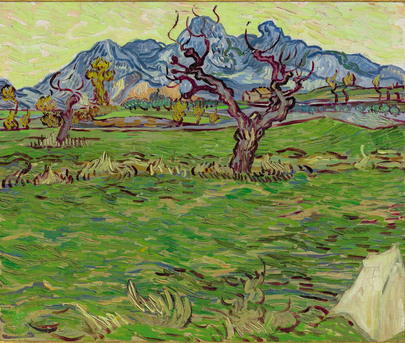
Van Gogh: $45 million (Christie’s, May 11)
Fields near the Alpilles is an oil-on-canvas executed in November 1889, six months after Vincent VAN GOGH mutilated his ear. He painted the work at the time of his voluntary internment in Saint-Rémy-de-Provence, then sent the canvas to his friend Joseph Roulin. The work has remained in private hands ever since and has never been exhibited to the public. It should sell for around $45 million.


Jackson Pollock: $45 million (Christie’s, May 12)
Canvas Number 31 dates from 1949, shortly after Jackson POLLOCK had dropped his brushes to devote himself to Action Painting and upset the framework of traditional pictorial practices in the process. In charge of 20th and 21st century art at Christie’s, Alex Rotter recalls that “true dripping paintings were – and still are – the ultimate in mid-century American avant-garde, and it is rare to see them appear on the secondary market”. A rarity that could attract 45 million dollars on May 12 according to the estimate provided by François Pinault’s auction house.

Having remained in the same private collection for more than two decades, Number 31 sold for $3.5 million in 1988 at Christie’s. This painting could now sell for 13 times that amount. To beat Pollock’s current auction record, Number 31 will have to exceed the $61.1 million reached last November by Number 17 (1951), a painting from the Macklowe Collection sold at Sotheby’s.

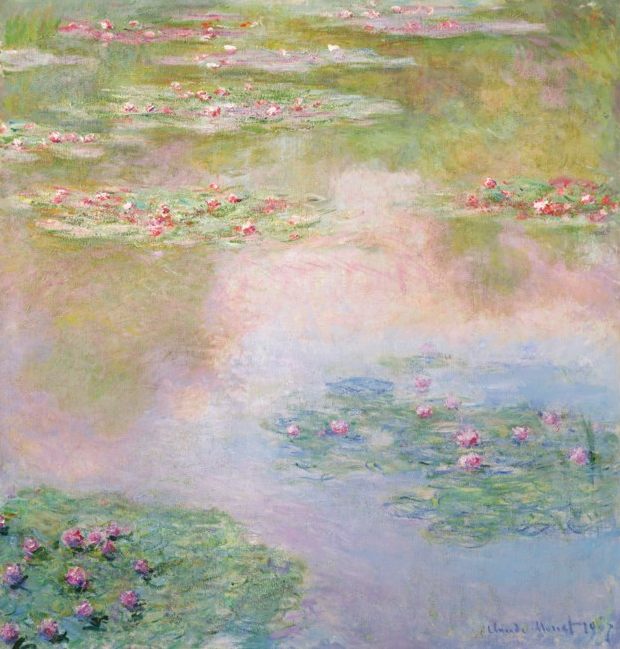
Claude Monet: $150 million in three lots (Christie’s, May 12)
The collection of American investor Anne H. Bass is impressive. Christie’s has been awarded the honor of dispersing 12 of its masterpieces on May 12, including three paintings by Claude MONET which should bring in, together, 150 million dollars. Two of them – Le Parlement, soleil couchant et Peupliers au bord de l’Epte, automne – were purchased from the Acquavella gallery in 1982; the third – a hypnotic Water-lilies in spring colors – was acquired from Wildenstein New York in 1984.

The highest estimate has been given to Le Parlement, soleil couchant (1900-1903) which is expected to reach $60 million. It is one of the four paintings of the British Parliament in private hands, but above all one of Monet’s finest achievements, being among the most colorful of the series he began in London in 1899 and completed in Giverny in 1904. The future owner of this canvas will own a Monet on a level equivalent to those present in museums such as the Musée d’Orsay in Paris, the Metropolitan Museum of Art in New York and the National Gallery of Art in Washington.


Mark Rothko: $80 million (Christie’s, May 12)
Also from the Anne H. Bass collection, a flamboyant Mark ROTHKO from 1961 is estimated between $60 and $80 million. But if it exceeds its high estimate, this marvelous canvas could renew the American artist’s auction record which has stood at nearly $87 million since a canvas painted in the same year and with a similar, but slightly larger, chromatic range, Orange, Red, Yellow (1961), sold at Christie’s New York on 8 May 2012. Having guaranteed a minimum price to the seller, the stakes are high for Christie’s.


Man Ray: $7 million (Christie’s, May 14)
Another record that could be broken concerns the art photography market as a whole. On May 14 Christie’s will be offering MAN RAY’s iconic photograph “Le Violon d’Ingres”. Having spent 60 years in the same collection, the curves of this woman-violin (whose model is none other than Kiki de Montparnasse) are estimated to attract between 5 and 7 million dollars.

The image is on track to smash Man Ray’s record of $3.1 million for a photographic work, a record hammered for his Noire et Blanche (1926) at Christie’s Paris in 2017. But even if it reaches its low estimate it will become the most expensive photographic work ever sold at auction. Excluding Jeff Koons’ photographic portrait under a light box which fetched $9.4 million in 2013, the global auction record for a photographic artwork is currently held by Andreas Gursky’s Rhein II which fetched $4.3 million at Christie’s in New York in 2011.


Pablo Picasso: $60 million (Sotheby’s, May 17)
Pablo PICASSO is the star of Sotheby’s Modern Art sale on May 17 with a canvas expected to fetch around 60 million dollars. It’s a 1932 portrait of Marie-Thérèse Walter with whom the artist fell in love five years earlier (when she was 17 and he was 45). In Femme nue couchée, Walter takes on the contours of a sensual creature by the sea in a Surrealist setting.

Philip Guston: $30 million (Sotheby’s, May 17)
Nile is a monumental work that represents the pinnacle of Philip GUSTON’s abstract practice and, according to Sotheby’s catalog note, it is among the works that established the artist’s reputation “in the foremost rank of the preeminent art movement of the twentieth century, Abstract Expressionism”. On May 17, Sotheby’s is hoping to revise Guston’s auction record with a result above $30 million.

Remaining in the Dallas-based collection of Peter and Edith O’Donnell for over 40 years, the presentation of Nile is certainly timely with the opening of the “Philip Guston Now” exhibition at the Boston Museum of Fine Arts in early May.
$70 million Basquiat (Phillips, May 18)

Phillips (which posted a record turnover of $706 million in 2021 from art sales) could attract the best bid of its history on May 18 with a major 1982 canvas by Jean-Michel BASQUIAT from the collection of Japanese billionaire Yusaku Maezawa. If it reaches the estimated $70 million, Mr. Maezawa, its Japanese billionaire owner, will pocket around $10 million having acquired the canvas at Christie’s for $57.3 million in 2016. The following year, he bought another work by Basquiat for $110.5 million (Sotheby’s), setting the American artist’s all-time auction record.

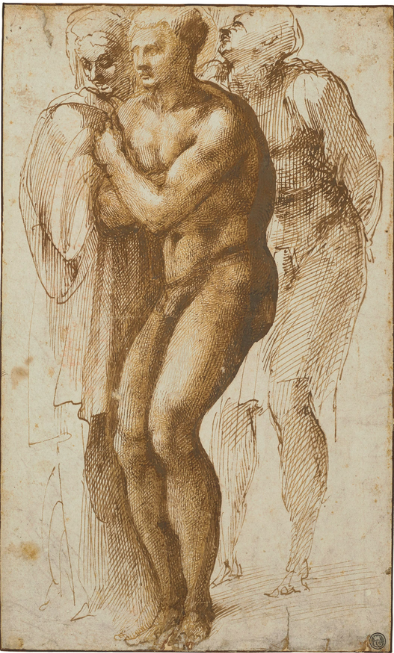
Michelangelo: $30 million (Christie’s, May 18)
“Rare” would be an understatement! Only eight drawings by MICHELANGELO (1475-1564) have been offered at auction in the past 40 years. Here is the ninth: an early drawing from the 1490s inspired by Masaccio’s frescoes in the Brancacci Chapel in Florence. Above all, It was the artist’s first known ‘academic’ Nude, rediscovered in a French collection.

In 1907 the drawing was presented for sale at the Hôtel Drouot in Paris as a work by “a member of Michelangelo’s entourage”. It was finally recognized as a veritable Michelangelo work in 2019 by Furio Rinaldi, then a specialist in Christie’s Old Master Drawings department.

Fewer than ten of the artist’s works are still in private hands around the world, so the sale of this 33 × 20 cm sheet takes on an exceptional character that Christie’s is highlighting by dedicating a sale uniquely to this work. The rare bidders will battle it out in Paris on May 18 and this incredible “jewel” is expected at fetch around $30 million.