Showing posts with label Hasselblad. Show all posts

23.1.22

717-Gigapixel, 5.6-Terabyte Photograph of Rembrandt’s “The Night Watch”


Generally, seeing art on a computer screen is never as good as seeing art in real life. At Glasstire, we’ve always espoused this statement, and I do firmly believe it still. 

However, there are certain times when seeing an artwork online — and the capabilities offered by digital technologies — comes close to eclipsing the live experience.

Maybe this isn’t for me to judge, as I’ve never been to Amsterdam’s Rijksmuseum, but the institution’s recent online offering of a 717-gigapixel (that’s 717,000,000,000 pixels) image of Rembrandt van Rijn’s The Night Watch (1642) is very compelling, and perhaps even better than seeing the nearly 15-foot-wide canvas in person.


Rembrandt van Rijn, “The Night Watch,” 1642, Oil on canvas, 379.5 cm × 453.5 cm. Collection of the Rijksmuseum

There’s been a lot of work done on and press about the painting recently. In June of last year, Artnet News reported that, with the help of artificial intelligence, museum experts were able to reconstruct missing sections of the painting, which were lost after the work was trimmed so it could fit inside Amsterdam’s Town Hall in 1715. This was just the latest revelation during the Rijksmuseum’s ongoing effort to conserve and restore the painting, which began in 2019. Likely because the piece is so well-known (and because the public wouldn’t want it to disappear for years into a back room), conservators worked on the painting in a glass chamber, in full view of the public.

The process of how this 717-gigapixel photo came to be is stunning, and the level of detail it makes legible is more stunning still. See information about the process below, via the Rijksmuseum. And see (and zoom into!) the photo here.

This is the largest and most detailed photo ever taken of a work of art. It is 717 gigapixels, or 717,000,000,000 pixels, in size.

The distance between two pixels is 5 micrometres (0.005 millimetre), which means that one pixel is smaller than a human red blood cell.

The team used a 100-megapixel Hasselblad H6D 400 MS-camera to make 8439 individual photos measuring 5.5cm x 4.1cm. Artificial intelligence was used to stitch these smaller photographs together to form the final large image, with a total file size of 5.6 terabytes.


Brandon Zech

5.12.21

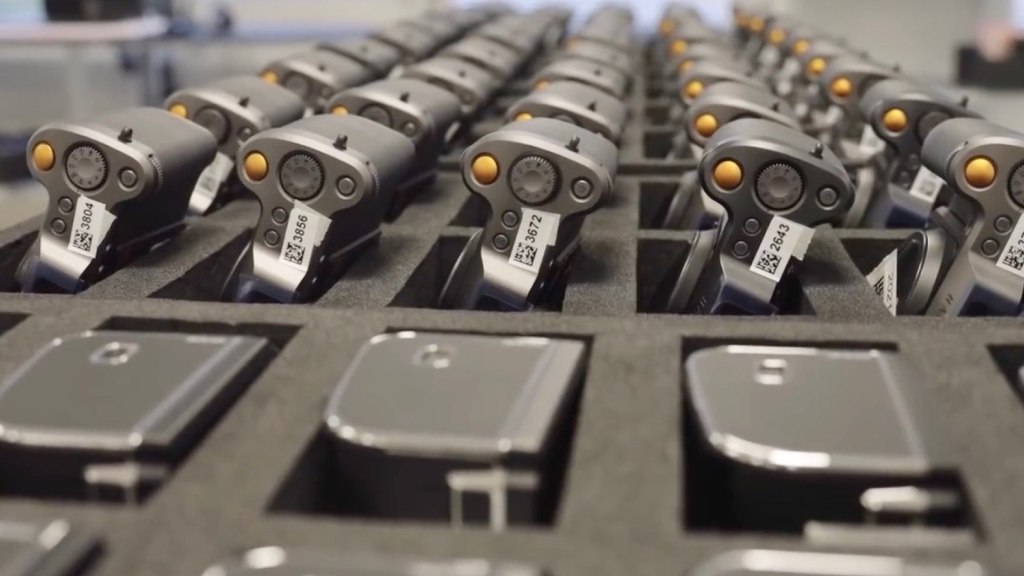
Inside Hasselblad’s Factory: Assembling the Medium Format Magic

Inside Hasselblad’s factory. Image: Hasselblad


What does it take to manufacture a high-end prestige piece of an imaging device, like Hasselblad cameras? Also, what makes those cameras so expensive? Let’s take a look inside the Hasselblad factory to find out.

The first Hasselblad: ROSS HK-7

The first-ever Hasselblad was made by Victor Hasselblad who was approached by the Swedish government with the task of replicating a recovered German aerial camera during World War II. That’s how the first Hasselblad was born. This model was called ROSS HK-7. From 1941 to 1943, a total of 240 HK-7 units were produced, measuring 31x26x17.6cm and weighing 4.8 kilograms with a 13.5cm (135mm) lens attached. The camera featured a basic set of shutter speeds from 1/150 of a second to 1/400 of a second. Take a look at the ROSS HK-7 in the pictures below.

The ROSS HK-7
The transition from analog to digital: “Prices exploded”

When Hasselblad has decided to manufacture digital cameras and transitioned from analog, it faced a significant challenge regarding medium format imagery technologies which caused to huge elevation in pricing. “When the company transitioned to digital, the price exploded” said Hasselblad executives. One of the reasons for those steep prices is that the company didn’t want to abandon its specialty which is the medium format imagery. Thus, producing these huge medium format sensors has resulted in a cost, and there’re no shortcuts. “When medium format technology transitioned from analog to digital, the medium format sensors became extremely expensive, and the camera system became extremely expensive and very niche”, said Bronuis Rudnickas, Global Marketing Manager at Hasselblad.

Inside Hasselblad’s factory. Image: Hasselblad


When medium format technology transitioned from analog to digital, the medium format sensors became extremely expensive, and the camera system became extremely expensive and very niche.
Bronuis Rudnickas, Global Marketing Manager at Hasselblad.
Medium format sensor which costs $26,000

Hasselblad’s high-end cameras consist of three main parts: The digital back, the body, and the lens. The back which includes the sensor costs about 70% of the price of the whole camera (in the case of the flagship H6D-100c costs more than $26,000). The sensor is manufactured by Sony. In fact, this is the IMX 461100MP Sony sensor, which Hasselblad utilizes and adapts for its flagships. Furthermore, Hasselblad spends major quality control resources to verify this sensor meets Hasselblad’s standards (calibration and testing, which resulted from more than 700 images taken by this sensor).

Large-format: Sensor size comparisonHasselblad sensor sizes: X1D II 50C vs. H6D-100c
No mass production

Hasselblad doesn’t mass produce its cameras. It makes them in small batches assembled in-house by hand, one by one. In 2018, The Verge reported about less than 10,000 units manufactured per year, as opposed to other camera manufacturers (Canon, Nikon, Sony, Fujifilm, Olympus) that produce millions of cameras per year. The cameras are being assembled for 6-8 hours and for some cases it may reach up to a few days. However, the sensor calibration process can take up to a third of that time. “Each sensor is calibrated and tested to a single-pixel level, which is very time-consuming and quite unique in this industry,” says Rudnickas.

Inside Hasselblad’s factory. Image: Hasselblad


Each sensor is calibrated and tested to a single-pixel level, which is very time-consuming and quite unique in this industry.
Bronuis Rudnickas, Global Marketing Manager at Hasselblad.
Medium format sensor calibration

“The sensors are calibrated separately from the camera body in a calibration station. Over 700 images are taken, testing the sensor under various settings, and then a specialized software calculates composition parameters and produces calibration files specific to that sensor. That file is later transferred to that specific sensor’s camera. When test shooting with that camera in the final stage, the calibration data is applied to the naked images before the image is stored” says Vivian Gorges which is the Production Leader at Hasselblad. For instance, the X-system is divided into five stages, which the sensor calibration constitutes Lion’s share of it.

Inside Hasselblad’s factory. Image: Hasselblad

Here’re the steps concerning the X models:
Checking for cosmetic issues
Programming the camera and updating it to the latest firmware
Sensor calibration: The major part in the production (see above)
Digital unit test: Adjusting focus, power management, noise, and other parameters
Photo quality tests: Examination in a studio environment against objects, color charts, and more

Here’s a brief look at all that stages:

More affordable Hasselblads

Due to the market demand for large format cameras, Hasselblad has released more affordable entry-level large sensor products. Although these cameras have smaller sensors, they are still considered medium format cameras, like the X1D II 50C which owns a 50MP 43.8 x 32.9mm CMOS sensor. The prices are not so cheap though and reach $6,000. However, it’s still in the high-end segment regarding pricing. Nevertheless, the main issue is the limited video capabilities comparing other flagships, like the Sony Alpha 1, which is located in the same price range. Hasselblad doesn’t offer 8K video, accurate autofocusing, advanced image stabilization, and more video features that are essential to professional videographers, and for that reason, it’s a real challenge to compete with other manufacturers.

Inside Hasselblad’s factory. Image: Hasselblad
Impaired video capabilities

With all that medium format goodness, the video capabilities of Hasselblad cameras are still impaired. The advantages of that huge sensor are not shown when shooting videos in Hasselblad cameras. It seems that the sensor is capable of shooting extraordinary photos, but not videos. A lot of artifacts, like an extensive rolling shutter, low dynamic range, and poor codecs, locates Hasselblad away from being a decent option for professional videographers. Last year, Hasselblad announced firmware Update 1.2.0 for its X1D II 50C and 907X Special Edition which allows recording at resolution 2.7K (2720 x 1530) & HD (1920 x 1080). In this update, the video can be recorded at 29.97 fps with 4:2:0 8bit color. According to Hasselblad, the 2.7K resolution option delivers improved capture of details, whilst balancing the final video capture size.​​ Although the full width of the sensor is used in a 16:9 aspect ratio (43.8 ×24.6), resulting in a massive 50.25 mm image circle which is more than 16% larger than typical full-frame video capture, and nearly double comparing the standard cinematic Super 35, it needs to be emphasized that this is an 8-bit video. Not good enough. The flagship H6D-100c can shoot 4K RAW, however, this is not a real RAW, and the results are poor.

Hasselblad X1D II 50C: Medium -Format video capabilities
Final thoughts

We’ll sum it up by saying that Hasselblad is an amazing camera that is built for real artists. And allow us to quote our previous statement by saying that Hasselblad needs to invest more R&D resources focusing on its video capabilities regarding codecs. Let’s imagine partnering with Atomos for outputting ProRes RAW from this huge sensor. Utilizing an external recorder to output decent video should be the mandatory strategy for Hasselblad, especially in this price range. That will allow Hasselblad to push the envelope concerning medium format video imagery.

 
 YOSSY MENDELOVICH

7.5.21

Hasselblad 907X Review: Beautiful Photos, Frustrating Experience


Despite lots of gorgeous resolution and a beautiful solid metal design, the $6,400 Hasselblad 907X 50c is not without its problems. It lacks a traditional viewfinder and has noticeably slow autofocus.

It’s a system that took a fair bit of practice to get used to, but once you manage to figure out the camera’s quirks, you are sure to fall in love with the images you create with it. It’s up for debate if that effort is worth it in the end, as as much as the 907X gets right, frustrating design limitations hold it back from truly spreading its wings.

Hasselblad’s latest medium format digital system is not only a throwback to the classic looking film systems of the companies early days, but also a beautiful metal 50-megapixel box that can operate as both a standalone digital system or as a digital back for classic Hasselblad V-System cameras that were made from 1957 and beyond. While it is slightly smaller than the other medium format bodies that the company has made in the past, it is still jam-packed with every feature you have come to expect from the Hasselblad name.

One of the first things you’ll notice about this system is the lack of a “traditional” viewfinder — electronic or optical — built into the camera. That said, there is an optional optical viewfinder for $499 that you can mount onto the system that has a fairly wide field of view and is detailed with markings for the XCD 21,30, and 45mm lenses to give you some idea for your image framing. It is definitely a neat-looking addition that adds a touch of flair to the system, but I didn’t find much use for it personally, even when shooting outdoors in bright light. In fact, shooting in bright light, in general, is tough with this camera.

If you’ve never shot with a top-down system before, the first few hours using this system can feel a tad awkward since you have to look at the rear touch screen display by holding it at eye level, or taking advantage of flipping the screen out a full 90 degrees to give you a little more flexibility with positioning. Luckily, I have been shooting with an old Twin Lens Reflex (TLR) system for a few years so the transition wasn’t hard to get used to. You can shoot this system using a shutter button located on the bottom corner of the camera much like traditional film systems, or by mounting an optional grip ($729) that provides you with four additional button, two dials, and a small joystick for more manual control over the system. Personally, I preferred using the grip to shoot since it allowed for much faster and easier setting changes.


The battery and dual SD memory card slots are found on the right side of the camera behind a “hidden” USB-C port on the left-hand side that is used to tether or charge the system. Under the touch display, there are a series of ports hidden under a rubber door that includes connections for headphones, mic, and flash ports. It is worth noting that while all of these connections and slots are hidden, there are zero claims of weather sealing anywhere on the product pages for this system. So if you plan on taking the 907X out in any sort of non-perfect weather, do so at your own risk.


Overall Performance

If you have ever used traditional TLR systems or any of the classic Hasselblad film cameras, using the 907X will feel quite familiar. If not, then it’s definitely going to shake things up and leave you with a bit of a learning curve to figure out, especially if you opt to use the camera without any of the optional accessories for added functionality.

Without the grip, you’ll notice there’s only one dial on the system that encompasses the shutter button on the front of the camera. By default, this will adjust the f-stop, but holding the small button on the opposite side of the camera down while spinning this dial will adjust your shutter speed. All other controls like ISO and shooting modes are only accessible via the touchscreen display on the back of the system. That’s not something that everyone will like, but the nice thing is the touch screen is incredibly responsive and smooth which makes even zooming in on image previews and moving forward/backward an absolute breeze.


The menu system on the 907X is actually quite refreshing. Compared to systems like Sony and even Nikon, the Hasselblad 907X menu is incredibly simplistic and easy to use. There are 5 buttons below the 3.2-inch touch screen with almost every function you need access to accessible by the touch functions. The menu is fully customizable letting you place your “favorites” in the order you’d prefer.

Another feature worth covering in this section is the Phocus 2 app for mobile devices. Connecting this system is incredibly easy and allows for some very handy camera controls if you decide to shoot it remotely. If you set it up, you can also download full-size JPEGs right to your phone or mobile device for fast client or social sharing.


There’s a lot of good things packed into this medium format system, but it is worth mentioning that battery life is not one of those things.

It is by no means the worst I’ve experienced and since many camera manufacturers are able to offer all-day life in batteries much smaller in size, I was hoping for even just a little more out of them. In the real working world, I would recommend having no less than two spare batteries with you so you’d not have to worry about a full day of shooting. This should let you keep a rotation of charged batteries going if you’re not in a position to plug the camera into a USB-C power source while on set.

The 907X can also shoot video. However, there is no stabilization available and the max resolution for video is 2.7K at 29.97fps which crops the image to 16:9. This crop was surprising to me given the native 4:3 ratio of the system for stills but, despite these not-so-impressive video specifications, the incredible colors you get from your stills also apply to your video. Just be sure to have things locked down on a tripod and pre-focused before you start shooting as even light jostling of the camera is extremely noticeable in the footage.
Image Quality And Dynamic Range

The photo quality is where things really stood out for me and my testing. The 907X system with the CFV II 50C is capable of capturing 50MP images at 8272 x 6200 pixels, which is significantly larger than a standard full-frame system but the sensor isn’t exactly new — It’s the same sensor as the X1D released in 2018.

Even without a brand new sensor, there’s just something about the colors that come out of this rig that are jaw-dropping. I’ve worked with a lot of systems over the years and there’s just something about the color you get out of the Hasselblad systems that I love. Maybe it boils down to personal editing style, but the image colors are almost exactly where I want them straight out of the camera, and I find they require very few adjustments.

The Hasselblad 907X has 14 stops of dynamic range available. While this was incredible at one point, it isn’t anything crazy anymore. However, what I found is the 907X will leave you with an incredible amount of detail in those recovered highlights and shadows to a degree that I feel exceeds expectations for those coming from full-frame or smaller.

While the camera can shoot from ISO 100 to ISO 25,600, there is a very noticeable grain present once you hit that ISO 6400 mark. It is not “bad” as it really reminds me of shooting on film, but be aware that the low-lit shots will have noise in them that is very visible.

RAW Highlights and shadow recovered

Highlights and Shadows recovered by 100%
Autofocus

Once you get comfortable with the intricacies of the system, you’re bound to notice the first major “flaw” in this camera and that’s just how slow and noisy the autofocus is. The 907X with the CFV II 50C back will definitely force you to change the way you shoot. In a weird way, it is kind of like jumping back to film shooting after years of digital-only.

Unlike some of the other recent cameras I have been testing which have made speed and burst shooting a primary feature, the Hasselblad makes you slow down, stop, and really appreciate what you’re putting into the photo. Clearly, this system isn’t aimed at action shooters since you have to frame, adjust the ISO, shutter, aperture, and then adjust the focus before snapping the final shot.

This is not a deal-breaker in the grand scheme of things, but it’s definitely worth being aware of if you’re a shooter who needs faster autofocus for your work. The system isn’t really designed with a street photographer or action shooter in mind but is instead meant for more thought-out, planned shoots in controlled environments. I missed focus on so many photos just trying to photograph my dog while doing some testing with the system.


What I Liked
Discreet, vintage-looking system (if you leave off all the accessories)
Very responsive touchscreen
Mobile app is very easy to setup and use
Gorgeous color science and medium format image quality
Classic historic feel
Additional accessories increase “usability”
Modular design makes using with older systems easy and fun
Not exactly cheap, but still one of the more affordable modular Medium Format Systems on the market


What I Didn’t Like
Additional accessories are expensive
Very slow and noisy autofocus
Weak battery Life
Video features are available but very limited
Lack of a “true” viewfinder makes shooting outdoors in bright conditions difficult
Missing traditional hot/cold shoe mounts for accessories and triggers

For the Love of the Photos, Not the Experience

This system is aimed at a professional studio, fine art, and commercial photographer. The ideal customer is one who is looking to combine the unique look and shooting experience with photos that reach incredible quality. If money isn’t an issue, and you want to flex a retro style with your medium format digital system, then perhaps the Hasselblad 907X and CFV 50C should be on your radar.

For most everyone else though, as much good as the camera offers it has so many other major pitfalls. It’s expensive, slow, the battery life is poor, and while its design is great for use in a controlled environment like a studio, it’s not really good for anything else. It’s a bit frustrating, to be honest, and expensive: everything together without any lenses is going to cost around $7,500. The camera body retails for $6,400, the grip kit is an additional $730, and the optical viewfinder adds on $500 more. Adding lenses is going to rack that price up even higher.

What there is to like here is bogged down by other issues that come very close to souring the whole experience. Are There Alternatives?

There are several other medium format systems available for a similar price including the $5,750 X1D II 50C, the $4,499 Fujifilm GFX 50R, the $5,499 Fujifilm GFX 50S, and then some Phase One XT & XF Medium format systems that range in price from from $6,000-9,000. All of these systems offer you a suite of capabilities and lenses that’ll let you capture nearly anything you want to shoot. Each brand can offer more options, and more expensive medium format systems as well should you really want to dive down that rabbit hole. Specifically, the X1D II solves some of the issues that plague the 907X by offering a dedicated viewfinder and more buttons, but it doesn’t fix the slow autofocus or the battery life.

The bottom line is, there are a lot of systems out there for you to choose from at very similar prices. The decision on what to buy boils down to your personal preference of design, color science, and specific features available within each system. One benefit the Hasselblad system has going for it is the ability to use older film bodies with the digital back, along with its wide variety of lenses, which should make it an easier decision if you have some of those cameras in your kit already.
Should You Buy It?

Probably not. The 907x is a fantastic-looking retro camera that is undeniably fun to shoot. Hasselblad should be commended for the design here, as medium format cameras rarely look this good. Additionally, if you already own Hasselblad cameras and lenses, want to do more with medium format systems, and want to do it in style, then yes, it can be recommended.

But there are not a lot of people that fit into that extremely tight niche.

The colors and detail of the raw files straight out of the camera are honestly some of the best I have ever worked with and shot on to date. But, to be fair, while the colors may not be as nice straight out of the camera, with proper lenses you can get just as much detail out of the similarly priced Sony Alpha 1, get a better overall experience out of any of the current Fujifilm GFX cameras, or save yourself a few thousand dollars and use the Nikon Z7 II.


DAVID CREWE

26.3.21

It’s Hasselblad’s cheapest-ever camera, it can make calls, & it’s simply sensational!


The medium-format masters team up with OnePlus to produce one of the finest flagship phones we’ve seen in a while.

We’ve seen phone companies join forces with established camera lens manufacturers for years – Sony and Nokia with Zeiss, Huawei with Leica. But now Chinese phone brand OnePlus has collaborated with no less than Hasselblad to add some kudos to the camera set-up in the new OnePlus 9 Pro. It’s a pairing that could well have just been marketing hyperbole, but our in-depth review of the OnePlus 9 Pro proves quite the opposite: this is one hell of a camera phone. The likes of Samsung and Apple should be very, very worried.

So what makes the OnePlus 9 Pro so special? Firstly, Hasselblad’s color science expertise has been applied to the phone’s image quality, and it shows. Images snapped on the OnePlus 9 can look nothing short of mesmerizing when viewed on the phone’s awesome 6.7-inch display (more on this later). Color saturation and contrast are spot-on, and while image processing is inevitably applied, it’s not overzealous. Low light photography is just as satisfying, helped in part by the phone’s automatic mode firing up a long exposure when it detects a dim scene.

It’s not just the gorgeous Hasselblad image processing that makes the OnePlus 9 Pro such an accomplished shooter – the hardware is equally impressive. When it comes to image quality, larger sensors are simply better – the extra space means larger photosites (pixels), and the bigger the pixel, the more light it can suck in when you hit the shutter button, making for brighter, crisper images with less grain.

Consequently, the primary camera module features a 48MP Sony IMX 789 sensor with a huge (for a phone) 1/1.43-inch size, 1.12-micron pixels, a seven-element lens, OIS, an f/1.8 aperture and a wide 23mm focal length equivalent – quite the spec list.

What’s more, the 14mm-equivalent ultrawide camera isn’t just a lame marketing ploy to make up the camera numbers (as is so often the case with camera phones). It too is based around a large sensor – a Sony IMX 766, 1/1.56-inch chip – fronted by another seven-element lens, including a freeform lens to minimize distortion. It’s one of the best ultrawide cameras we’ve ever used, sporting autofocus, delivering ample detail and doubling up as a handy macro camera.

The third rear-facing camera is an 8MP telephoto snapper with large 1-micron pixels, an f/2.4 aperture and a roughly 70mm focal length, equating to a respectable 3.3x zoom. Not the most remarkable reach we’ve seen, as phones like the Huawei P40 Pro Plus can manage the equivalent of 10x optical zoom. However, at 10x zoom the P40 Pro Plus' image quality noticeably suffers, whereas you can fully exploit the full zoom range of the OnePlus 9 Pro without seeing a significant drop in detail.

And it’s not just the cameras that make the OnePlus 9 Pro so special. The 6.7-inch OLED screen sports a colossal 1440 x 3215 resolution, equating to a sky-high 525PPI pixel density. It’s matched with HDR10+ credentials, up to 1300-nit peak brightness, and a host of color modes within the UI, so you can warm things to protect your eyes from blue light, boost screen saturation or dial it back for a natural look.

Then there’s the blazing-fast Qualcomm Snapdragon 888 SoC that means the OnePlus 9 Pro benchmarks better than most gaming phones, while the 120Hz screen makes it feel incredibly smooth and nippy. Add to this a large 4500mAh battery paired with 65W wired charging and class-leading 50W wireless charging and you’ve got one of – if not, the - most complete flagship camera phones of the moment.

And best of all, it’s priced like a OnePlus phone – that is to say, very competitively. Sure, gone are the days when OnePlus phones were ‘cheap’, but with the 9 Pro starting at £829 (approximately $1,150), it comfortably undercuts the iPhone 12 Pro Max or Galaxy S21 Plus.

We don’t know whether it’s down to Hasselblad, OnePlus or both, but the OnePlus 9 Pro is the OnePlus we’ve been waiting for. It still undercuts flagships from the big brands, but its camera steps up to the plate and hits a home run! 


https://www.oneplus.com/

3.1.21

Nikon, Leica and Hasselblad: The Cameras That Have Been To Space


Meet the cameras that were used by astronauts to take some of the most iconic images from space.

Cameras like the Hasselblad 500 EL, which were used by astronauts in space, now hold a special place in history. These cameras were used to capture some of the most iconic images of the last century. 


It's pretty incredible to think that these individuals and cameras were literally off planet and taking pictures – it's definitely a cut above our own efforts at shooting a little astrophotography!

A recent video (below) from Scott Manley discusses the different kinds of cameras that went into space along with the astronauts, and also talks about how they were used – and the challenges that were raised. 

During the days of film, almost all of the cameras required some kind of modification. This was either to ensure that the cameras could accept the special film that the National Aeronautics and Space Administration (NASA) used, or to simply make them operational when astronauts went out for a walk. 

Some of the most famous images taken on the moon were shot with the Hasselblad 500 EL camera. This camera was specifically designed for NASA, which is why it looks very different from most Hasselblads. 


A Leica camera had also been used in space ,and this camera was modified for a science experiment; the main purpose of this camera was to perform spectroscopy on the stars. 


More recently however, NASA moved over to working with Nikon full-frame cameras. Between 2013 and 2016, NASA ordered 48 Nikon D4 cameras along with 64 Nikkor lenses. NASA bought even more cameras from the manufacturer in 2017, when it purchased 53 Nikon D5 cameras. 


These flagship professional cameras from Nikon (the latest of which is the Nikon D6) are designed for the most demanding situations, with their rugged design and simple reliability being why so many professionals use them. It's quite a endorsement, when an organization like NASA chooses to use a particular camera!

Usman Dawood

14.8.20

The Hasselblad 907X 50C goes on sale at the end of August and could change everything


Affordable medium format cameras were the first breakthrough; affordable modular systems could be the next!

The Hasselblad 907X was originally announced as a special edition model back in July 2019, but the company said at the time that a full production version was planned, and here it is.

The 907X 50C has the same 50MP resolution as the Hasselblad X1D mirrorless camera and uses the same XCD lenses. However, it uses a completely different, modular design, consisting of a CFV II 50C digital back which handles the image capture and the new, slimline 907X body, which effectively acts as the physical and electronic interface between the digital back and the lenses.

Where the Hasselblad X1D is a mirrorless camera with a medium format sensor, the 907X 50C is a modular camera which harks back to the design of classic Hasselblad professional camera systems, right down to the black leatherette trim and chrome edging.

The 907X 50C will be sold as a kit, consisting of the digital back and the 907X camera, while lenses will be sold separately. 

The CFV II 50C digital back can be detached and used separately, however, and we’re told it can be attached directly on to the back of an old 500CM modular DSLR with no extra cables or connections, resurrecting a classic 20th-century film camera once found in every pro’s kitbag.

Hasselblad 907X 50C specifications

The Hasselblad 907X 50C has the same sensor (we believe) as the X1D II, measuring 43.8 x 32.9cm and with a resolution of 50 million pixels. It’s the smaller of the two ‘medium format’ sensor sizes currently in use, but still 67% larger in area than a full frame sensor. Hasselblad says its sensor offers 14 stops of dynamic range. It also captures 16-bit raw files, compared to the 14-bit capture of full frame cameras.


The CFV II 50C digital back has a 3.2-inch 2.36m-dot titling touchscreen display. There is no viewfinder built in, but there will be an add-on 907X Optical Viewfinder for $499/459. The back also offers modern conveniences like an integrated battery slot and USB charging.

There is also going to be a 907X Control Grip ($729/£629) for a more conventional handling experience in handheld photography, with its own camera controls.


The 907X 50C doesn’t quite stretch to 4K video, but does offer 2.7k (2720 x 1530) and Full HD (1920 x 1080) video. Stills and video are captured on dual UHS-II SD card slots.

The combined weight of the CVF II 50C back and 907X camera body is a modest 740g.

Hasselblad 907X 50C price and availability

The 907X 50C goes on sale at the end of August but is available for pre-order now. The price will be $6399/£5990 for the camera back and body combined, with lenses sold separately. 

The 907X 50C makes the medium format market a whole lot more interesting! Until now, Fujifilm has had the advantage for ‘affordable’ medium format cameras with the GFX 50S and GFX 50R, with the Hasselblad X1D II as a slightly more expensive alternative

The arrival of the 907X 50C could really turn things around for Hasselblad, though, as it’s not just a standalone camera but part of a flexible, modular system that ties in with the rest of the Hasselblad ecosystem. 

Affordable medium format cameras were the first breakthrough; affordable modular systems could be the next.