Showing posts with label Japan. Show all posts

22.5.22

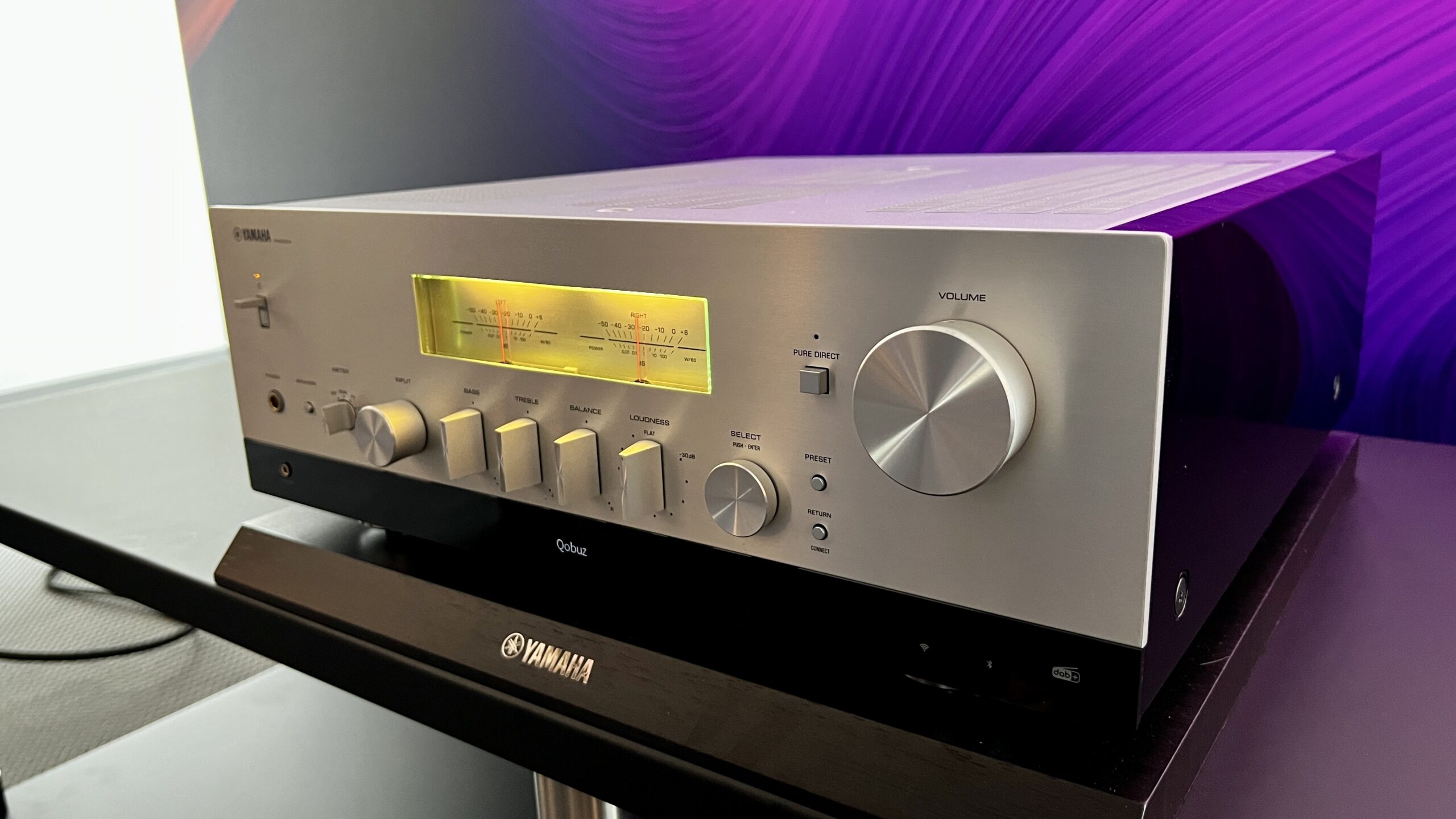
High End 2022: Yamaha RN-2000A


Super exciting integrated amplifier with streaming and DAC.

We asked Yamaha if they could make this – and they did! A fully integrated amplifier with power galore, wireless and analog with digital input, turntable input, and audio calibration system.

All in one box, weighing around 22 kg, and looking exactly like the high-end amplifiers in the 3000 and 5000 series.

It’s equipped with the Yamaha Parametric Room Acoustic Optimizer (YPAO), which, like the receivers, uses a microphone to calibrate the sound in the room. It worked, you can say, for just where yours truly sat, I had the calibration turned off and on, and the sound was clearly best with it activated.


RN-2000A. (Photo: Lasse Svendsen, L&B Tech Reviews)

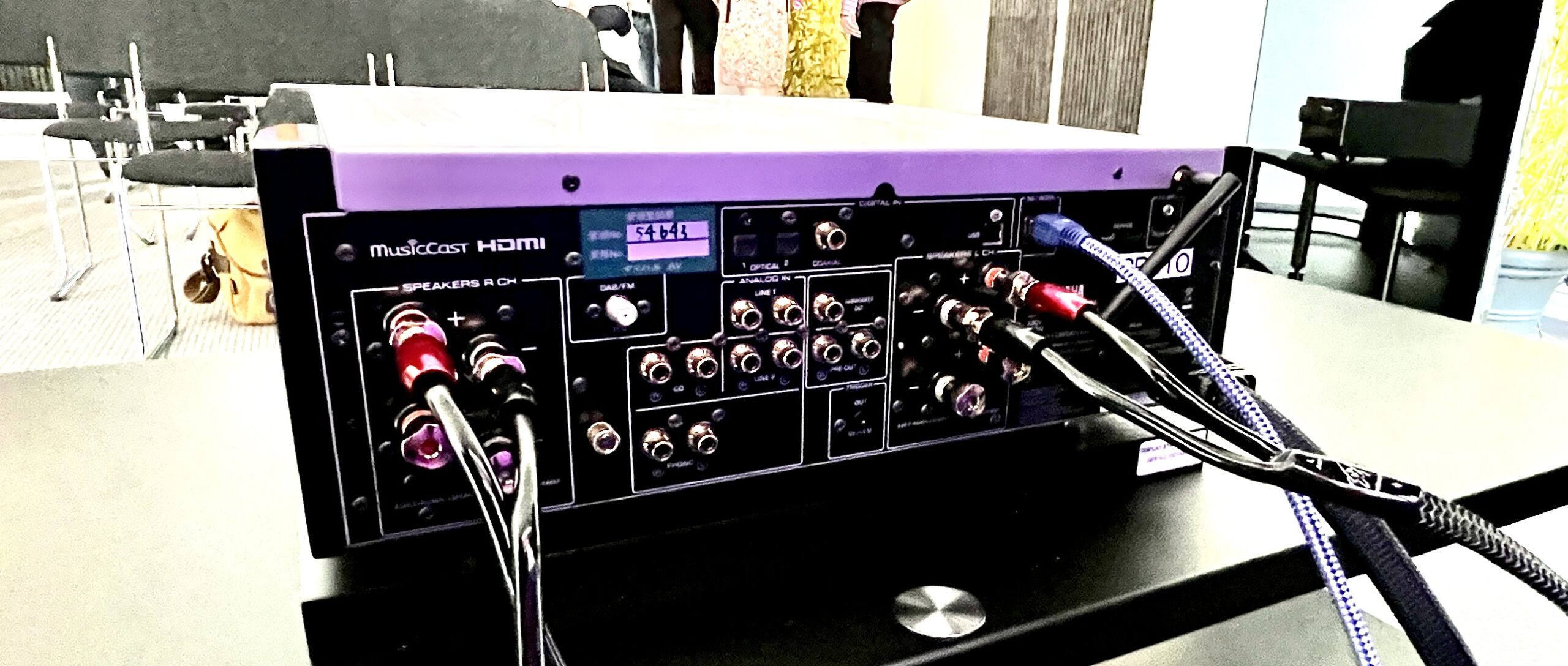
The amplifier, which also comes in black, has HDMI input with audio return (eARC), turntable input for MM pickup, a 32-bit, 384 kHz ES9026PRO DAC from ESS, USB DAC input, two optical and one coaxial digital input, Ethernet, DAB radio, subwoofer and pre-out.

It also has Yamaha’s MusicCast, which is their wireless variant with streaming over Wi-Fi, and it supports AirPlay 2, as well as pretty much every streaming service.


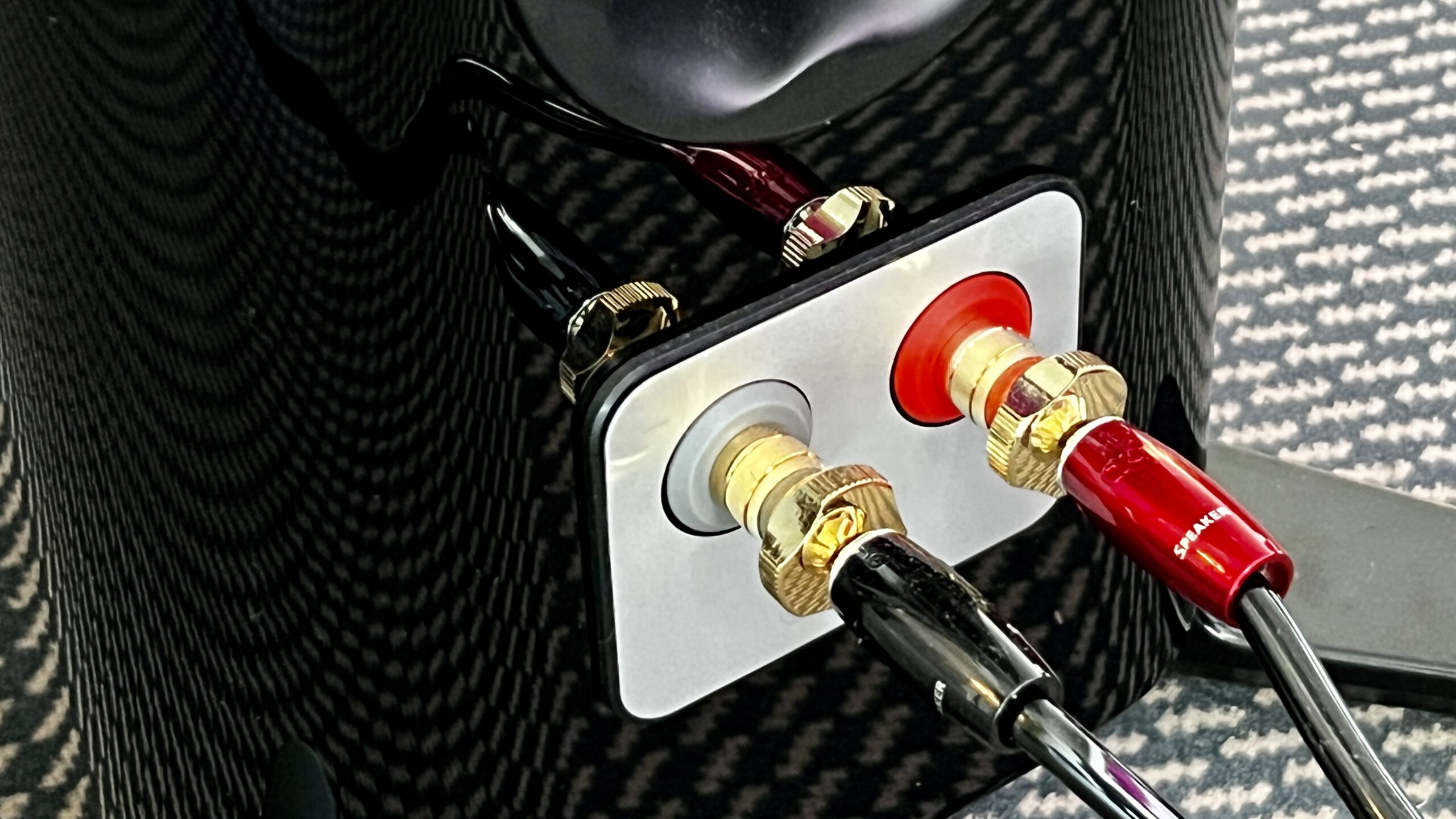
RN-2000A from behind. (Photo: Lasse Svendsen, L&B Tech Reviews)

The amplifier part of the RN-2000A, is a mix of the integrated A-S1200 and AS2200, with fully symmetrical built circuitry, a quite generous toroidal transformer, and components of a quality not found in the more affordable Yamaha amplifiers.

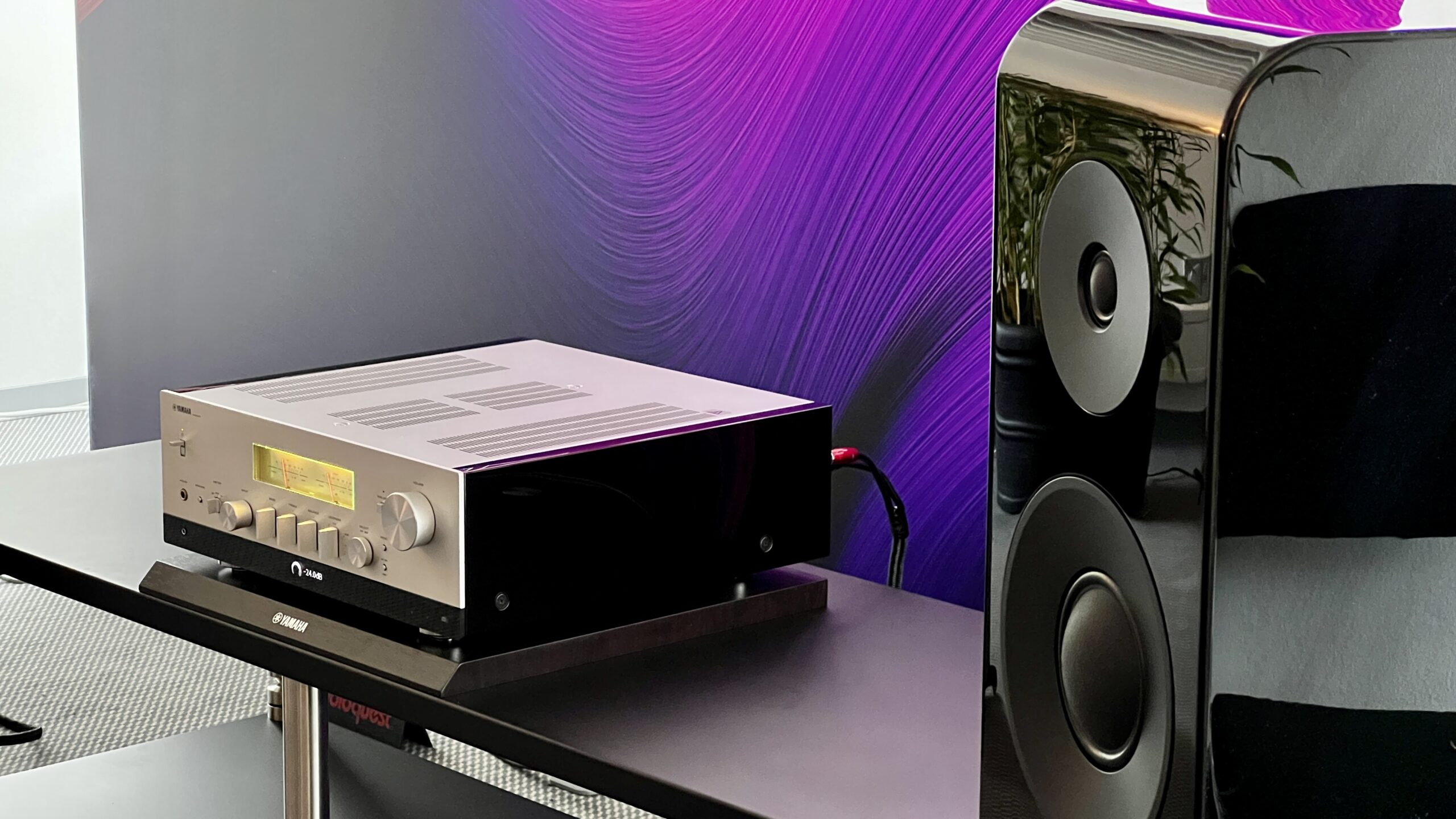
RN-2000A in silver finish. (Photo: Lasse Svendsen, L&B Tech Reviews)

The design is classic Yamaha, with a black area below the switches and potentiometers, where among other things an OLED screen shows setting selection and input. Yamaha specifies the power at 2 x 100 w in 8 ohms, or 185 w in 4 ohms.

The amplifier will not be in stores until the third quarter of 2022, estimated price is around 3500 Euro.
NS-2000A

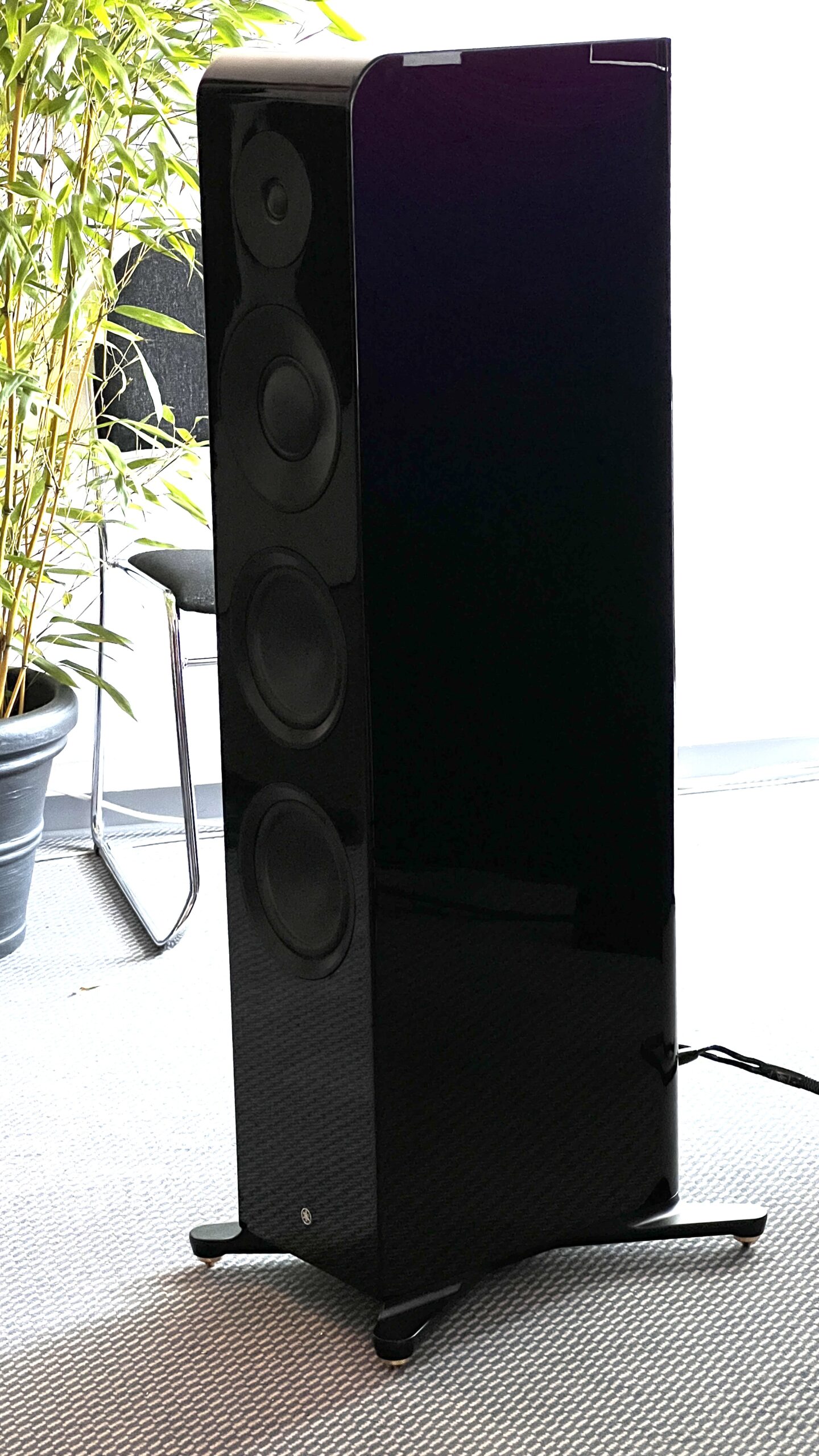
Around that price also the upcoming NS-2000A, a pair of floorstanding passive loudspeakers. A pair will end up at 7000 Euro.


RN-2000A and NS-2000A. (Photo: Lasse Svendsen, L&B Tech Reviews)

The speakers, like the amplifier, should be loyal to Yamaha’s True Sound concept. Which is about creating lifelike and harmonious sound, with realistic dynamics. In concrete terms, this means that the loudspeaker has Yamaha’s Harmonious Diaphragm, which is a combination of the artificially produced material Zylon, and spruce in the diaphragms.


Keen readers may notice that the NS-2000A has a completely new midrange driver, an 8 cm dome, which, together with two 16 cm woofers, and a 30 mm dome tweeter, makes up the speaker’s drivers.

NS-2000A. (Photo: Lasse Svendsen, L&B Tech Reviews)

Which also features Yamaha’s J-shaped acoustic absorber on the inside of the piano lacquered cabinet, which should manage to attenuate standing waves while not having to cram the speakers full of damping material. That also dampens the dynamics.

Yamaha specifies the frequency range to 34 Hz-65 kHz (-10 dB), the crossover frequencies are at 750 Hz and 3.5 kHz.

The dimensions are 33 x 113 x 46 cm and the weight 32 kg.
NS-2000A. (Photo: Lasse Svendsen, L&B Tech Reviews)

Lasse Svendsen
UNITED PHOTO PRESS


2.9.21

Canon Benefits From the Death of the DSLR


Notwithstanding problems with ramping back up production to pre-COVID levels, manufacturers have been generally optimistic about the emerging camera market as consumers start spending money that has been hoarded over periods of lockdown. Canon looks set to be the big beneficiary, but what about the other manufacturers?

Last year, 2020, was a year to forget for camera manufacturers as shipments of cameras (as recorded by CIPA) imploded from a record low of 15.2 million units in 2019 to a barely believable 8.9 million units. It's not so much the fact that shipments nearly halved, but rather that 10 years previously, camera shipments peaked at an incredible 121 million units. Of course, that isn't an entirely fair comparison, as compact cameras made up some 90% of those shipments; the margin was slim, but spread across a large number of units meant manufacturers made a very healthy profit. The camera world has changed significantly since 2010 with compact cameras now accounting for just 39% of units shipped. Perhaps of more interest to enthusiasts is the dramatic decline in shipments of DSLRs at the expense of increasing mirrorless units. Crucially, 2020 was the first year where more mirrorless cameras were shipped than DSLR. So, how is 2021 shaping up?

If there was a phrase to sum things up then it would be: "not good, but not disastrous." Looking at the monthly CIPA shipments to date (below), 2021 is significantly up on 2020, having reached parity in February. However, that is against a backdrop of a stop in manufacturing as COVID hit. Looking at 2019 is a better comparison, and shipments are down 40%, a significant drop; it is worth noting that we are not back at 2019 production levels yet, though. That said, by May in 2019, shipments were valued at ¥170 billion on a total year's value of ¥587 billion; 2021 is currently sitting at ¥134 billion, a 21% drop. This proportionately smaller reduction reflects three factors: a shift in production away from compact cameras, which now make up only 35% of shipments, the increasing price of cameras, and a shift toward more expensive models.


Perhaps of more interest is the split between DSLRs and mirrorless. Canon and Nikon have the former market sewn up, with Pentax desperately clinging on to whatever is leftover. The latter, however, is a complete free-for-all, as manufacturers battle to establish themselves in this emerging market. Of the 2.3 million interchangeable lens cameras shipped this year, 1.3 million were mirrorless (and 1 million DSLR) meaning that they make up 56% of the market. This compares to 2019 where 3.2 million units had shipped by this point, with 1.4 million mirrorless (and 1.8 million DSLR) making up 43% of the market.

Let those numbers sink in, then read this: mirrorless models make up 71% by value. And even though mirrorless shipments were down by 100,000 units, the value actually rose by 9%. There are some huge takeaways from (nearly) the first half of the year. Firstly, the value and shipments of DSLRs continue to implode. Not only are they shipping in significantly smaller numbers, but they are worth much less than the mirrorless market. DSLRs are rapidly becoming a small (but still important) camera segment. Secondly, ILCs share an increasing proportion of total camera shipments as manufacturers ramp down compact production. Thirdly, mirrorless models are now the single most important segment by volume and value. In fact, they make up 59% of the value of all camera production. The short story is that manufacturers have shifted production to mirrorless, and consumers are buying them. Quite where the balance between consumers wanting them and manufacturers wanting to produce their lies remains to be seen. If you are a camera manufacturer not making mirrorless cameras, then you are in a rapidly contracting market. Pentax, take note.
Canon Shines in the Mirrorless Market

I previously commented on 2020 sales figures and how these align with CIPA shipment figures. Canon was the best performing manufacturer last year. However, we are now halfway through the year. So, how are sales looking? There is limited evidence on this front; however, Nikon Rumors recently reported BCN sales data. As a reminder, BCN Retail reports online and in-store sales data for Japan and is believed to represent some 40-60% of domestic Japanese sales, with Japan accounting for about 15% of worldwide shipments.

In terms of mirrorless sales, Canon is closing the gap on Sony at about 28% and 32% respectively. The big loser has been OM Digital, dropping from over 25% to less than 15% of sales. This has now started to recover, and the brief bump for Fuji sales above 20% appears to be reversing. BCN doesn't report on sales below 10%, and so, Nikon is excluded, a worrying sign. When you switch to all ILC sales figures, Nikon pops back into contention (on the back of those declining DSLR sales) but at a worryingly low 10.9%, beaten by OM Digital at 11.3%, with Sony (25.8%), and Canon (36.8%) leading the pack. In fact, Canon has had an exemplary start to the year at the expense of almost everyone else but particularly Nikon. In short, while DSLR sales continue to drop, Canon is shifting plenty of mirrorless cameras, something which Nikon is struggling to do.

As expected, 2021 is proving to be a pivotal year for manufacturers for a variety of reasons. First and foremost, the DSLR is dead in terms of significant revenue and profit generation. Less than a third comes from DSLRs, and that figure is dropping with each month. In the same way that compact cameras serve a niche, so does the DSLR. The sooner that it becomes a small-scale, low overhead concern, the better for manufacturers. Secondly, rolling out a full suite of mirrorless models while at the same time filling out APS-C and full frame lens lineups is critical. This is where revenue is coming from.

Where does that leave manufacturers? Sony and Canon are both benefiting from the mirrorless pivot and remain highly competitive. Nikon is continuing to produce a range of highly desirable cameras, but for whatever reason, is not selling as many as it needs to; its quarterly report should provide more detail. Olympus has completed its transition to OM Digital in what has been a difficult year that has seen sales drop to low levels. Going forward, it remains to be seen if new management can provide a stable platform for future development. Pentax remains strangely wedded to the DSLR and must surely be cross-subsidized as a loss-making division by Ricoh. Fuji, through all of this, has remained buoyantly successful, quietly filling out its X and GFX lines while also selling an awful lot of Instax cameras and film. Eyes will almost certainly be on Nikon as the camera market continues to evolve.

Mike Smith

2.7.21

Here Comes the Canon EOS R3: More Specs Emerge


Canon has made a few development announcements regarding the upcoming EOS R3, dropping some specs that underscore just what a powerful camera it will be. Still, there is a lot we do not know about the upcoming body, such as its resolution. However, Canon is planning to make the official announcement in just a few days, and we'll soon know everything about the camera.

Canon Rumors is reporting that the official announcement of the Canon EOS R3 is coming on June 29, 2021 and that the RF 14-35mm f/4L IS USM will be announced on the same day. Perhaps the most exciting rumor is that the camera will come with a 30.1-megapixel backside-illuminated sensor. Canon already announced the design of the sensor, but its resolution has been up in the air until now. 

While it wasn't expected to be ultra-high resolution like EOS R5, I was certainly hoping it would be more than the 20 megapixels seen in the EOS R6. 30 megapixels seems to be a real sweet spot in modern cameras; it was an excellent balance in my 5D Mark IV. Of course, we'll also see other features like 30 fps continuous bursts, internal raw video, advanced autofocus, 8 stops of image stabilization when coordinated with optical and in-body capabilities, and more. It will be quite exciting to see what Tuesday brings!

Alex Cooke

29.4.21

Legendary Technics SL-1200 deck gets its MK7 release next month


Technics will next month release the SL-1200MK7, the silver finish of its legendary DJ turntable with specs matching those of the SL-1210MK7 released two years ago.

A club staple since being adopted by disco DJs soon after the deck's initial release in 1972, the SL-1200 is one of those rare components that blurs the lines between hi-fi and musical instrument thanks to its direct drive, high-torque motor, and the genius of some of the millions of fingers that have manipulated its platter.

With the silver top being part of what makes this record player such a cross-industry icon, this is also one of the few occasions where a new finish constitutes actual news. For those waiting out to adopt a MK7 Technics for that reason, May 2021 is the time – in Europe, at least.

Otherwise, the SL-1200MK7 is identical to the SL-1210MK7 the company released in January 2019. It features the same coreless direct drive motor with powerful torque, S-shaped tonearm, pitch control and reverse play function.

Both decks also boast a highly rigid cabinet and high-damping insulator, alone with a two-layer platter also with improved vibration damping – essential for stability in the face of 12 hours of bruising kicks.

The SL-1200MK7 will be on sale in Europe from next month, with RRP set at £799 (€899), with information on wider release to follow.

Those after the Technics sound in a more traditional home audio package, meanwhile, will be pleased to find the company has also detailed a new entry-level record player to follow the Award-winning SL-1500C.


5.4.21

Best professional camera 2021


Canon EOS 1D X III

Finding the best professional camera for you depends very much on the types of photos or video you're looking to take. Unless you can stretch to landmark all-rounder like the Sony A1, specialist tools remain the best choice for professionals – and whether you're a landscape photographer, portrait snapper or hybrid shooter, we've rounded up all of the best ones here.


Our best cameras for professionals round up mainly focuses on stills photography in the higher end of the mirrorless and DSLR market – though we have also included a couple of our favorite video-focused options and, yes, a Leica for the those who want something that's just a little bit more than a photographic tool. If you're looking for cine camera comparisons, though, it's best to look elsewhere.


We've picked our favorite choices covering an array of photography disciplines, including action, landscapes and reportage. DSLR fan? You'll find our favorite option, the Nikon D850, in our list. Branching out to mirrorless and the hybrid world of photo and video? There's a bit more choice here, from the Canon EOS R5 to the more affordable Fujifilm X-T4.

With smartphones monopolizing beginner-level cameras, manufacturers are investing heavily in this pro-level part of the market – and professionals are well and truly enjoying the fruit.


As things stand, the Canon EOS R5 is currently our top pick as the best professional camera. Aside from its initial overheating issues and video recording limits, it's a formidable camera that has well and truly raised the bar for photo and video performance, all in a compact body.

We're treading on new and exciting ground and there's never been an easier time to raise your game as a pro – so make sure you check out our whole guide to find the right match for you. Whatever scenarios you find yourself making images in, you'll know how important a reliable camera system is – and all of the ones below will both support your craft and stand the test of time.


The Canon EOS 1D X III is the company's flagship DSLR, a camera typically seen in the hands of professional action photographers at big events. It's a substantial and rugged bit of kit, designed for speed and to withstand harsh conditions. They don't come tougher than this.


You'll be able to rattle off 20.1MP still images at a rate of 16fps until the memory card fills up. Truly, there is no limit in the camera's performance for action and it is backed up by a staggering battery life of nearly 3,000 shots (which in real use for continuous shooting is much higher, too). Subject-tracking autofocus performance is also simply jaw-dropping.


But this isn't just an action camera – the EOS 1D X III is a brilliant video tool too, with 5.5K RAW 10-bit video up to 60fps. Beware, you'll need to save up for a handful of expensive CFexpress cards because those video files are huge. Unlike other competing DSLRs, Canon's Dual Pixel AF works exceptionally well in Live View, where you virtually get equal AF performance to when you're using the bright optical viewfinder. The only real downside is that there has been a price hike in this third 1D X installment.

13.2.21

More Sony FX3 Leaks – is Sony Gunning for Canon, Sigma & Blackmagic?


New images and specs of the Sony FX3 reveal a modular cinema camera with a possible $4,600 price tag.

More pics of the Sony FX3 have leaked online, along with purported specs, giving us a better feel for the mysterious new camera.

These new images of the Sony FX3 reveal a cine camera that seems to have a lot in common with the modular Sigma fp, with a form factor similar to the Blackmagic Pocket Cinema Camera 6K.

However, where previously we suspected that the top joystick might be so positioned due to a potentially huge screen that filled the camera rear, it now seems that the LCD screen has conventional dimensions – and the expected rear controls seem to be present and correct.

While these should be taken with a grain of salt, a set of specs leaked by Sony Alpha Rumors confirms that the FX3 will not be an 8K and may indeed occupy a similar position in Sony's lineup to that enjoyed by the Canon EOS C70 in Canon's.

According to the website, "The reliable specs so far" are as follows:

• Price is €3,795 [approximately $4,600 / £3,320 / AU$5,929]
• Takes CFexpress A cards
• Records 4k 120p and not 8k
• Preorders start on 23 Feb

In addition, the site also quoted a new source providing the following specs:

• "New fx3 is littlebit same as a7s3"
• Active cooling
• XLR adapter in box
• S-Cinetone
• "No overheating after 13hours 4K all-in 10bit 422"
• "3/4 holes on top 2 for xlr adapter 1 free"
• 3/4 on both sizes
• Price is €4,500

It certainly looks like Sony will be unveiling the FX3 at CP+ 2021 on 25-28 February, and we'll no doubt be seeing more leaks before then!


ORIGINAL STORY (11 Feb): Just weeks after the Sony A1 bombshell, another camera has been leaked – and the Sony FX3 could be poised to fire another salvo across Canon's bow.

Much as the Sony A1 launched as a direct competitor to the Canon EOS R5, it looks like the newly revealed Sony FX3 might be set to challenge the Canon EOS C70 – as well as other compact cinema cameras like the Blackmagic Pocket Cinema Camera 6K.

What's confusing about the Sony FX3 is that it carries the FX designation – making it part of the manufacturer's cine camera series, which includes the Sony FX6 and Sony FX9. However, it also bears the Alpha mark ("ฮฑ") that suggests it is part of Sony's conventional mirrorless camera range.

Still, the "Cinema Line FX3" branding on the camera's top plate betrays that Sony is positioning this as another contender for the best cinema camera crown. And the top plate also reveals something else very interesting: a top joystick, which is something we've never seen before.

This could be incredibly significant. It's entirely possible that a top joystick is simply an added bonus to improve ergonomic handling. However, it's also possible that Sony has delivered a monster 5-inch rear screen (similar to the Blackmagic Pocket Cinema Cameras, and the increasingly mythical Sharp 8K Video Camera), which means there's no room on the back of the camera for a joystick.

Further questions are raised by the camera's supposed specs, along with its naming convention. While uber-leaker Nokishita posted the image of the FX3, Mirrorless Rumors shared purported specs that this is "A New 8K ILME VIDEO CAM! It Can Shoot UHD 8K, Oversampled DCI 4K, HFR UHD 4K."

On the one hand, this is entirely possible; this could be the cine camera equivalent of the 8K Sony A1. And, much like the A1 bucked Sony's convention of lower numbers signifying more junior models, this could indeed mean that the FX3 is actually a technically senior camera than the FX6 and FX9.

So where does the truth lie? At the moment, between this and the A1, the video-focused Sony A7S III might just have become completely redundant. Of course, the specs could be incorrect and this could be, like the Canon EOS C70, a hybrid DSLR-styled cine camera that bridges the gap between mirrorless and cinema cameras.

With Japan's CP+ 2021 trade show taking place from 25-28 February, we're willing to bet that we'll find out the answers very soon.

James Artaius

28.12.20

Fujifilm Created a Magnetic Tape That Can Store 580 Terabytes

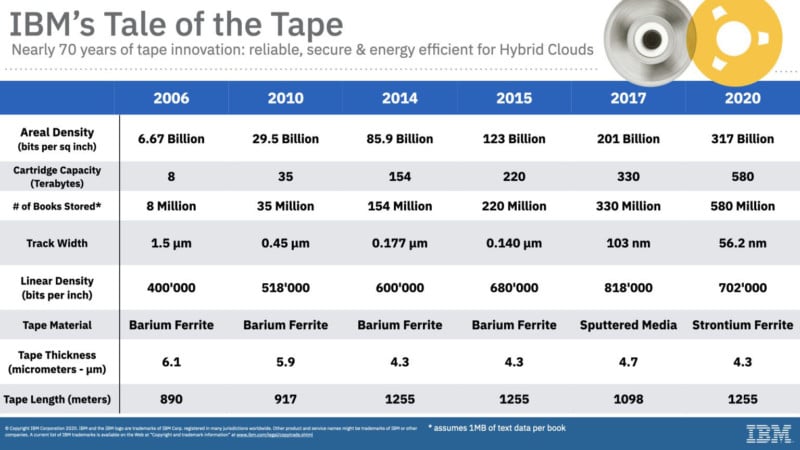
The progression of record-breaking magnetic tape storage capacities.


Fujifilm develops technology to deliver the world's highest 580TB storage capacity* for magnetic tapes using strontium ferrite (SrFe) magnetic particles

Data recording at the world's record** 317 Gbpsi*** recording density verified

TOKYO, December 2020 — FUJIFILM Corporation (President: Kenji Sukeno) is pleased to announce that it has achieved the world's record 317 Gbpsi recording density with magnetic tapes using a new magnetic particle called Strontium Ferrite (SrFe)*4. The record was achieved in tape running test, conducted jointly with IBM Research. This represents the development of epoch-making technology that can produce data cartridges with the capacity of 580TB (terabytes), approximately 50 times greater than the capacity of current cartridges*5. The capacity of 580TB is enough to store data equivalent to 120,000 DVDs.

SrFe is a magnetic material that has very high magnetic properties and is stable to maintain high performance even when processed into fine particles. It is widely used as a raw material for producing magnets for motors. Fujifilm has applied its proprietary technology to successfully develop ultra-fine SrFe magnetic particles, which can be used as a magnetic material for producing particulate magnetic tape media for data storage. The company has been conducting R&D for commercial use of SrFe magnetic particles as potential replacement of Barium Ferrite (BaFe) magnetic particles, currently used in magnetic tape data storage media. Magnetic tapes used in this test have been produced at the company's existing coating facility, confirming the ability to support mass production and commercialization.

The amount of data in the society is exponentially increasing due to the introduction of high-definition 4K / 8K video, advancement in IoT / ICT, and the proliferation of Big Data analysis. “Cold Data,” or data that was generated a long time ago and rarely accessed, is said to account for over 80% of all data available today. There is a fast-growing trend of utilizing such Cold Data and other accumulated data, creating the need to secure safe, affordable and long-term data storage. Magnetic tapes have been used by major data centers and research organizations for many years as they not only offer benefits including large storage capacity, low cost and long-term storage performance, but also create air gap data protection, physically isolated from the network, thereby minimizing the risk of data damage or loss caused by cyberattacks. In the future, magnetic tapes are expected to be used in cutting edge research fields involving large-scale data generation, such as the use of hybrid cloud environment*6 for efficiently managing massive data, smart-manufacturing for high-quality and high-efficiency production, and connected vehicles with internet connectivity.

Fujifilm has evolved its unique magnetic tape technology “NANO CUBIC”*7 to further increase the tapes' data recording density. The company's unique technology to synthesize nano-sized particles is applied to control particle growth by adjusting the addition of trace elements and the conditions for blending raw materials. This way, the particle volume is reduced to less than 60% of that of the current BeFe magnetic particles to successfully produce ultra-fine SrFe magnetic particles suitable for coating on magnetic tapes. A new dispersant is then used to evenly disperse and arrange the ultra-fine SrFe magnetic particles in the order of nanometers so as to achieve a high signal-to-noise ratio.

Additionally, the use of a newly-developed smooth non-magnetic layer (under layer) has improved the smoothness of the tape surface even further, reducing the space between a magnetic head and a magnetic layer for enhanced read back output. When combined with IBM Research's new track-follow technology*8, signal processing technology*9 and recording/read back devices that support them, the magnetic tape with a servo pattern*10 precisely laid out with proprietary technology can deliver the world's record 317 Gbpsi recording density, giving a further boost to the potential capacity of magnetic tapes.

As the world's top*11 manufacturer of magnetic tapes for computer data storage, Fujifilm will continue to develop and supply high-performance and high-quality media and services that satisfy customer needs and expectations to solve social issues.
<Fujifilm's technologies that have contributed to the latest achievement>

1) Development of fine SrFe magnetic particles

Fujifilm has successfully developed SrFe magnetic particles, which have higher magnetic characteristics and particle volume less than 60% compared to BaFe particles used in current magnetic tape media (Figure 2). They demonstrate excellent recording/read back performance with low noise.
Similarly to BaFe, SrFe is a chemically stable oxide, suggesting expectations of excellent performance in long-term data storage.

2) Enhanced perpendicular orientation of SrFe magnetic particles

Fine particles typically create difficulty in achieving their even dispersion. Fujifilm has applied a new dispersant and unique process technology to establish precise particle dispersion, thereby drawing out the performance of fine SrFe magnetic particles to the maximum. Evenly-dispersed SrFe magnetic particles are then arranged perpendicular to achieve a high signal-to-noise ratio.
[Image]
3) Improved smoothness of magnetic tape surface

The use of a newly-developed smooth non-magnetic layer (under layer) has reduced unevenness in the interface between the magnetic layer and the non-magnetic layer, improving the smoothness of the tape surface. This allows a magnetic head to go closer to the tape surface when reading signals, recorded in the magnetic layer (low spacing), boosting signal detection accuracy and read back performance.

4) Development of high-precision servo writing technology

Fujifilm has developed a unique tape-handling technology to control tape vibrations when writing servo patterns. Fluctuation of servo signals is minimized to maximize drive tracking performance, as assessed by IBM Research, thereby achieving high-density data recording in the direction of tape width.

10.8.20

Hiroshima atomic bomb memories still fresh for Japanese war bride of WWII digger


Takako Watts remembers washing her newborn sister's nappies in Kure hospital when suddenly the windows smashed.

The then-12-year-old came to learn it was caused by the shockwave from the atomic bomb dropped on Hiroshima, 20 kilometres away.

Although it happened 75 years ago, Ms Watts, who is now known as Cherry and lives in Murwillumbah in northern NSW, remembers as if it was yesterday.

"I started seeing all these people with burns coming into the hospital. I thought it was the end of the world," she said.

She remembers leaving the hospital with her mother and sister and seeing the devastation from the bomb.

"All the buildings were smashed to the ground with dead bodies underneath and a massive fire was burning throughout the city.

"We could smell the burning of flesh for days. It was horrible."

Before World War II, Ms Watts had lived a happy childhood; her parents were wealthy and had provided a stable environment for their children.

But that came to an abrupt end.

Kure, Japan's largest naval base and arsenal at the time, was constantly attacked by American bombers, with the family taking refuge in the side of a mountain where caves had been built.

"It was scary being in the cave at night because it was so dark. I would constantly pray to God to stop the war," Ms Watts said.

The mountain caves where Ms Watts and her family would hide during US bomb attacks.(Supplied)

When the war did end, it brought the arrival of occupation forces into cities like Hiroshima and Nagasaki — there was animosity in the ranks of allied soldiers and fear among the local population.

"My mother sent my sister and I away from Kure for fear that we would be raped by the soldiers, but we were allowed to return home when things calmed down," Ms Watts said.
Fraternising was discouraged

Despite the widespread ill feeling towards the occupiers, the young Takako would meet and fall in love with Australian soldier William Watts who was stationed at Kure.

"Bill was very good looking and cheeky and I married him against my parents' wishes," she said.

Ms Watts said they had to marry three times due to international law.

They first obtained permission to marry in 1949 at Kamiyama jinja, they married again in 1952, and then at the British consulate in 1953.

Takako and her husband had two children when they returned to Australia.(Supplied: Margaret Watts)

Mr Watts returned to Australia, and Cherry followed with 12 other war brides and their children on the long sea journey to Sydney in late 1953.

She was travelling with their two-year-old son, Joji, and new baby, Margaret.

"Australians found it difficult to pronounce our Japanese names, so many war brides were called Cherry after Japan's famous cherry blossom trees," she said.
Aussie humour for dinner

The family lived in Murwillumbah with Ms Watts's mother-in-law, Florence, who taught her how to cook local food — with a bit of Aussie humour thrown in.

"Florence was cooking rissoles one evening, and I asked her what they were; she said they were R-soles.

"So the next night I was cooking Bill's dinner, and he asks me what we were having, and I said, 'Arseholes'.

"Well, you should have seen the look on his face!"

No racial tension in small country town

Despite the anti-Japanese sentiment after the war, Ms Watts said she never experienced racism, with many locals becoming life-long friends.

Keiko Tamura, a researcher of Japanese war brides and lecturer at the Australian National University, said Japanese women were treated much better in regional towns than those who lived in the cities.

"They became known as someone's wife or sister-in-law instead of the enemy and country towns grew protective of them," Dr Tamura said.

Ms Watts's family in Japan did not speak to her until she returned for a visit in 1975.

Takako and Margaret live next to each other and love catching up for tea and sushi.(ABC News: Donna Harper)

Bill and Cherry had seven children and ran a banana plantation.

Mr Watts died from emphysema in 1995. He would have turned 100 last November, and Cherry and her eldest daughter celebrated his birthday in a unique way.

"We visited the cemetery where he's buried and poured beer over his headstone and wished him a happy birthday," Margaret Watts said.

Cherry and Margaret had hoped to travel to Japan this year to visit family on the 75th anniversary of the Hiroshima bombing but had to cancel due to the COVID-19 pandemic.

3.8.20

This week marks the seventy-fifth anniversary of the bombing of Hiroshima

A hundred thousand people were killed by the atomic bomb. Survivors wonder why they lived when so many others died.
Nuclear Remembrance days: 75th anniversary of Hiroshima and Nagasaki nuclear bombings.

2020 marks the 75th anniversary of the detonation of nuclear bombs during World War II in Hiroshima (August 6) and Nagasaki (August 9). There will be official commemoration ceremonies in Hiroshima and Nagasaki organised by these cities, was well as actions and events organised by civil society in Japan and around the world.

Due to COVID-19 pandemic, the official ceremonies in Hiroshima and Nagasaki will be invite only (to restrict numbers and allow for physical distancing) but can be watched live online. A number of other commemoration events will be run online as video conferences or live-streamed events.

See below for information on the Hiroshima and Nagasaki ceremonies plus other key international commemoration events. For more detailed information see Nuclear Remembrance and Action Week Aug 1-9 2020, which includes international events and suggested nuclear disarmamament actions to commemorate the 75th anniversaries of the nuclear bombings of Hiroshima and Nagasaki.


Hiroshima and Nagasaki ceremonies

The official Hiroshima commemoration ceremony will take place on Thursday August 6 from 8:00am-8:50am Japan time. Click here for information on how to watch the ceremony on livestream. The UN Secretary-General is expected to either attend the event or provide a video message if pandemic conditions prevent his attendance. For more information see Hiroshima Peace Memorial Ceremony and Notice regarding Hiroshima Memorial 2020 ceremony procedures in light of COVID-19 pandemic. The official Nagasaki commemoration ceremony will take place on Sunday August 9 from 11am-12pm Japan time. Click here to watch the ceremony on livestream. For more information see Nagasaki Peace Memorial Ceremony


Peace Wave

From August 6 at 8:15am, the time that the nuclear bomb was detonated over Hiroshima, until August 9 at 11:02am, the time the nuclear bomb was detonated over Nagasaki, peace activists around the world will undertake individual and/or group actions as part of a ‘Peace Wave’. You can join the peace wave by undertaking your own small, creative, social media action from home or interesting location, or joining an action in your community. For more information and to register your action, please visit Peace Wave 2020.

International Fast

Every year since 1984, a small group of peace campaigners from France and Germany have fasted from August 6 until 9 in commemoration of the nuclear bombings and to call for the global abolition of nuclear weapons. In recent years, they have been joined by fasters in the Ivory Coast, New Zealand, UK and USA. This year, in the light of the Coronavirus pandemic and its devastating consequences, the fast will also highlight the many millions around the world threatened by malnutrition or famine, while governments continue to spend $100 billion per year on nuclear weapons and $1.9 trillion per year on weapons and war. Participants in the Fast will donate the money they would on food during that time to organizations or charities helping to feed the destitute. You are invited to join the fast. Contact Dominique Lalanne (France) or Marc Morgan (UK).

2020 World Conference against A and H Bombs

Every year Gensuikyo (the Japan Council against Atomic and Hydrogen Bombs) holds a world conference against A and H Bombs in Japan in conjunction with the commemorations of Hiroshima and Nagasaki Days. The theme for the conference this year is “With the Hibakusha, Let Us Achieve a Nuclear Weapon-free, Peaceful and Just World – for the Future of the Humankind and Our Planet” Due to COVID-19 pandemic, the 2020 world conference will be held by a series of webinar sessions from August 2 until August 9. There will be three main sessions (2 hours each) on August 2, 6 and 9, plus some additional special sessions. For more information including the draft program see 2020 World Conference on A and H Bombs.

Youth Peace Week and UN International Youth Day

Youth Peace Week is from August 3rd to 9th 2020. Originally established in New Zealand as Schools Peace Week with the support of the New Zealand government, the week spread to other countries. This year it has been broadened to Youth Peace Week as it only suits schools in the Southern Hemisphere (schools in the North are mostly on summer break). The theme this year is Celebrating Diversity. For more information and to register your youth action, see Youth Peace Week, visit the Youth Peace Week facebook page or contact the Youth Peace Week coordinator. Abolition 2000 also encourages those commemorating UN International Youth Day on August 12, to ensure that peace and nuclear disarmament are included as themes to your action or event.

Ribbon 2020 – Tangible hope for No nuclear war

The Ribbon International was founded as an artistic event to commemorate the Hiroshima and Nagasaki anniversaries. On August 4, 1985, fifteen miles of Ribbons encircled the Pentagon and other important monuments: With the message of “What I cannot bear to think of as lost forever in a nuclear war”. The Atomic Bomb Dome in Hiroshima was also encircled. Various other Ribbon events have taken place since then. On August 1st 2020 at 10:00 am (EDT), The Ribbon International will hold a Ribbon 2020 memorial event by Zoom. You are invited to join the event with your friends/family. Hold your Ribbon in front of the Zoom screen, and pray for a nuclear free world. For details see The Ribbon International 2020 event, or contact The Ribbon International

Other events and event Calendars

The above, and other international events are listed on the Abolition 2000 events calendar. National and local events are listed on the FCNL Nuclear Calendar, World Beyond War events calendar and Hiroshima Nagasaki 75 events page (USA), Terminkalender (Germany) and Campaign for Nuclear Disarmament Events (UK). We encourage you to check these calendars.

22.6.20

Take a first look at the flagship Technics SL-1210GAE turntable "Limited Edition"


A new video shows the all-black Technics SL-1210GAE limited edition, 55th anniversary turntable, in all its glory.

Few things get us hot under the collar like a new Technics turntable. Last month Technics gave us the lowdown on a new limited edition, flagship record player, the SL-1210GAE, and now the company has given a first look at the deck in the flesh.

The video sees Bill Voss, the Technics Business Development Manager in the US, walk us through the product, giving us a better look at the new all-black design on this new 1210GAE model.
The turntable is a 55th anniversary, limited edition special, with only 1000 units set to be made available worldwide. Based on the SL-1200G, and following in the footsteps of the limited edition SL-1200GAE from 2016, the new SL-1210GAE has a 10mm-thick aluminium top panel complete with an anodized black brushed finish. The buttons and tonearm also have the same all-black finish.

As well as the all-black design, the GAE has a special badge with inscribed serial number, upgraded insulation and, for the first time, the European models will ship with a specially-tuned Nagaoka MM cartridge.
You can turn off the strobe light on the 1210GAE, a first for Technics, which Voss demonstrates in the video by holding the x2 pitch button for 5 seconds. 
He's also keen to show-off the high torque, holding his finger against the rotating platter while the motor corrects the speed to keep a constant rotation. 

Tipped to "sell out very quickly", the SL-1210GAE is due on sale this month, priced at €4719. You better speak to your friendly dealer sooner rather than later if you want to splash the cash. A little dear for your tastes?