Showing posts with label Fujifilm. Show all posts

7.1.23

4 Favorite Medium Format Film Cameras


If you love film photography, you’re missing out if you don’t use medium format film cameras. Arguably, this is where you’ll really to start a major advantage over digital photography. There’s also things like the look, the feel, and the overall approach to how you work with subjects. You have to be a million times more conservative with how you shoot photos. So we dove into the Reviews Index to find some of the best medium format film cameras we’ve used.

Why We Chose These Medium Format Film Cameras

First off, we’ve reviewed a bunch of medium format film cameras over the years. And we’ve specifically chosen these for a variety of reasons. With the exception of the Mamiya 6, all of these cameras are completely analog and don’t need batteries at all. Of course, if you get a metered prism for the two SLRs, that’s the exception. But a fully analog camera will always work no matter what. The Mamiya 6 was chosen because the system has arguably some of the best lenses ever made. It’s also incredibly versatile, and I love the square format.

No Hasselblad? Yes. The reason for this is because of the pricing. That’s also why we haven’t reviewed or listed the Contax 645, Mamiya 645, etc. We also chose the Mamiya RB67 because it’s often more reliable than the RZ67. We also didn’t choose a 645 format camera because digital 645 arguably outdoes film at this point.

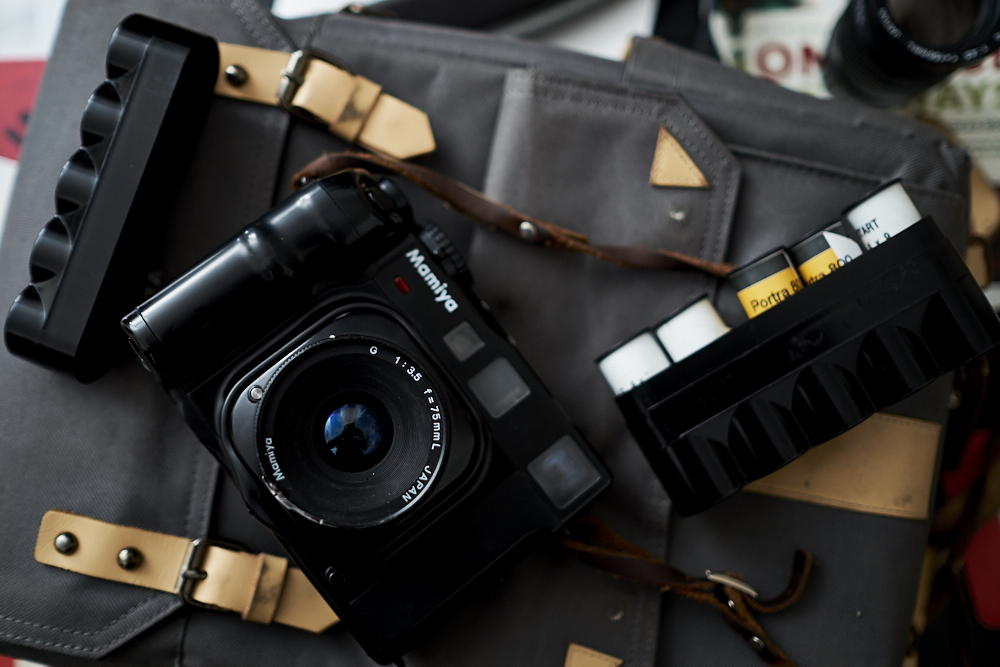
Mamiya 6: Square Medium Format
“I’ve been on the search for the perfect medium format film camera for me for years now. This, the Fujifilm GW690 III, and the Mamiya RB67 Pro S are amongst my favorites. I prefer to have a multitude of formats and cameras that can handle different situations accordingly. But of any of those, the Mamiya 6 seems to offer the most versatility. I can use it for documentary work, studio work, landscapes, portraiture, and so much. It’s just meant to be a damned good professional film camera.”

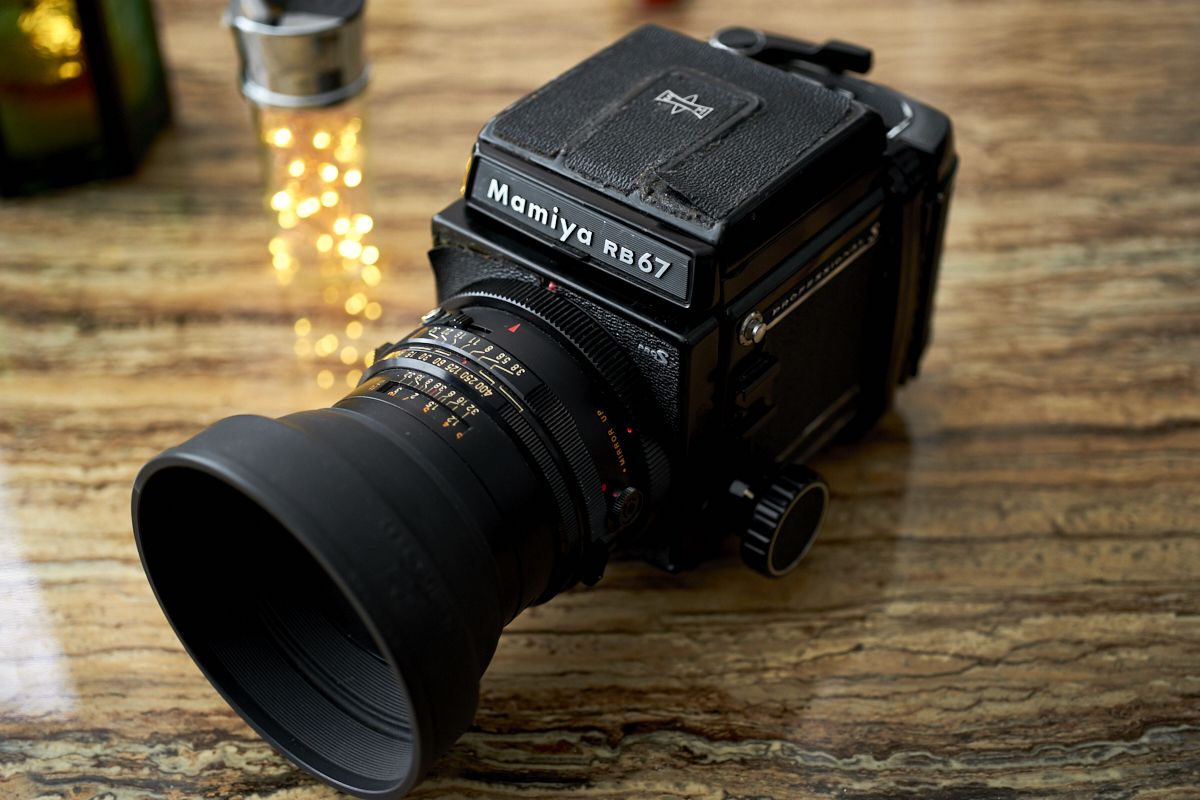
Mamiya RB67: 67 Medium Format
“The Mamiya RB67 Pro S is a camera meant for the serious photographer that wants to stick to analog. It’s a studio and landscape camera that will most likely require a tripod from you. They’re fantastic to use; but also keep in mind its difficulty.”

Pentax 67: Obviously, 67 Format
“The Pentax 67 is honestly a fantastic medium format SLR camera. It has found a way into the heart of so many photographers. With a plethora of fantastic lenses, it is surely best used when shooting with natural light outdoors. It’s not the best for studio work and location work with a flash due to the long flash duration of 1/30th. You’ll also want to use wider lenses for something like that.”

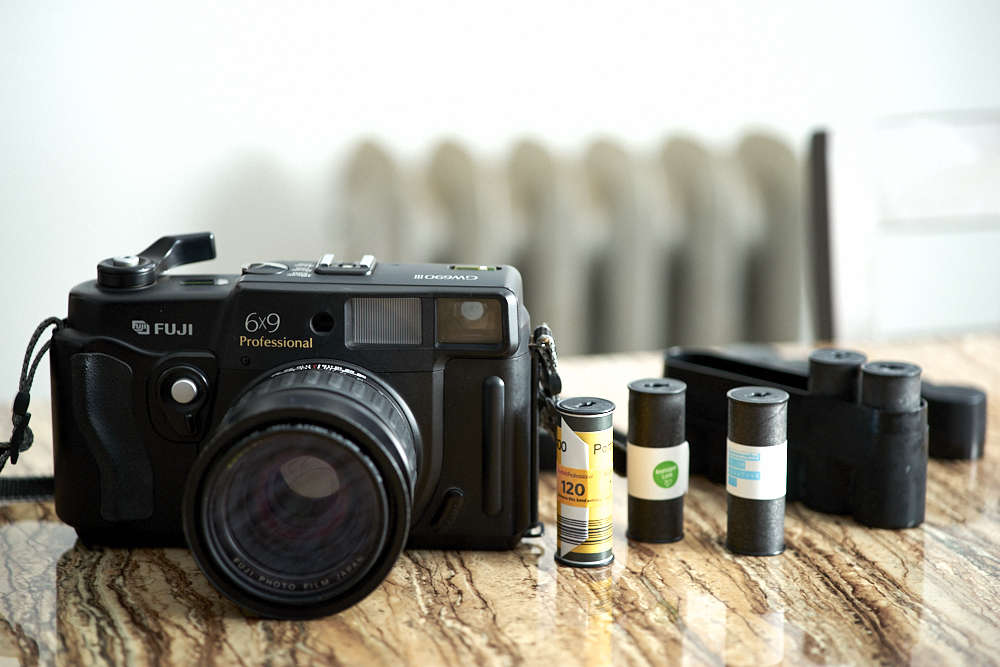
Fujifilm GW 690 III: Big is Beautiful
“I’ve been using the Fujifilm GW690 III for a really long time now. By far, it’s my most used medium format film camera, even over my Mamiya RB67 Pro S. That’s because it’s got a small(ish) size, fantastic lens, rangefinder focusing, and it’s reliable. Sure, you’re only getting eight shots per 120 film roll, but if you’re careful then that’s enough.”

28.3.21

Shooting Affordable Medium Format Polaroids


There are areas of photography that are revered by many photographers, two of them are medium format and Polaroid. However, combining the two has become tremendously expensive in recent years. Perhaps now there's a solution.

I have a well-documented love affair with medium format. Some of it — possibly a lot of it — isn't overly logical, but I love it all the same. In the last few years, I have dipped my toe into something else that interested me and the other side of today's coin: Polaroid. I was lent a Leica Sofort and while it wasn't perhaps the best example of instant photography, it was endearing. Then my girlfriend's family found their original Polaroid similar to the famed SX-70 and I fell deeper still.

However, the idea of shooting medium format square Polaroids is very enticing indeed. It was a popular way of shooting, both creatively and for testing purposes, during the film era and Fujifilm has an adored film type called the FP-100C which was discontinued in 2016. As with all discontinued film types that are loved, their price rocketed, and now even expired packs of 10 shots will cost you $70 or more. In this video, George of NegativeFeedback experiments with a cheaper way using a Zinstax Polaroid back for the Mamiya RZ67 which can use Instax film at a much cheaper price per shot. If you want to see a video showing exactly how it all works, here you are:


5.3.21

Examining 400 Megapixel Images From the Fujifilm GFX 100 Pixel Shift Mode


The Fujifilm medium format titan was already called into question by many because 100 megapixels is overkill for most photographers. Well, Fujifilm didn't just double-down on that, they used a Pixel Shift mode to quadruple-down.

I've already waxed lyrical about the Fujifilm GFX 100 this month, singing how it's even more impressive than you might have realized once you see inside the specialized factory which makes it. Well, I'm going off again, this time over the Pixel Shift mode that was added through a firmware update.

My first experience with Pixel Shift was with a much smaller sensor: the Olympus OM-D E-M1 Mark III which uses a micro four-thirds sensor. I was thoroughly impressed that, handheld, I could take pictures of most subjects — even wildlife — and increase the image resolution far beyond the sensor's maximum. If you're not sure how that's achieved, I implore you to Google it as it's a little time-consuming to explain, albeit rather straightforward.

Well, Fujifilm updated the GFX 100 to include this technology, increasing the maximum image resolution from 100 megapixels, to 400 megapixels. I'll echo what I said in the first line: 100 megapixels is overkill for most photographers. Even in my niche work macro stacking watches for commercial use wouldn't see much use out of 100 megapixels over, say, just 50 ("just.") So, 400 megapixels really will take some spectacularly specific work to see any form of a necessity for it. That doesn't mean, however, it isn't incredibly impressive. I shot an image from a Tokyo rooftop in daylight with the GFX 100 just to see how much I could zoom. A 200% crop on a baseball field showed the players clearly — players I couldn't really see when viewing the full image. Well, with 400 megapixels, I could probably tell you their eye color.

A quick word of warning, though: you're going to need a computer with a high spec for these files not to cause your RAM, processor, and graphics card to fuse together in a smoldering blob at the bottom of your case.

Robert K Baggs

28.12.20

Fujifilm Created a Magnetic Tape That Can Store 580 Terabytes

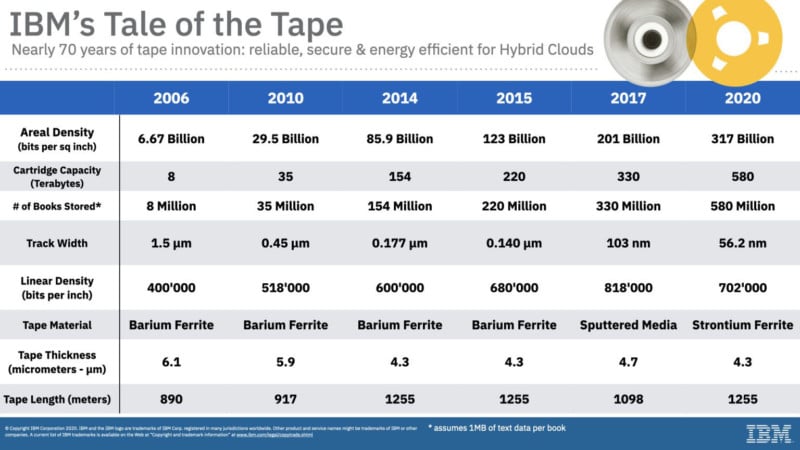
The progression of record-breaking magnetic tape storage capacities.


Fujifilm develops technology to deliver the world's highest 580TB storage capacity* for magnetic tapes using strontium ferrite (SrFe) magnetic particles

Data recording at the world's record** 317 Gbpsi*** recording density verified

TOKYO, December 2020 — FUJIFILM Corporation (President: Kenji Sukeno) is pleased to announce that it has achieved the world's record 317 Gbpsi recording density with magnetic tapes using a new magnetic particle called Strontium Ferrite (SrFe)*4. The record was achieved in tape running test, conducted jointly with IBM Research. This represents the development of epoch-making technology that can produce data cartridges with the capacity of 580TB (terabytes), approximately 50 times greater than the capacity of current cartridges*5. The capacity of 580TB is enough to store data equivalent to 120,000 DVDs.

SrFe is a magnetic material that has very high magnetic properties and is stable to maintain high performance even when processed into fine particles. It is widely used as a raw material for producing magnets for motors. Fujifilm has applied its proprietary technology to successfully develop ultra-fine SrFe magnetic particles, which can be used as a magnetic material for producing particulate magnetic tape media for data storage. The company has been conducting R&D for commercial use of SrFe magnetic particles as potential replacement of Barium Ferrite (BaFe) magnetic particles, currently used in magnetic tape data storage media. Magnetic tapes used in this test have been produced at the company's existing coating facility, confirming the ability to support mass production and commercialization.

The amount of data in the society is exponentially increasing due to the introduction of high-definition 4K / 8K video, advancement in IoT / ICT, and the proliferation of Big Data analysis. “Cold Data,” or data that was generated a long time ago and rarely accessed, is said to account for over 80% of all data available today. There is a fast-growing trend of utilizing such Cold Data and other accumulated data, creating the need to secure safe, affordable and long-term data storage. Magnetic tapes have been used by major data centers and research organizations for many years as they not only offer benefits including large storage capacity, low cost and long-term storage performance, but also create air gap data protection, physically isolated from the network, thereby minimizing the risk of data damage or loss caused by cyberattacks. In the future, magnetic tapes are expected to be used in cutting edge research fields involving large-scale data generation, such as the use of hybrid cloud environment*6 for efficiently managing massive data, smart-manufacturing for high-quality and high-efficiency production, and connected vehicles with internet connectivity.

Fujifilm has evolved its unique magnetic tape technology “NANO CUBIC”*7 to further increase the tapes' data recording density. The company's unique technology to synthesize nano-sized particles is applied to control particle growth by adjusting the addition of trace elements and the conditions for blending raw materials. This way, the particle volume is reduced to less than 60% of that of the current BeFe magnetic particles to successfully produce ultra-fine SrFe magnetic particles suitable for coating on magnetic tapes. A new dispersant is then used to evenly disperse and arrange the ultra-fine SrFe magnetic particles in the order of nanometers so as to achieve a high signal-to-noise ratio.

Additionally, the use of a newly-developed smooth non-magnetic layer (under layer) has improved the smoothness of the tape surface even further, reducing the space between a magnetic head and a magnetic layer for enhanced read back output. When combined with IBM Research's new track-follow technology*8, signal processing technology*9 and recording/read back devices that support them, the magnetic tape with a servo pattern*10 precisely laid out with proprietary technology can deliver the world's record 317 Gbpsi recording density, giving a further boost to the potential capacity of magnetic tapes.

As the world's top*11 manufacturer of magnetic tapes for computer data storage, Fujifilm will continue to develop and supply high-performance and high-quality media and services that satisfy customer needs and expectations to solve social issues.
<Fujifilm's technologies that have contributed to the latest achievement>

1) Development of fine SrFe magnetic particles

Fujifilm has successfully developed SrFe magnetic particles, which have higher magnetic characteristics and particle volume less than 60% compared to BaFe particles used in current magnetic tape media (Figure 2). They demonstrate excellent recording/read back performance with low noise.
Similarly to BaFe, SrFe is a chemically stable oxide, suggesting expectations of excellent performance in long-term data storage.

2) Enhanced perpendicular orientation of SrFe magnetic particles

Fine particles typically create difficulty in achieving their even dispersion. Fujifilm has applied a new dispersant and unique process technology to establish precise particle dispersion, thereby drawing out the performance of fine SrFe magnetic particles to the maximum. Evenly-dispersed SrFe magnetic particles are then arranged perpendicular to achieve a high signal-to-noise ratio.
[Image]
3) Improved smoothness of magnetic tape surface

The use of a newly-developed smooth non-magnetic layer (under layer) has reduced unevenness in the interface between the magnetic layer and the non-magnetic layer, improving the smoothness of the tape surface. This allows a magnetic head to go closer to the tape surface when reading signals, recorded in the magnetic layer (low spacing), boosting signal detection accuracy and read back performance.

4) Development of high-precision servo writing technology

Fujifilm has developed a unique tape-handling technology to control tape vibrations when writing servo patterns. Fluctuation of servo signals is minimized to maximize drive tracking performance, as assessed by IBM Research, thereby achieving high-density data recording in the direction of tape width.

9.9.20

Fujifilm Introduces World's First F/1.0 Mirrorless Lens


An ultra low light 50mm lens that’s weather sealed.

Fujifilm has just released a new X-Mount lens that’s a winner in low light conditions — the world’s first F/1.0 mirrorless lens. 

The Fujifilm XF 50mm F/1.0 mirrorless lens features 12 elements, a smooth 120-degree focusing ring, and is capable of shooting in 14 degree F temperatures in wet and sandy environments.

Nicknamed “The One” this is one chunky lens as its filter size alone is 77mm and it weighs 1.86 pounds. Heftiness aside, the lens is incredibly sharp and made for portrait shooting. 

Those looking for a fast prime lens for their Fujifilm X-Mount camera can find the XF 50mm F/1.0 over at Fujifilm where it is selling for $1,500 USD.