Showing posts with label photography. Show all posts

28.6.22

How to Turbocharge Your Photography Workflow


I recently heard a photographer say he’d spent 17 hours going through 10,000 images, deciding which ones were worth saving. My first thought was, “I hope he’s retired.” My second thought, though, was that he badly needed a lesson on speeding up his workflow. Which led me to write this guide on how to turbocharge your photography workflow.

I started shooting digital for my newspaper in the fall of 1996. By the spring of 1997, I’d been tasked with helping convert the entire department to digital. I quickly learned that the gear was the easy part. It was the workflow — downloading, organizing, renaming, adding valuable information to the photos (names, locations, etc.), and then being able to find the images — that was the hard part.

Over the next half-dozen years, as I left my paper and began a freelance career, I carved out a niche in helping other newspapers make the transition to digital. And again, gear was the easy part, workflow the challenge. My attitude was that with computers and the right software, photographers should be able to handle more photos more quickly than ever before. But that wasn’t as easy as it sounds.
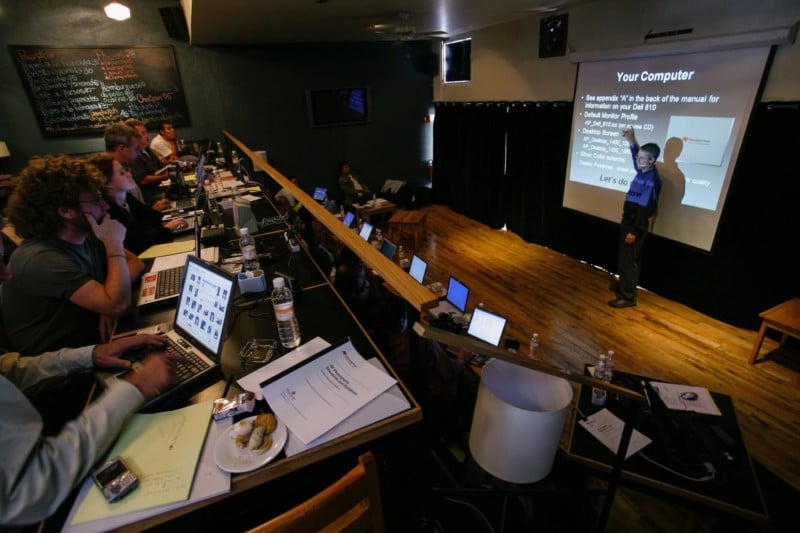

In 2007 I was hired by the Associated Press to lead workflow classes for their photographers at different locations around the world. In addition to this class in Mexico City, I also ran sessions in Bangkok, Delhi, Tokyo and Lima, Peru.

The two keys to any good workflow are that it’s easy to repeat and accomplish whatever goals you have. In a company, that means it has to be designed to fit the company’s needs, and then everyone has to follow it. Both of those can be challenging to accomplish when a large number of people are involved.

For an individual, though, it’s much simpler. I’m often asked what my workflow is, and I am happy to share it. But what really matters is that it makes sense to you and is easy to do. Here are the five basic steps that any photographer can (and should) take to make the process as painless and efficient as possible.

1. Automate the Download

Computers are great at automating things, so why not have them do that? The best photography applications out there can automate the download process. They can create a folder structure, name the folder(s), rename the images, and add important metadata (like copyright, location, and caption information).


If your workflow has you plugging the card in, creating a folder on the computer, and dragging the images to it, you’re not just wasting time, you’re making every step after that more difficult. For years now I’ve posted a PDF on my website titled “Automating Digital Downloads” that explains, step-by-step, how to accomplish this with Photo Mechanic (my favorite), Lightroom and Adobe Bridge. It covers everything from folder structure to captions and renaming (which is critical).
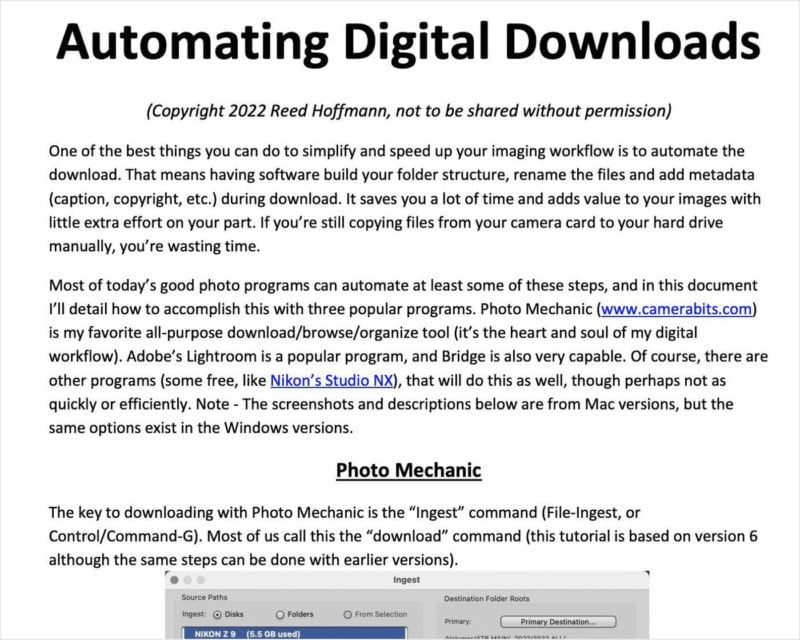

This is the PDF I’ve written explaining how to automate the process using Photo Mechanic, Adobe Lightroom or Adobe Bridge. Click the link in the text above to go to the download location for it.


2. Keep or Delete?

In the early days of teaching workflow, one of the things I always preached was, “Why waste time looking for bad photos?” That meant storage was cheap, so don’t spend time looking for photos to delete. Download, find your best photos, work them up and move on.

Then I got my first truly high-resolution camera, a Nikon D800 (36 megapixels). Shooting RAW, each time I pressed the shutter button I was creating a file around 50MB in size… which made me change my tune and flipped that part of my workflow upside down. Now, after downloading, I still go through and look for my best photos. But as I do that, I mark them (“tag,” “flag,” whatever your software calls it). I’m overly generous doing that, not looking at images critically and marking any image I may have a possible use for (I shoot a lot of “before” and “after” photos for teaching).

Once I’ve marked them, I tell the software to select the photos I didn’t mark (“Untagged,” in Photo Mechanic terms) and delete them. That means that on most shoots, I end up keeping about 25% of what I shot. Going through 1000 images takes me less than an hour.


3. Master Files

The goal here is to always work on your images non-destructively, meaning the original pixels remain untouched. That could be through a catalog program (like Lightroom or Mylio), where the edits are virtual, or saved with Layers or as a DNG file (with more traditional editing programs, like Photoshop or Adobe Camera Raw). All of those mean that whatever you’ve done can be undone easily, allowing you to go backwards or forwards without starting all over again, from that “Master” file.

If using a catalog program, then you should have a way of marking your very best images (color or number rating) so they can be easily searched for and found. If you use a folder-based workflow (like I do), then those best images should be saved as PSD or DNG files. In that case, for me, it makes sense to save those “Master” files back into the folder with the RAW or JPEG originals.
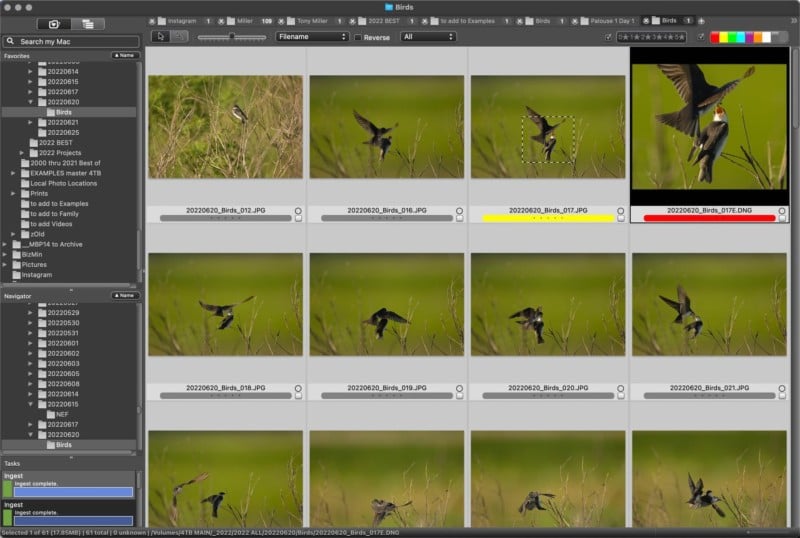

Here’s a contact sheet (in Photo Mechanic) from some bird photography I did earlier this week. The image marked yellow was one I chose to edit, the red one is the version after being edited and saved as a DNG file, and what I used to generate a lower-rez version with PM to share on Instagram.


4. Create Smaller “Best Of” Collections

Obviously, any time you need to find one of your best photos, you don’t want to search the entire archive. So easy access to smaller sets, or collections of images, is important. And once again, how you do this will depend on whether you use a catalog system or folder-based (like with Photo Mechanic or Bridge).
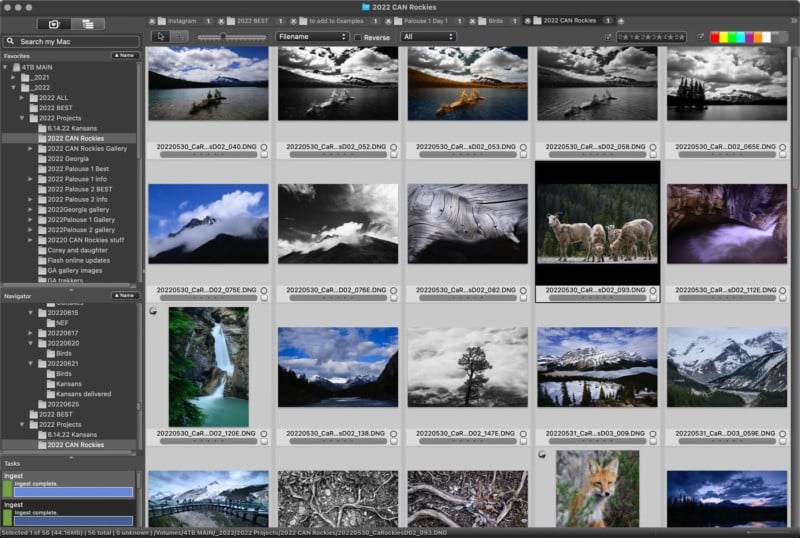

Each trip I take, or workshop I lead, results in a folder of my favorite images. I do everything date based, starting with the year, making it easy to sort and find chronologically. Here’s the folder with my favorite 56 photos from the Canadian Rockies photo trip I recently led.

Catalog. Lightroom calls this ability to group virtual images together “Collections.” The advantage of a catalog is that you only need one original. You can then have as many virtual copies of that image in as many different collections as you like without copying it over and over. The disadvantage is that you need to be very careful to keep that catalog, as well as the original files backed up in multiple locations. Otherwise, a hard drive failure or other loss could be catastrophic, since all the work you’ve done lives in that catalog.

Folder-Based. On the other hand, a folder-based system means that as you create different collections, you’re copying that original (and edited version) to multiple locations, which automatically creates multiple backups. The advantage here is that those original files live in multiple different places. The disadvantage to this system is that it requires more storage capacity (hard drives).
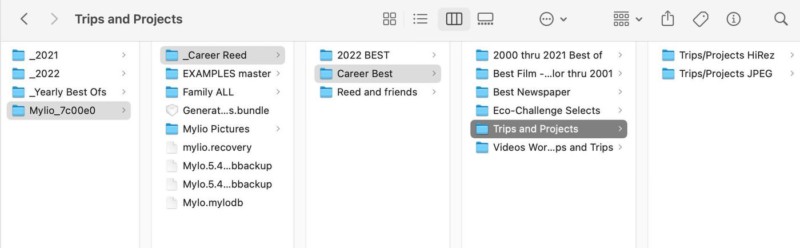

Here you can see the folder structure for my long-term archive. I use Mylio to synchronize the images to other devices (from hard drives to my phone), as a way to both backup the files and make them easily accessible.

Regardless of which system you use, creating smaller collections of your best images will make it much easier to find the ones you want, quickly. For instance, right now I’m building a “Best of 2022” for my very best photos from this year. I also have a “Best of 2000-2021” which is the cream of the crop from each of my yearly “Best of” collections. And in early 2023, I’ll select the very best from 2022 and add them to that larger collection, then change the name to, “Best of 2000-2022.” This is how my system looks right now:
2022 ALL. Contains dated folders for every day I’ve taken pictures this year.
2022 Best of. Every couple of months I go through my recent shoots and add some photos.
2022 Trips. I create “best of” collections from every trip or workshop each year. So far:2022 April Georgia
2022 May Palouse 1
2022 May Palouse 2
2022 June Canadian Rockies
5. Storage and Backup

Whenever I’m asked how many backups people should have, my answer is always, “However many lets you sleep soundly.” In other words, there’s no magic number, just whatever makes you feel comfortable your photos could survive a disaster. But the rule of three is a good starting place. One copy on your primary hard drive (I use a RAID array, mirrored, as that primary drive). One copy on a second hard drive you can connect and backup to regularly (in other words, at home). And a third hard drive that’s kept off-site, whether at a friend’s home, an office, or a safe deposit box, that you can easily bring home, back up to, and then return to that off-site location.

If you have high-speed internet, then taking advantage of a cloud option is a good idea as well. However, considering the amount of time it would take to download everything from the cloud, I hope to never need it.

The second part of backup is to ask what you really need backed up. After all, should my home be destroyed, I don’t care about recovering every photo I’ve ever taken, just the best ones. My backups focus on those best-of collections (and that’s what I back up to the cloud as well).

And thinking long-term, past my lifespan, what photos are truly the most important? My family photos, not my career ones. So that collection/folder is the one I put the highest priority on. I want to make sure my kids have those photos once I’m gone.
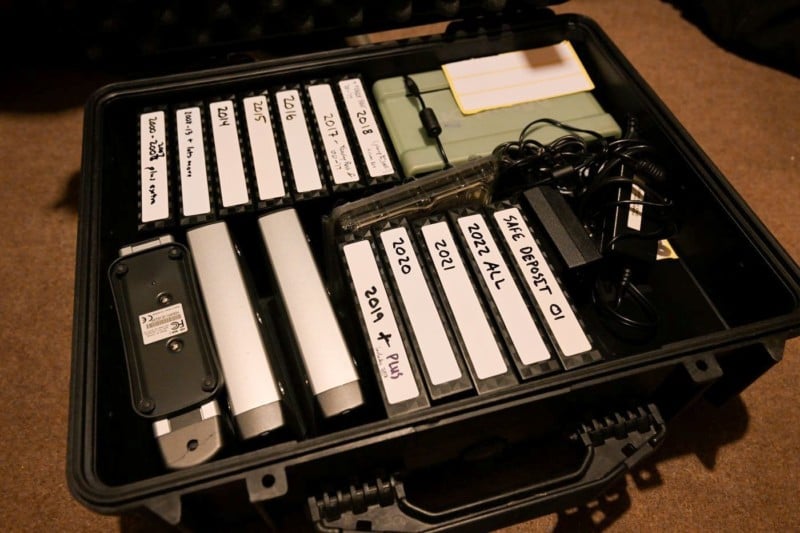

Here’s part of my own backup strategy, a Pelican case (waterproof) that I keep at home with hard drives containing all of my best images throughout my career. That includes scans of film-based photos prior to 1997.

Remember, the key to any good workflow is that it works for you. If you struggle to follow a routine someone else suggested, that’s not a good workflow. Sit down with a sheet of paper and start sketching out plans until you find one that feels like a good fit. Set a date that you’ll start using that plan. Then make a list of those steps, put it next to your computer, and start following them every time you download and work on photos from that date forward.


In time, it will become second nature. What about your older photos? There’s no reason you can’t go back and start shifting them into your new workflow (collections/folders, renaming, batch captions, etc.) when you have time. It’s mostly about better organization.

If you’re doing photography for fun and find the workflow part painful or frustrating, you’re doing something wrong. And in my experience, most of the time that pain comes from a poor workflow. Fix your workflow, then start having fun with photography again.
A Note About Photo Mechanic

I’ve outlined what I consider a good, basic workflow above. My personal one incorporates all of that, but I’m going to take a moment now to explain why my primary tool for achieving it is Photo Mechanic.

When I started shooting digital in 1996, I was using a Kodak DCS camera (a converted Nikon N90s body) and Kodak software that was clunky at best. Enter Dennis Walker. He started a small company, Camerabits, and created a much better software solution for handling those image files, Photo Mechanic.

As news organizations around the world converted to digital, all of them also adopted Photo Mechanic. A browser, not an image editor, it was that key step between the camera and Photoshop that took care of the download, captioning, renaming, and organizing/sorting, among other things. It was (and still is) the fastest program (that I know of) for doing that, which is why every news organization I know of still uses it.

When people ask me why I use it instead of something else, I explain that it’s the hub of my digital workflow, so speed is essential. Every image I shoot comes into my system through it, is managed with it, and goes out through it. I spend more time in Photo Mechanic than with any other piece of software, and have used it so long it’s second nature.

There are keyboard shortcuts to about anything you’d want to do — I only need the mouse when I want to click a specific area to check sharpness and zoom to 100%. And that’s where one of the big speed gains happens, when zooming. If you shoot RAW, when you click an image to get a larger preview (or zoom), most software takes a moment to process that RAW data. Photo Mechanic doesn’t. It simply takes the JPEG that’s embedded in every RAW file and uses it for the preview/zoom. That, of course, is much faster than processing the RAW data.


Think about how many times you look at a preview of images, or zoom in. If you’re saving one or two seconds each time you do that, it adds up quickly. Simply said, it’s the best, fastest program I’ve ever found for managing images.

Here’s my basic workflow:Put card in reader, Ingest (download) with PM, having it create folder structure, caption and rename.
Browse through photos, “tagging” (“t” key) all that I want to keep.
Invert the selection (“Select untagged”) and delete.
Go through a second time, now marking my favorites with a yellow mark (“2” key).
Sort by “Color Class” to view those images.
Zoom to 100% to check sharpness (“z” key), find the very best and give them a red mark (“1” key).
Use the “e” key to launch any of those images into Adobe Camera Raw (set in Preferences) to edit, saving back to the original folder as DNG files (non-destructive, edits intact).
Use Cmd/Ctrl-S to save any of those images out as JPEGs at whatever resolution I need for Instagram, Facebook, or any other use requiring JPEGs (and PM can convert the color space to sRGB at the same time, which is important because I shoot in AdobeRGB).
At a later time, I’ll use Cmd/Ctrl-Y to copy any favorites to the “2022 Best of” folder.
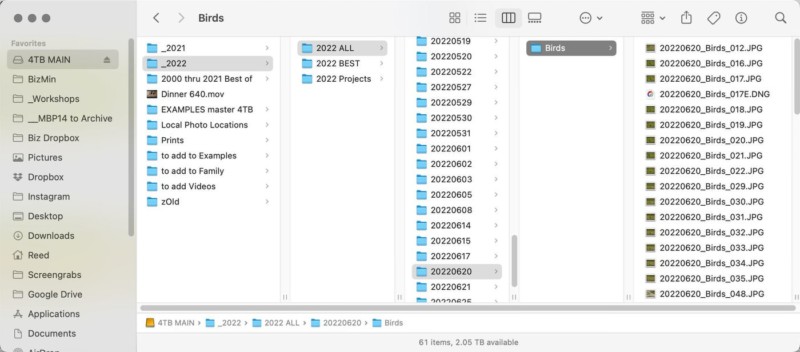

“4 TB MAIN” is an eight-terabyte mirrored drive attached to my home computer. That’s where I keep all the images I need immediate access to, and where all current images are downloaded to via Photo Mechanic, using a date-based system. As a RAID array, that means it has two four-terabyte hard drives inside, and they “mirror” each other. So if one should fail, the other still has everything intact.

What else do I do with Photo Mechanic?Create galleries for my website.
Open images into other editing programs (DxO PureRaw 2, PhotoMatix Pro, Nikon NX Studio, etc.).
FTP images to various clients.
Run slideshows.
Burn images to disc (CD, DVD, Blu-ray).
Import and embed GPS coordinates.
Show on a map where those photos were taken.
Use Code Replacement (automates the input of names/teams/numbers in sporting events) when doing work for wire services.
Manage/change Metadata/IPTC information like Keywords.
Search even large folders of images (thousands) quickly.
Sort by almost any criteria imaginable, from ISO to resolution to camera to focal length…
Change capture dates and times (if I didn’t set the camera properly when traveling).
Create “Snapshots” to further automate things like captioning, renaming, gallery creation, FTP transfers, etc.
Have multiple contact sheets open at the same time.
And there’s much, much more.

If you don’t take a lot of pictures, or do much with them, then you probably don’t need Photo Mechanic. But if you do, and aren’t happy with your current system, then you might want to give the 30-day free trial a go. It’s not for everyone, but if it works for you like it does for me, it’s well worth the cost (and is regularly updated without asking for more money).


Reed Hoffmann

30.5.22

Best Cameras for Landscape Photography 2022


If your primary subject for photography is landscapes, then it’s likely you’ll want to choose a camera that’s great at capturing landscape images. Here we look at some of the best cameras for landscape photography, and what makes them a good choice. We also run through some of the things you should be thinking about when choosing a camera for landscape photography, as well as letting you know what lens options there are.

There are several things you want to consider when looking for a camera for landscape photography, here they are: 
Resolution
Dynamic range
ISO range
Image stabilisation
Weather-sealing
Lens choices
Resolution

Ultimate resolution may be your aim, and for that there are a wide range of high-resolution options. But if travel, and hiking is one of your aims, then you may not want something so large and heavy, and we’ve highlighted some other options as well. High-resolution sensors help you capture more detail, and can let you crop into your image, but it’s also worth pointing out that a high-quality 20MP image can be printed upto 18x12inches at 300dpi, roughly A3. If you don’t want to print your photos, then resolution may not be as important.

Zenit M rangefinder camera | Amateur Photographer
Dynamic range and raw

Dynamic range is generally pushed to its limits when shooting landscape images, as you often have darker areas or shadows, along with a bright light in the scene, and you want to capture as much as this as possible. The human eye can normally cope with a much wider range than most cameras, so you’ll want to shoot in raw or use other all available options to capture as much dynamic range as possible. All of the cameras shown here shoot raw so you can process the images later when needed to get the best results. See our guide on how to maximise dynamic range.
ISO range

ISO range – In landscape photography, you’re most likely going to want to use the lowest ISO speed possible, in order to ensure your image is capturing as much fine detail as possible. One thing that can help is a lower ISO speed. There’s not a massive difference between using ISO100 and ISO200 on most cameras, however, if your camera has an even lower ISO speed, such as ISO50, then it’ll be easier for you to use a slower shutter speed when needed, helping you when you’re trying to capture blurred water, or blurred clouds etc. Be aware that some extended ISO speeds, marked as “Low” or “L” will show a reduced dynamic range, and are therefore best avoided.
Image stabilisation

Image stabilisation (IS) can help, and we’re at a point in time where it’s more common for new cameras to have in-body image stabilisation than not, and not only lets you expand your ability to shoot at slower shutter speeds, but also allows manufacturers to add multi-shot high-resolution modes to some cameras. If you can afford a model with image stabilisation built-in, then this is worthwhile, as it works with all lenses, letting you save money when buying a lens without IS built-in.
Weather-sealing

Weather-sealing is likely to be a must, especially if you’re happy shooting in all-weather conditions. If this is important to you, then look out for cameras that feature weather-sealing. You’ll also need to make sure the lens you use with the camera is weather-sealed, otherwise you won’t be able to get the benefits of this.
Lens choices

Lens range is another key factor to consider, are the lenses you want available, for the camera you want to use? We run through some of the options available as we go through each camera.

Now that you’ve had a look at the aspects that make for a great camera for landscape photography, lets have a look at some of the options available. In no particular order, we’ve selected options that are suitable for a range of different budgets, and different needs.

Best landscape camera for beginners
Nikon D5600 – £749 with 18-140mm lens

The Nikon D5600 offers easy transfer of images via Nikon’s SnapBridge technology

At a glance:24.2MP APS-C sensor
ISO100-25,600
3.2inch 1.4m-dot full articulated touchscreen
820 shot battery life

The Nikon D5600 offers a 24.2MP APS-C CMOS sensor, and Nikon’s excellent colour management giving images with warm, saturated colour and plenty of detail. There may only be FullHD video, but if you don’t need 4K then the camera gives everything else you need, including access to some great APS-C (DX) lenses.

Ultra-wide-angle lenses include the AF-P DX-Nikkor 10-20mm f/4.5-5.6G VR lens (£309), which gives a 15-30mm equivalent ultra-wide-angle zoom, as well as the Nikon 10-24mm f/3.5-4.5 G AF-S DX lens (£949). If the Nikon lenses available don’t take your fancy, then there’s also lots of lens choices from Sigma, Samyang, Tamron and others.

Best for: DSLR fans who want a fully articulated touchscreen
Best landscape camera on a budget under £500
Nikon D3500 – £449 with 18-55mm VR lens

Nikon D3500 DSLR

At a glance:24.2MP APS-C CMOS sensor
ISO100-25,600
FullHD video (60fps)
1550 shot battery life

The Nikon D3500 features a 24.2MP APS-C CMOS sensor, with no optical low-pass filter, which means it’s designed to give as much detail as possible. Active D-Lighting helps with dynamic range in JPEG images, and the camera has traditional DSLR handling, making it a comfortable camera to use. You’ll also find incredible battery life, with up to 1550 shots possible.

The 18-55mm lens can give sharp results, and is a great starting point, but it’s likely you’ll want to have a look at the AF-P DX-Nikkor 10-20mm f/4.5-5.6G VR lens (£309) if you want a wider view.
Best for: those on a budget

Best camera for landscape photography under £1000
Fujifilm X-S10- £949 body only

At a glance:26MP APS-C CMOS sensor
In-body image stabilisation
PASM mode dial
4K video

The Fujifilm X-S10 is a great handling mirrorless camera, with a large hand-grip and DSLR like controls, with a PASM mode dial, making it easy to use. It also benefits from the same excellent 26MP APS-C X-Trans CMOS sensor as Fujifilm’s flagship X-T4 model, giving you images with plenty of detail, and Fujifilm colour. In-body image stabilisation is built-in, and it offers 4K video.

The downside to this model, compared to the X-T4, is the lack of weather-sealing on the X-S10. The X-S10 uses X-mount lenses and there are a number of options available, although perhaps not as much budget lenses as you’d find with other cameras.
Best for: Someone wanting a compact camera, and fans of Fujiifilm colour

Best Canon DSLR for landscape photography (APS-C)
Canon EOS 90D – £1629 body only

The Canon EOS 90D DSLR is a highly versatile and reliable camera

At a glance:32MP APS-C CMOS sensor
Canon EF-S lens support
1300 shot battery life
3inch vari-angle touchscreen

The Canon EOS 90D offers the highest resolution APS-C sensor currently available, and gives you Canon’s great colour reproduction, and high-levels of detail. It also offers an impressive battery life of 1300 shots.

There is a good range of ultra-wide-angle Canon EF-S lenses, with the Canon EF-S 10-18mm f/4.5-5.6 IS STM being a great value budget choice at £245 (16-29mm equivalent). For those with more cash, there’s a 10-22mm available (£529, 16-35mm equivalent), or for those than want wide-angle and zoom, there is a 15-85mm IS USM lens available (£779, 24-136mm equivalent).
Best for: Canon DSLR fans

Best Nikon DSLR for landscape photography (full-frame)
Nikon D850 – £2799 body only

The Nikon D850 boasts a 153-point autofocus system

At a glance:45.7MP Full-frame BSI CMOS sensor
Low base ISO speed of ISO64
4K video, 8K timelapse support
1840 shot battery life
Weather-sealed

The Nikon D850 is a high-resolution full-frame DSLR, with a 45.7MP sensor that is capable of producing images with high levels of detail, thanks in part to no low-pass filter. The camera also benefits from an ISO range that starts at ISO64, which is usefully lower than many cameras.

For some, the handling of a DSLR will be of great importance, and for these people, the Nikon D850 certainly delivers, with great ergonomics, particularly if you’re a fan of larger cameras. You’ll also benefit from impressive battery life, with up to 1840 shots possible from one battery.

There’s a range of lenses including the Nikon 16-35mm F4 G AF-S VR lens at £1149, or you could look at these wide-angle prime lenses: Nikon 20mm F1.8G AF-S (£799) or the Nikon 24mm F1.8G AF-S (£749).
Best for: Nikon DSLR fans


Best Nikon mirrorless camera for landscape photography
Nikon Z7 II – £2999 body only

The Nikon Z 7II with a 24-70mm zoom lens

At a glance:45.7MP full-frame BSI CMOS sensor
ISO64-ISO25,600 (standard)
In-body image stabilisation
Weather-sealed

The Nikon Z7 II is one of the second generation full-frame mirrorless cameras from Nikon, and offers an impressive 45.7MP full-frame BSI CMOS sensor, along with Nikon’s Z-Mount series of lenses which have all been developed specifically for the new mirrorless camera range. This means they give exceptional image quality, in combination with Nikon’s excellent focus system.

There’s a growing range of lenses, but you’ll notice that many are at the more expensive end of the market, with ultra-wide-angle options being the 14-24mm f/2.8 S (£2499), and another being the 14-30mm f/4 S (£1349).
Best for: those looking for a compact full-frame camera


Best Panasonic camera for landscape photography
Panasonic Lumix S1R – £3299 body only

At a glance:47MP full-frame sensor
ISO100 to ISO25,600 (standard)
In-body image stabilisation
High-res multi-shot mode (187MP)
Weather-sealed

The Panasonic Lumix S1R offers a high-resolution 47MP full-frame CMOS sensor, along with a high-resolution electronic viewfinder, 4K video recording, and in-body image stabilisation. There’s a multi-shot high-resolution mode that can produce 187MP images, and the camera has a mode to reduce motion blur, so that it can be used for landscape photography. Despite being a mirrorless camera, the S1R is quite weighty and large.

As part of the L-Mount alliance, there are wide range of lenses, available from Panasonic, Sigma, and Leica. Options include the Sigma 14-24mm F2.8 (£1299), Panasonic Lumix S Pro 16-35mm F4 (£1499), Leica 16-35mm F3.5-4.5 (£4850), and Panasonic Lumix S 20-60mm F3.5-5.6 (£619), to name a few ultra-wide zoom lens options. There are also a range of ultra-wide-angle prime lenses available.
Best for: Those looking for a wide range of lens options

Best Canon camera for landscape photography
Canon EOS R5 – £4299 body only

At a glance:45MP full-frame sensor
Sensor-shift IS
ISO100 to ISO51,200 (standard)
8K/4K video recording
Weather-sealed

The Canon EOS R5 is Canon’s premium full-frame mirrorless camera, offering a 45MP full-frame CMOS sensor, as well as in-body image stabilisation that works with any lens. There’s a high-resolution 5.76m-dot electronic viewfinder (EVF), and a 3.2inch fully articulated touchscreen with 2.1m dots. This makes framing and composing shots a real pleasure when using the camera. A top LCD display also lets you see camera settings at a glance.

The camera offers advanced video modes, including 8K (30fps) and 4K (120fps) video recording, however, you need some quite impressive hardware to edit this, and you’ll also need to be aware that the camera does have some limitations due to over-heating while recording. There’s also relatively short battery life to be aware of, with 490 shots on offer when using the LCD, or a much shorter 320 shots when using the EVF.

If stills is your primary aim, then you don’t need to worry so much about video recording and overheating, and there are a growing range of Canon RF lenses available, with ultra-wide-angle lens options including the RF 14-35mm F4L IS USM (£1779), and RF 15-35mm F2.8L IS USM, plus the “standard” 24-70mm f2.8L IS USM (£2189). If you’re on a budget, there’s a compact RF 16mm f2.8 lens (£319).
Best for: Canon fans (full-frame), and those with an interest in high-resolution video
Nb. A second-hand option could be the Canon EOS 5DS R (50MP), which has been discontinued.


Best Sony camera for landscape photography:
Sony Alpha A7R IV – £3199 body only

At a glance:61MP full-frame sensor
ISO100-32,000 (expands to ISO50)
5-axis in-body image stabilisation
5.76m dot electronic viewfinder (EVF)
Weather-sealed

The Sony Alpha A7R IV features a 61-megapixel BSI CMOS sensor, the highest resolution available on a full-frame camera (along with the Sigma fp L), and to get any higher resolution than this you’d have to move over to medium format. This makes it a great choice was absolute resolution is of the highest importance. You can even use the pixel shift multi-shot mode for whopping 240MP images, however, these needs combining on a computer, and any movement in the scene can cause image quality problems.

Sony has been making full-frame E-Mount cameras since 2013, so as you’d expect there’s a vast array of lenses available, with high-quality options available from Sony, as well as a number of other options from Sigma, Zeiss, Tamron, Tokina and others. You can choose from a number of ultra-wide-angle zoom lenses, such as the Sony FE 16-35mm F4 ZA OSS (£1049), or the newer more compact FE PZ 16-35mm F4 (£1300) as well as many prime lens options.

Best for: Sony fans, wide lens choice, high-resolution

Nb. A second-hand or value choice could be the Sony Alpha A7R III, with 42MP sensor, it still offers high-resolution, but is much more affordable.


Best landscape camera for maximum resolution:
Fujifilm GFX100S – £5499 body only

At a glance:102MP medium-format sensor
In-body image stabilisation
ISO50 to ISO102,400 (extended)
Top display screen
Weather-sealed

Fujifilm’s GFX100S features an impressive 102MP medium-format sensor, at a previously unheard of price, seriously challenging how much a medium format camera normally costs. You’ll also find that it’s packed into a camera body that’s similar in size to a Digital SLR, making this a seriously impressive bit of kit, considering the size, and what it is capable of.

Image quality is impressive, and the camera makes it easier to achieve great results, thanks to the camera’s built-in in-body image stabilisation. The camera also delivers excellent dynamic range, as well as extremely pleasing colour reproduction, thanks to Fujifilm’s film simulation modes.

For those that want even more resolution, then there’s a multi-shot mode available for 400MP images, but like the Sony A7R IV, these need to be merged together on a computer, and any movement in the scene is going to ruin the shot, so think of this as useful for mostly still life work.

There’s a range of GF mount lenses, and there’s a 0.79x crop factor, so the GF 23mm f4 (£2399) lens is equivalent to 18mm (in 35mm terms), and the GF 30mm F3.5 (£1649) is equivalent to 24mm. There’s also a GF 32-64mm F4 (£2149), equivalent to 25-51mm, and it’s the widest zoom lens currently available from Fujifilm in GF mount.
Best for: Ultimate resolution thanks to 102MP sensor


Fujifilm GFX50S II – £3500 body only, or £3900 with 35-70mm lens

At a glance:50MP medium-format sensor
In-body image stabilisation
ISO50-102,400 (extended)
Top display screen
Weather-sealed

Medium format cameras used to cost an arm and a leg, so it’s incredible to think that you can purchase a brand-new medium format camera for £3500 body only in the form of the GFX50S II. In order to make the GFX system more affordable, the GFX50S II was introduced with a new budget lens, the GF 35-70mm F4.5-5.6 WR zoom lens (£849 lens only, or £3900 as GFX50S II kit with lens), which gives a 28-55mm equivalent.

Despite the lower price, it’s difficult to see where the camera is lacking, as the camera features a 51.4MP medium format sensor, in-body image stabilisation, a high-resolution electronic viewfinder (3.69m dots, 0.77x magnification), and a 3.2inch 2.35m dot tilting touchscreen. The price makes it competitive with high-resolution full-frame mirrorless cameras, and really does make medium format an option.

However, one thing to be aware of is the price of wide-angle lenses, as most GF-mount lenses are more expensive than the 35-70mm lens designed for this camera model, particularly if you’re looking for a wide-angle lens, with the GF 30mm F3.5 being £1649, and equivalent to 24mm.
Best for: Medium-format on a budget


Best landscape camera for hiking and all-weather
OM System Olympus OM-1 – £1999 body only

The OM System ‘Olympus’ OM-1

At a glance:20MP Micro Four Thirds sensor
Weather-sealed (IP53 rating*)
In-body image stabilisation
5.76m dot electronic viewfinder (EVF)
Compact body and lenses

The OM System Olympus OM-1 offers an impressive IP53 weather-sealed rating, when used with compatible lenses, giving this camera system some of the best weather-sealing of any current model. This feature, plus clever computational features make this camera more suited to landscape photography than it may appear on first glance.

You’ll find Live-ND built-in (upto ND64), which lets you use a slower shutter speed, without the need to attach an ND filter on the lens. There’s also in-camera focus stacking, in-camera high-res multi-shot (50MP handheld, upto 80MP with a tripod), HDR, timelapse, plus live composite / bulb modes for low-light shooting, as well as Starry Sky AF. As with other high-res multi-shot modes it’s best for static scenes, but there is a handheld mode, and we had success shooting outdoors with the camera.

As the camera is part of the Micro Four Thirds system, introduced in 2008, alongside Panasonic, there is perhaps the widest range of lenses available for any mirrorless system, with ultra-wide-angle lenses available from both Olympus and Panasonic, with multiple zoom lens options, as well as primes. There are also third party lenses available from Sigma, Laowa, Tamron, Samyang, and many others. Have a look at some of the best micro four thirds lenses.
Best for: Those who want full control, but also want a small weather-sealed camera system


Best Pentax camera for landscape photography
Pentax K-1 II – £1999 body only

At a glance:36MP full-frame CMOS sensor
Weather-sealed
Innovative tilting screen
Wide range of K-mount lenses
In-body image stabilisation

The Pentax K-1 II, and the original Pentax K-1, both offer a 36MP full-frame CMOS sensor, along with Pentax’s excellent build quality and ergonomics. The camera is weather-sealed, features an optical viewfinder, and an innovative tilting screen on the back. Using the Pentax K-mount you can use a vast range of lenses, dating back to 1975.

Speaking of lenses, there are a number of new full-frame lenses from Pentax, including the Pentax-D FA HD 24-70mm f2.8 ED SDM WR (£1179). Care needs to be taken when choosing a lens, as many of Pentax’s lenses are designed for Pentax APS-C DSLRs. There’s also support from third parties, including Samyang, and Irix, who offer a number of different ultra-wide-angle lenses, although it’s worth noting that the majority of these are manual focus only.
Best for: Pentax fans, K-mount lenses


Canon Powershot G1 X Mark III – £1139

At a glance:24MP APS-C CMOS sensor
24-70mm equivalent lens
ISO100 to ISO25,600
Weather-sealed
Compact camera

If you’re looking for something pocketable, and don’t want to worry about changing lenses, then the Canon Powershot G1 X Mark III is a compact option, with a 24MP APS-C CMOS sensor, and a 24-70mm equivalent zoom lens, with an f/2.8-5.6 aperture, as well as optical image stabilisation. There’s full manual controls, as well as raw shooting, although it’s worth noting that battery life is quite short, so a spare battery is highly recommended. Despite being a compact camera, you’ll find a built-in electronic viewfinder (EVF), plus a full-articulated 3inch touchscreen.

Best for: Those that want a pocketable all-in-one camera


21.3.22

UPP presents the new exhibition: "FRAGMENTS - life in the world represented in the arts..."


UPP presents the new exhibition: "FRAGMENTS - life in the world represented in the arts..."

Alongside this exhibition the premiere of the documentary "Heartland - a dream of every conqueror - From the great restart to the rebirth of a nation“, - directed by UPP member Jacopo Brogi -  will take place.

United Photo Press looks forward to also present again the ambient music from the Jazz quintet of UPP member singer Alison Welles from New York during this exhibition.

www.facebook.com/events/3049276152066143
www.facebook.com/unitedphotopress

25.10.21

As the Photographers’ Gallery in London turns 50, we look at five of its defining shows

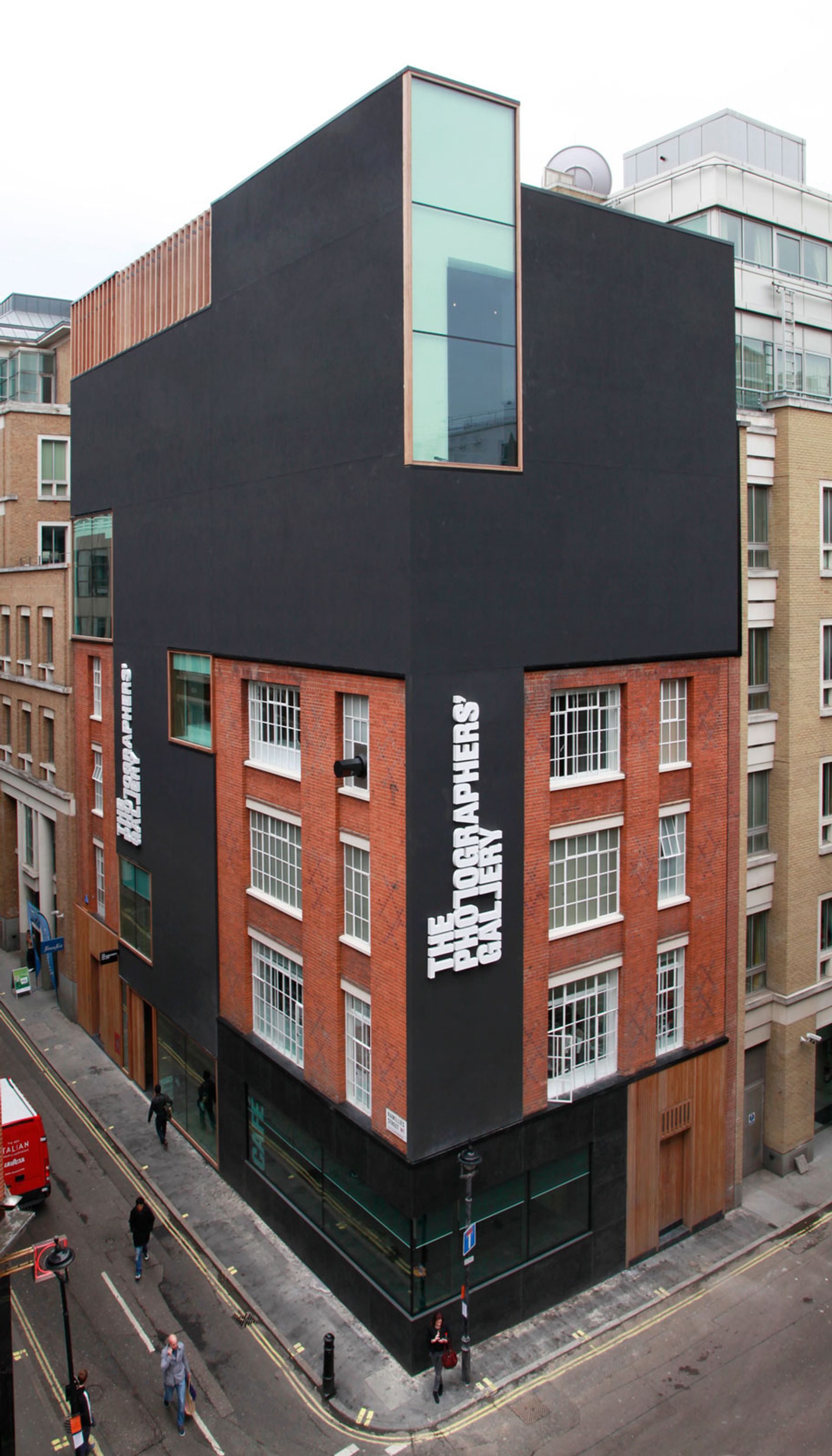
Sue Davies, the founder of the Photographers' Gallery standing at its entrance 
on Great Newport Street, between Leicester Square and Covent Garden.

The institution's director Brett Rogers has selected five key shows from the past five decades.

“Everyone put pressure on her to call it the Photography Gallery,” says Brett Rogers, the director of the Photographers’ Gallery in London. “But she said no, it’s a place for photographers, we want them feel comfortable here.” The “she” in question was Sue Davies, the founder and first director of the Photographers’ Gallery, which celebrates its 50th anniversary this year.

The Photographers’ Gallery was the first public institution dedicated to photography in the UK. In the lead up to its formation, Davies had been working at the Institute of Contemporary Art where she met several photographers who like her felt that London was in need of a space dedicated to the medium. One of her key goals was “to gain recognition for photography as an art form in its own right”. Davies drummed up support for the venture and raised funds, which included remortgaging her own house, before finding a space on Great Newport Street, near Covent Garden. And on 14 January 1971, the Photographers’ Gallery was born.

“[Davies] wanted to create a space for photographers who aspired to be artists and also for photographers who were photojournalists and trying to find their way within the industry, within editorial and advertising,” Rogers says. “That was quite surprising. She wanted to both recognise it as an art form but also to acknowledge the very important roles played by applied photography: magazines, print press, medicine, Nasa photography, picture postcards.”


The Photographers' Gallery moved to its new home just off London's Oxford Street in 2012

In the first year alone, the new gallery hosted 19 exhibitions. Among these were shows of photojournalism; landscapes; Polaroids by Andy Warhol; Zoe Dominic’s pictures of ballet dancers; a Jacques Henri Lartigue survey; sepia prints of London in the 1870s; and a group show of erotic photography. “All I ever say is, her view was very eclectic and Catholic and that was a good thing,” Rogers says. “[Davies] embraced the whole breadth, and we do today.”

Davies was director of the gallery for two decades, stepping down in 1991. She was followed by Sue Grayson Ford, Paul Wombell and in 2005 Rogers took over. The gallery moved to its new space in central London, just off Oxford Street, in 2012. For the past eight years Rogers has been planning the Soho Photography Quarter, an outdoor pedestrianised zone around the gallery “where you can see photography 24/7 free of charge”. The area underwent a soft launch in September with the final completion and formal opening planned for February 2022. “It’s going to be safe, and beautifully lit, welcoming and not smelly,” says Rogers, referring to what was often a urine-scented alleyway.

Rogers took some time away from planning the future of the institution to cast her mind back to its past and select five exhibitions that have defined the Photographers’ Gallery.
Five key exhibitions at The Photographers’ Gallery


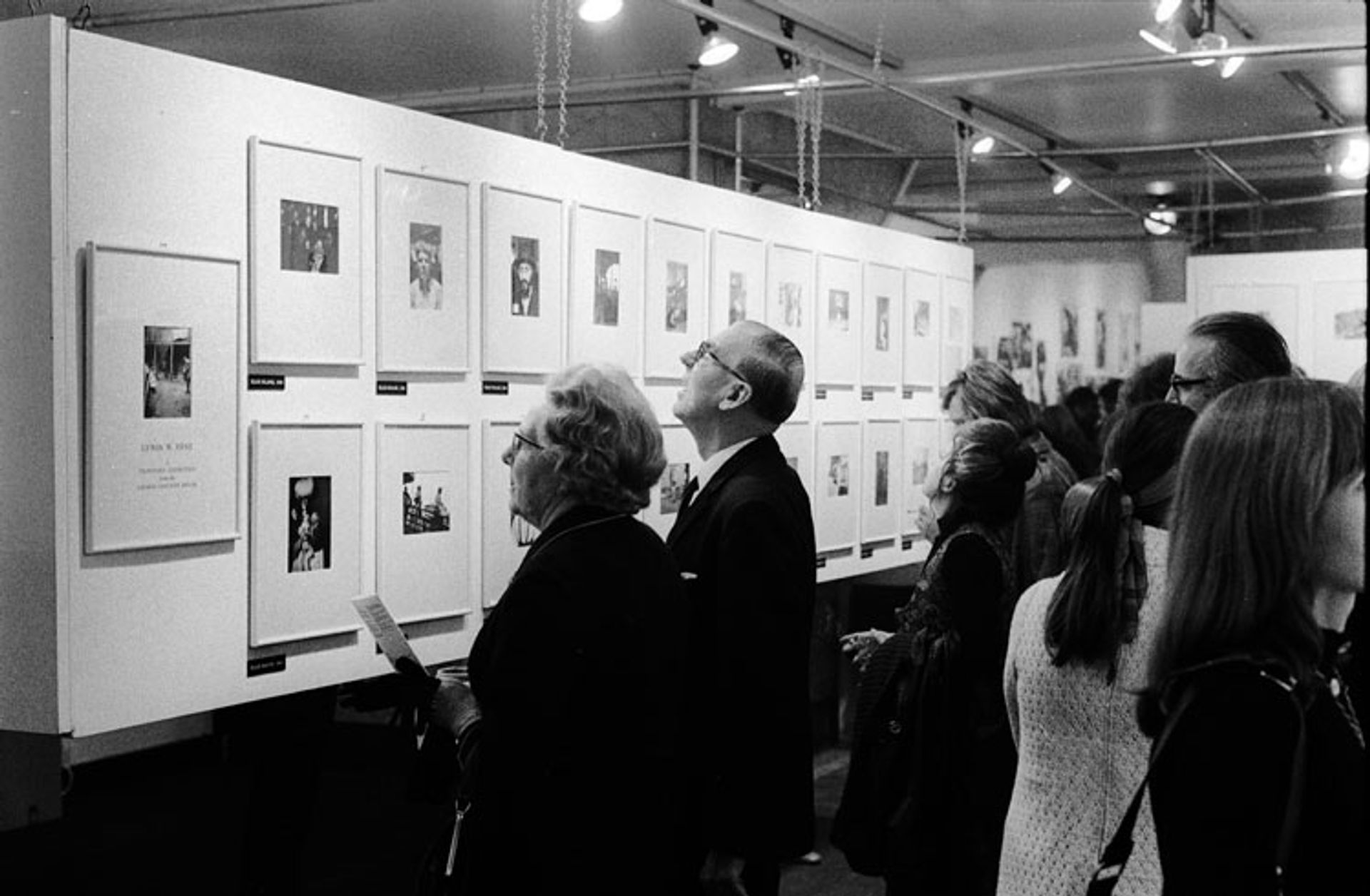
The private view for The Concerned Photographer, the first exhibition at The Photographers Gallery
The Concerned Photographer (13 January-13 February 1971)
Featuring: Werner Bischof, Robert Capa, Leonard Freed, André Kertész, David Seymour, Dan Weiner


The first exhibition at the newly formed gallery was an unplanned one. “Although Sue [Davies] wanted to do a show on Civil Rights photography, this came into her lap at the right time when we had to open,” Rogers says. The exhibition was organised by the International Fund for Concerned Photography in New York, founded by Cornell Capa, and which later spawned the International Center of Photography. “This was the heyday of Magnum and the photo agencies, so [the show] reflected the importance of photojournalism,” Rogers says. Among the highlights were works by Robert Capa—“there were some unusual ones by him”—and David Seymour’s “beautiful images of children during the war in Poland”.

The exhibition also experimented with new curatorial ideas, “transferring what had always been seen in print and in magazines, onto the gallery wall,” Rogers says. “That had never been done in the UK really. We very successfully did big blow ups [with] small images framed.” Rogers adds that the exhibition “set the tone” for the Photographers’ Gallery and led to many photojournalism and reportage shows over the decades, including work by, among others, Margaret Bourke-White, Elliott Erwitt, Eugene Smith, Bruce Davidson, Werner Bischof and Sebastião Salgado. “All the great names,” Rogers adds.


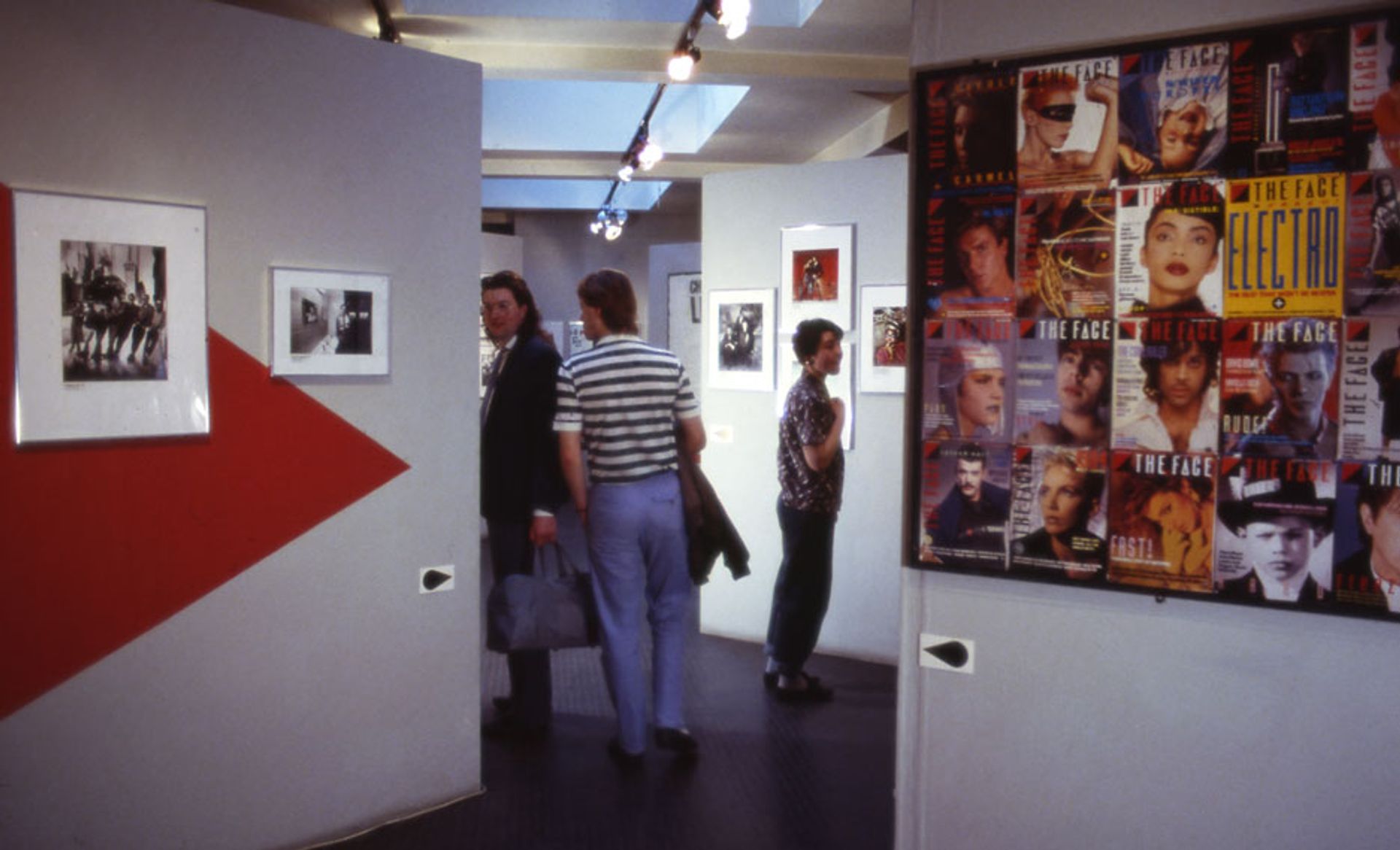
Installation view of Five Years with the FaceCourtesy of The Photographers’ Gallery Archive
5 Years with The Face (18 April-17 May 1985)
Featuring: Anton Corbijn, Chalkie Davies, Jill Furmanovsky, Mike Laye, Robert Mapplethorpe, Jamie Morgan, Sheila Rock and Carol Starr

The now legendary magazine The Face was at the height of its powers in the mid-1980s, covering youth culture and fashion its unique style. The exhibition included work by 37 photographers, including Anton Corbijn, Jill Furmanovsky and Robert Mapplethorpe. One of the key elements that it explored was the importance of the stylist in fashion and commercial photography. “Fashion photography is very collaborative; it’s not like most other independent photography,” Rogers says. “They always work with stylists and art directors. [The exhibition] very much investigated the role of Ray Petri, this incredible stylist from the 80s who subverted the whole way you took a fashion photograph.”

The graphic designer Neville Brody, who was the magazine’s art director at the time, designed the exhibition and its distinctive poster. Rogers adds that there is “a lovely link to our 50th anniversary” as Brody recently got back in touch with the gallery offered to design its 50th anniversary logo, because he had such “fond memories” of the show. The exhibition paved the way for later exhibitions by trendy fashion photographers such as Juergen Teller and Corinne Day, Rogers says. “We’ve always prioritised [fashion exhibitions] because we know young people love fashion. We’re just off Oxford Street, so why wouldn’t we?”


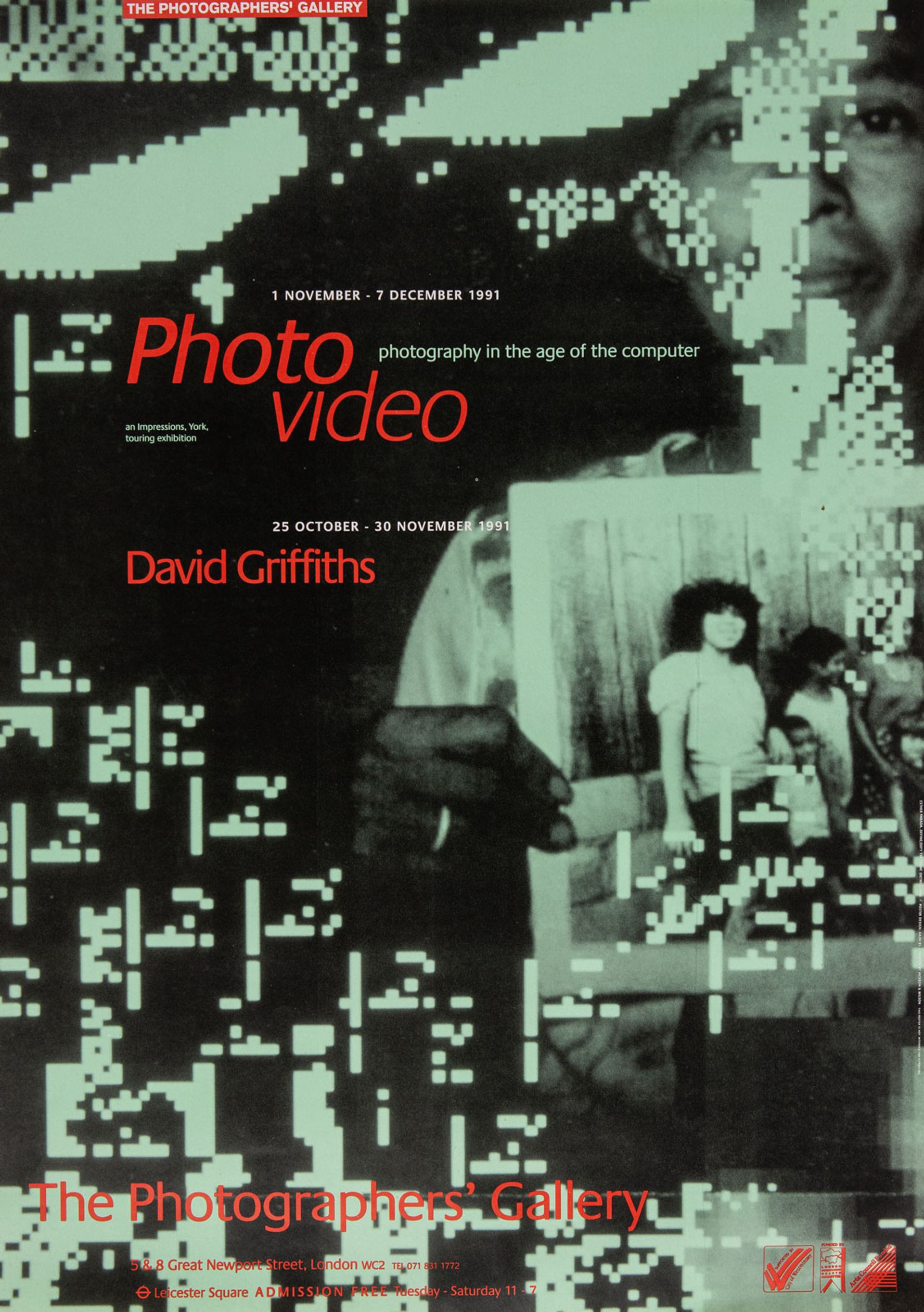
The poster for the Photovideo: Photography in the Age of the Computer exhibition
Photovideo: Photography in the Age of the Computer (1 November-7 December 1991)
Featuring: Susan Boyce, Susan Hardy, Brian Harris, Graham Howard, Pedro Meyer, Clinton Osbourne, Esther Parada, Philip Benson & David Perret, Keith Piper, Simon Robertshaw and Kativa Sharma

“The gallery was full of video screens and electronic buzzing and datasets,” Rogers says. It was an exhibition that showed how photography was going “from the darkroom to the computer screen—and how that change was already happening already in the 90s”. The exhibition was curated by Rogers’s predecessor Paul Wombell and Steven Bode, who runs Film and Video Umbrella. “What they recognised was the early impact of new technologies on the image,” Rogers says. “It was influenced by Tiananmen Square and all those images of the tanks and the blurry images and pixilation that came down through video stills.”

As well as examining the beginnings of the digital culture that we take for granted today, it also looked at who made and stored images and the use of big data. It explicitly asked “what are the implications for society?” Rogers says. “They looked at mass surveillance, the role of the military in creating images, and datasets—even in ’91. We think this was a prescient exhibition because nobody was talking about that.”


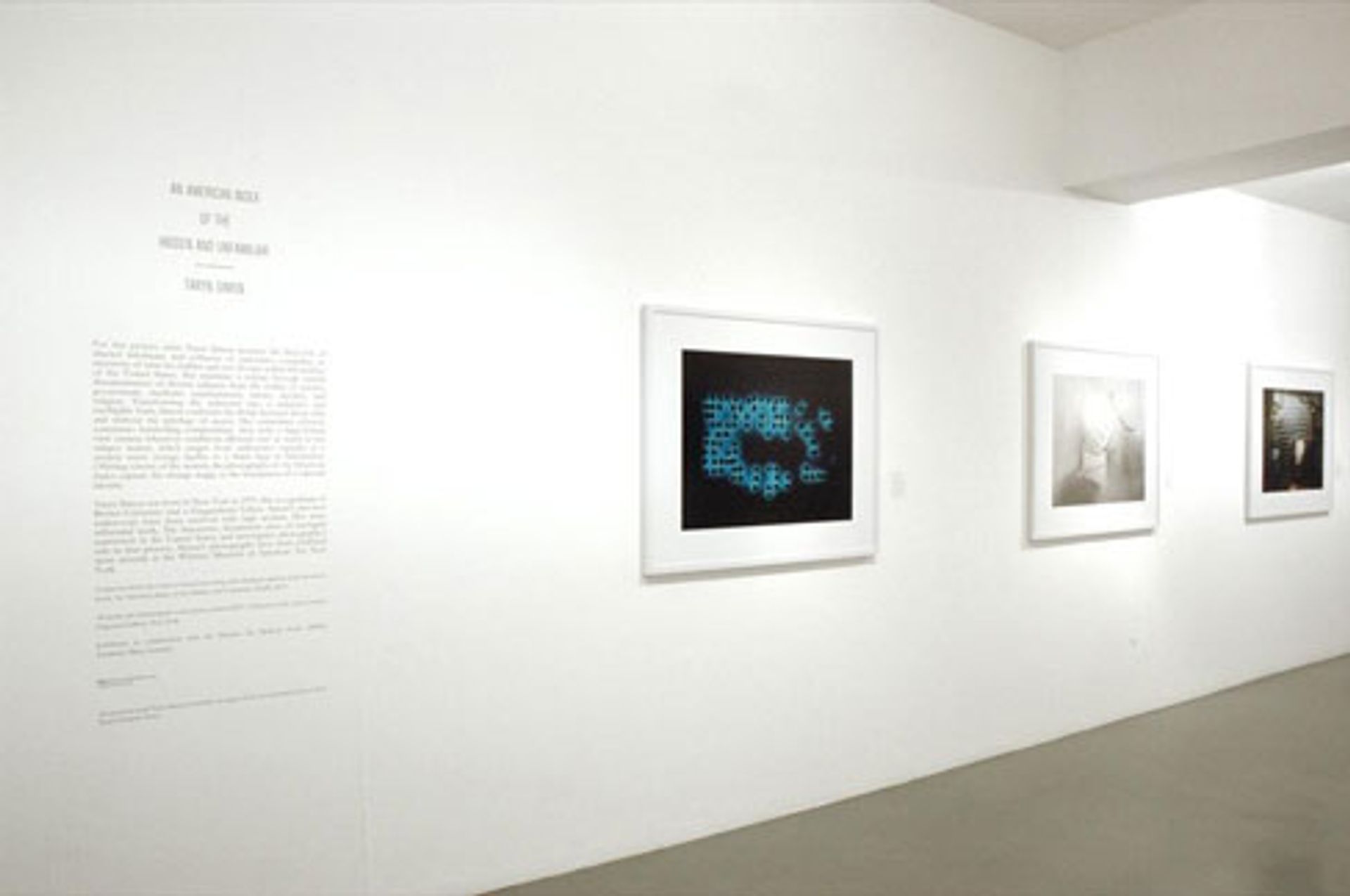
Taryn Simon's exhibition An American Index of the Hidden and Unfamiliar showing one of her works documenting a nuclear waste storage facilityCourtesy The Photographers’ Gallery Archive
Taryn Simon: An American Index of the Hidden and Unfamiliar (12 September-11 November 2007)
Featuring: Taryn Simon

“We have always had a very big commitment to promoting women artists and somebody who really set the bar high in interrogating documentary [photography] and really put conceptual photography on the map, is Taryn Simon. We were the first to show her [in the UK],” Rogers says. The impact of the topics covered by the American photographer marked many who saw the show. “Doesn’t it stay with you? She went into a forensic laboratory, she documented a Palestinian woman having a hymen reconstruction, [she photographed] inside the CIA, [showed] the big internet cables coming up from the sea. It was one of the most staggering exhibitions ever. She just struck a new chord with where photography could go.”

Simon went on to have a major shows around the world, branching out from photography with notable performance installations such as An Occupation of Loss (2016). There was a real “conceptual richness” to the show at the Photographers’ Gallery, which “reset the bar”, Rogers says. And led to “photographers thinking differently: what is photography capable of? What can it uncover?”


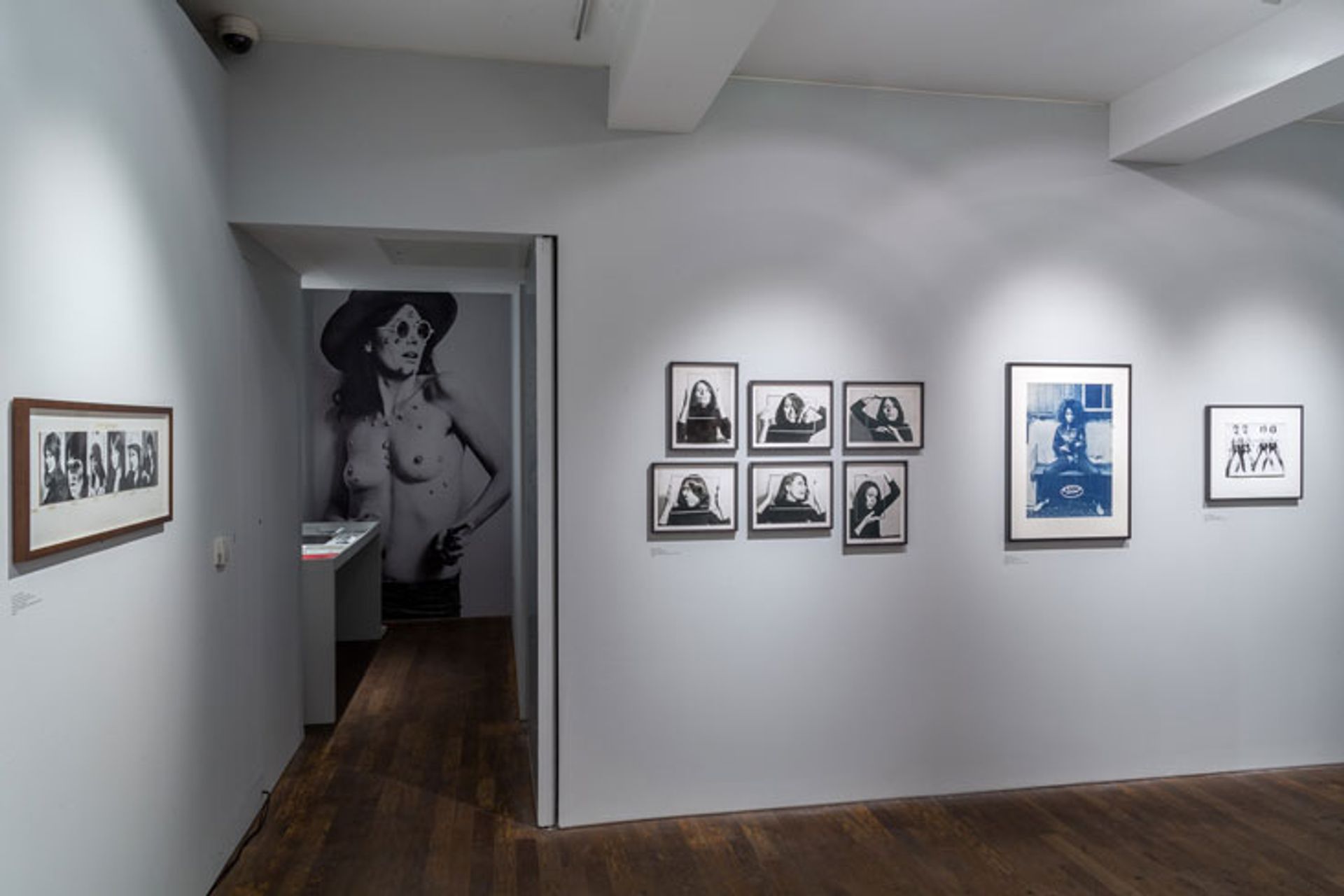
Installation view of Feminist Avant-Garde of the 1970s© Kate Elliot
Feminist Avant-Garde of the 1970s: Works from the Verbund Collection (6 October 2016-15 January 2017) Featuring: VALIE EXPORT, Cindy Sherman, Francesca Woodman and Martha Rosler, among others

“That show had everybody from Cindy Sherman to Hannah Wilke, to our lovely Alexis Hunter who died shortly after,” Rogers says. “As well as many unknow names.” The exhibition of 48 female photographers from the Verbund Collection in Vienna focused on work made during the 1970s that dealt with political issues such as the patriarchy and sexism. As well as photography, the show also include collage works, films and videos. Rogers says that with such a show it was important to see the works in the exhibition rather that in photobooks. “It’s the visceral quality; their work is so hard hitting. And some of them are stitched and you can’t really see that in a book.”

“To younger photographers coming to our gallery, they may have heard their names but they had never seen their work,” Rogers says. “[It was] really radical, provocative, political work. And I really think it shook them up; it had a big impact.”

20.7.21

Befinitiv's Digital Film Cartridge Adds a Raspberry Pi


Using a 3D-printed housing, a Raspberry Pi Camera Module, Raspberry Pi Zero, and LiPo battery, befinitiv has given an old camera a rebirth.

Pseudonymous maker "befinitiv" has shown off a Raspberry Pi-powered upgrade for film cameras, turning them into digital cameras capable of stills, video, and even live streaming — albeit with considerably different zoom from their stock designs.

"This was state of the art 50 years ago," befinitiv explains of a Cosina Hi-Lite film camera. "Back then, of course, you shot your films or photos on these films, and this was rather expensive back in the day — but today it's even more expensive and a bit cumbersome."

"So, of course, I did the obvious and replaced this film cartridge by a digital cartridge based on a Raspberry Pi — so you have a digital camera that looks like this and can do everything that you expect from a digital camera nowadays. It can do video, it can stream video over Wi-Fi, and store things on an SD card."
The secret behind the hack: A Raspberry Pi Camera Module with its integrated lens removed — something you don't have to do on the Raspberry Pi HQ Camera Module, which requires an external lens — fitted into a 3D-printed housing that secures it in the camera and aligns it at the focal point of the lens.

The Camera Module connects to a Raspberry Pi Zero W single-board computer, which handles the capture, streaming, and storage. A lithium-polymer battery powers everything through a DC-to-DC boost converter.

The result is functional, but a far cry from how images would have looked captured on film. "This is really far zoomed in," befinitiv notes — a result of the significantly smaller sensor size of the Raspberry Pi Camera Module compared with the 35mm film the camera and lens were originally designed to use."

"I can only recommend to also build something for your cameras because it is really fun and gives 
these things a new life, which is I think always great for these nice high quality 'retrotech' items."

24.1.21

A Greek Photographer’s Ode to the Dying Art of Mourning

“Nyx (the night),” 2019. Photographs by Ioanna Sakellaraki

Ioanna Sakellaraki’s series is an elegy both to her father and to the doyennes of a national tradition.


Ioanna Sakellaraki, a Greek photographer based in Brussels, left Athens at the age of eighteen to get an education abroad. She’d lived in seven different countries by the time she returned a decade later to attend her father’s funeral. 

The ceremony took place on a hillside of Mount Poikilo, where one of Sakellaraki’s aunts, Katina, hoped to perform a ritual lament in the style of the nation’s famed moirologists, or hired mourners. Since antiquity, women in Greece have been called on to voice the collective grief of the bereaved, gathering at gravesides to wail and pull their hair. 

Sakellaraki’s family decided against the idea; it didn’t seem to suit her father, a quiet man who’d died at ease, in the shade of his favorite orange tree. But the possibility of such a performance stuck in her mind as she spent the next months in her homeland, mourning.

“Moirologia (fate songs),” 2018.


“Atropos (the unturned),” 2018.

During the following years, Sakellaraki made several trips to the Mani Peninsula, in southern Greece, to document some of the last remaining representatives of the art of moirologia. 

She tracked down the mourners, some of them more than a hundred years old, by word of mouth, dawdling at guesthouses, chatting up locals, and hitchhiking to the funerals of strangers. In churches and at burial sites, she watched her subjects weep. Between services, the old women posed for portraits and told Sakellaraki stories, though several of them could barely hear her. 

“The Truth Is in the Soil,” a series of photographs and mixed-media images inspired by her travels, is an elegy both to her father and to the doyennes of a dying tradition.


“Ker (destruction),” 2019.


“Apate (deceit),” 2019.


“Clotho (the spinner),” 2020.

In rural Greece, family members often ready a body for burial by washing it with wine, water, or vinegar. They dress the deceased in clothing that he would have worn to church, coax the arms across the chest, tie the feet together, and strap the jaw shut. 

(In some ancient customs, a coin was set between the teeth, to fund the soul’s passage across the River Styx.) 

In editing film, Sakellaraki has established similarly intricate rituals. Some of her mixed-media images transport the mourners to remote landscapes, showing only the black back sides of their garments as they gaze at mountain ranges and roiling tides. In other cases, their silhouettes appear to have decomposed, as though over time, into the very texture of their surroundings: a chain-link fence, an aging vase, a cave wall etched with chalk drawings. 

Sakellaraki has recast a few of the images themselves as artifacts, altering their surfaces to include cracks that suggest the delicacy and compressed depth of fossils.


“Aletheia (unconcealment),” 2020.


“Achlys (mist of death),” 2018.

Greek lore describes a liminal period between a person’s funeral, when the journey to the underworld begins, and the rite of exhumation, when the soul escapes its earthly bonds. (The state of the body’s remains is understood to convey the destination of the departed: clean bones signify that the deceased has reached paradise, whereas blackened ones bespeak sin.) 

The grieving undergo their own metamorphosis, estranged from society until they relinquish the dead. Sakellaraki’s portfolio includes hand-stitched collages that embellish faded photographs from her father’s days as a sailor. After his death, she printed the original images on organza fabric and, working alongside her mother, traced their outlines in embroidery. 

When Sakellaraki left Greece, she and her mother completed the project by shipping works in progress across Europe, continuing each other’s stitches while they lived apart.


“Maizuru Jukogyo,” 2020.
“Memory of a Journey,” 2020.

Part of Sakellaraki’s aim, she told me recently, is to create space in her photography where “death can exist” apart from its formal commemoration. Though her imagery celebrates Greece—a few scenes feature pomegranate seeds or cypress branches, and the titles of individual shots evoke specific myths—Sakellaraki situates the toil of mourning somewhere placeless, everywhere and nowhere both. 

Her work projects a pronounced mournfulness at a time when funerary rites across the world have been disrupted, leaving the dying and the bereaved to suffer alone. Sakellaraki returned to Greece recently for the funeral of her aunt Katina, who fell at home and spent the last weeks of her life in a hospital where visitors were prohibited. 

For the service, a small, socially distanced affair held in a church by the side of a highway, Sakellaraki prepared a portrait of her aunt to decorate the tomb. The image depicts Katina as a black silhouette with red hands clutched over her heart, frozen in the role of both the mourned and the mourner.

“Thia Metamorfosis (holy transfiguration),” 2019.

Eren Orbey

20.5.20

Why We Do It: Photographers and Photo Editors on the Passion That Drives Their Work

LIFE photographer Margaret Bourke-White making a precarious photo from the Chrysler Building.
Oscar Graubner—The LIFE Images
The people who make up today’s thriving photographic community are our eyes to the world. Whether established artists and journalists or passionate emerging voices, they inform us, they inspire us, they amaze us, they put our world in the broader context of history.

But that community also faces great challenges — dwindling sales, increased competition and a fragile trust in photographers’ mission to inform. Too often, those factors can make those of us in that community, photographers and photo editors alike, lose sight of what drive us.

For this post, my last as editor of TIME LightBox, I asked 13 of my colleagues – some of the many photographers and photo editors who have influenced and inspired me over my last ten years in this industry – to answer these essential questions: Why do they do it? Why do they wake up every morning ready to take photographs, to edit them, to publish them? Why is photography important to them and, by extension, to all of us?

Here are their answers.

Kathy Ryan, Director of Photography, the New York Times Magazine

Photographs are the universal language of our era. Everyone has hundreds, maybe thousands in their pocket. Weightless, they turn the scale when the argument is: What happened here? Images don’t age or warp. A great photographer’s strings never go out of tune.

It is for this reason that we need photographers. They are the ones who sort all the chaos of the world into images that bring clarity to the free-for-all of life. They are the witnesses and artists who can distill the mayhem and beauty that surrounds us. They call our attention to the things we miss in our everyday lives and they call our attention to events and people at a great distance from our own patch of the universe. When they direct our eyes and hearts with precision and honesty, we know what we know differently and better. Photographers teach us to look again, look harder. Look through their eyes.

Ruddy Roye, Photographer

I shoot because I see. I shoot because if I don’t, I don’t know who will. Activism is seen as a dirty word. I shoot because I find peace in being especially active, and being a vigorous advocate for a cause.

How does one define what a “cause” is? According to Webster, it is “a person or thing that acts, happens, or exists in such a way that some specific thing happens as a result; the producer of an effect.”

I wish that every image I photograph reexamines and redefines the image of the black man, the black woman, and the black child. My photography is first and foremost a catalyst or reason to motive human action. Every picture I take asks the questions, “Who am I and what is my role here on this earth?” It is my way of seeing. It is my way of saying this is another way of seeing me.

Sarah Leen, Director of Photography, National Geographic

I have spent my entire professional life creating, editing, critiquing or teaching photography and working with photographers. It has been the way that I have experienced much of the world. In a deeply personal way I feel an image is a poem about time, about “staying the moment.” Photography can defeat time. Images can keep the memory of a loved one alive, hold a moment in history for future generations, be a witness to tragedy or joy. They can also change behavior, stimulate understanding and create a sense of urgency that will move people to action. Photography is the universal language that speaks to the heart.

Photographers are the dedicated, passionate and sometimes half-crazy individuals who are willing to give their lives, too often quite literally, to show us what needs to be seen, what needs to be known. I can think of no greater honor nor privilege than to have lived a life surrounded by images and the amazing individuals who create them and share them with us.

Stacy Kranitz, Photographer

For me it began with this fear of myself as a hermit and a search for a tool that would put me in a position to have to be out engaging with the world everyday.

Then it became this portal to and catalyst for reckoning with the other and how the camera can be used to breaking down barriers between the photographer, subject and viewer.

Now that the image has become devalued as a truth-revealing mechanism, it is free to own its subjectivity and becomes an ideal medium to navigate ideas around humanity, connection, identity, memory, presence, experience and intimacy.

Stephanie Sinclair, Photographer

Why do we do it? I think we all ask ourselves this question, especially as the industry becomes ever more volatile, with colleagues losing their jobs, and even their lives, more often than many of us ever expected when we went into this profession. Not to mention the steeply declining pay for those of us who manage to eke out a living doing editorial work… But for me, it comes down to the people in my photographs.

I still believe in the power of journalism and photojournalism to spark positive change — in a world where the pursuit of self-interest is prioritized by so many, its role speaking truth to power when all other avenues fail is unparalleled. And beyond the big-picture role of journalism, it can also be a revelation at the personal level. I’ve seen that from both sides of stories. For example, not long ago I was a story’s subject when my mother lost her life to medical malpractice in Florida hospitals; and, of course, I’ve been behind the camera interviewing hundreds of girls during my 15-year Too Young to Wed project. From both vantage points, I’ve learned how personally cathartic and validating it can be to share injustices suffered with a global community.

MaryAnne Golon, Director of Photography, Washington Post

Why is photography important? Photography speaks. When I discovered and later understood photographic visual language, I saw that this language could inform, educate and move audiences worldwide without the need for a shared spoken language. A successful photo story, when well-authored and edited, is universally understood. I once presented a photo story in China in silence to a professional photography group where the audience smiled, laughed, and fell quiet in all the right places — without a word in Mandarin or English. After the last frame, we all just beamed at each other. It was so thrilling.

I believe in light. Photography is light. That light is often shined into the darkest of places by the world’s bravest and most talented photojournalists. I have been most honored to support and publish work by many of them. I intend to continue nurturing, encouraging, supporting, cajoling, helping, counseling, appreciating, celebrating, and paying for professional photojournalism for as long as I am able. I believe in its power.

Aidan Sullivan, CEO and Founder, Verbatim

Photographers will tell you it’s almost like a disease, an obsession, a condition that drives them to tell the story at any cost, suffer hardships, isolate themselves and take extraordinary risks, all in an effort to capture and convey the story they are passionate about.

I have been there, as a young photographer, and I understand that passion and drive — and now, as my career has taken me through so many levels and roles in our industry, I feel compelled to support and nurture those storytellers, to help them continue to produce important work and tell those stories, often uncomfortable ones, so that we can, sitting in the comfort of our homes, be made aware of the darker side of our world.

This art, this madness, this compulsion to convey a story we know as photojournalism will not die, storytelling will not die, it will change and evolve but it is human nature to want to learn, to be educated and to understand our world through narratives.

I think photojournalism and the skills required to become a photojournalist are an inherent trait, genetic, it’s built into the DNA, it’s a need to be first to tell a story or pass on knowledge visually, like storytellers through the ages, when storytelling was deemed to be a gift and an important way to educate, when memory was a key requirement for learning.

Early cave drawings were the beginning of the visual narrative, all that has changed really is the method to capture those images and now, with a mobile and digital world, the way we disseminate them, instead of access to a few in our inner social circles, now it’s to hundreds of millions of people within the blink of an eye.

Laura Morton, Photographer

I first became interested in photojournalism primarily out of an interest in history. One day, while studying the Industrial Revolution, I found myself very saddened by a photograph of a child in a factory. I remember realizing in that moment that both the child and photographer were likely no longer alive and I became fascinated by how the photograph could make me so upset for the hard life of someone who lived so many decades before me. In a way both of them became almost immortal through the photograph and there was something very compelling about that.

I believe it’s incredibly important for photographers to document everyday life and even sometimes the seemingly mundane, not just for a better understanding of our times, but for individuals in the future to be able to reflect on who they are and how they got there. A photograph is particularly powerful because it is accessible to most of humanity. There is no language barrier in photography. I pick stories and pursue the projects I do with the goal of documenting not only important issues of our time, but ones that will also be relevant or perhaps even more vital for our understanding of humanity in the future.

Simon Bainbridge, Editorial Director, British Journal of Photography

Twenty years ago, I took a formative road trip across the Southwestern states with my sister and my best friend. She was studying literature at the University of Colorado in Boulder, and he was a film school graduate who was just beginning to take his experiments with a still camera more seriously. We planned to cross the San Juan Skyway, then head West to Canyonlands and Monument Valley, looping through New Mexico and back across the Colorado border, but we ended up taking the circuitous route.

Every few miles my friend would point excitedly at the horizon or some mark on the map, and suddenly we’d be veering off-road, heading for some rock or mountain or strange sounding name. Soon we’d be crossing “no entry” signs into reservation land, or knocking at the door of some crazy who’d spent years on a diet of marijuana and aloe vera, building a five-story tower made from Budweiser cans, or detouring up the aptly-named Oh My Gawd Road, or into Cañon City, “Corrections Capital of the World.” At first frustrated by these diversions, my sister and I soon gave in to the adventure, and over the next two weeks let ourselves be led by our random guide, in search of Kodak Gold. I would stand next to my friend, and see what he saw. But somehow he captured something ethereal and profound that I hadn’t recognized. We came to see the world differently; not through some new point of view, but by giving in to our heightened sense of curiosity.

Two decades later, this is still the Holy Grail. The photographers I most admire go out into the world with a sense of wonder and freedom and, yes, arrogance, challenging our apathy, making us see it afresh, for better or worse. Today, I am as willing and eager as ever to wade through the endless repeated themes and subjects to find those rare works that provoke, challenge and thrill me through their brave and insightful perspectives, or their sheer visual sublime.

Alex Potter, Photographer

When I left Yemen in August 2015, the place where I learned to photograph, build a story, and really love a community, I felt very lost. For over a year I tried to seek out a new base, a new story and group of people that had meaning to me, for something I felt connected to, without success. By November I was asking myself that very question — why am I still trying to do this?

I arrived in Iraq in November 2016, looking for stories having nothing to do with Mosul, yet I felt with so many other journalists around, I needed to find meaning elsewhere. I’m a registered nurse, so I sought out a small group of foreign medics working with the Iraqi military medics to treat people wounded during the battle. Living with this tight knit group, I began photographing our surroundings, the Iraqi medics whose job was so morbid, but who were so jovial in our downtime.

By working side by side with them and photographing what we went through together, I was useful, needed, and passionate about something again: I felt the desire to photograph for the first time in over a year. For me, photography is something I’ll always come back to, having assignments or not, to process my reality, to document the world around me, and to remember small details in difficult times that may have otherwise been forgotten.

Jeffrey Furticella, Sports Photo Editor, the New York Times

A favorite childhood memory is of my father driving us to a hobby store, purchasing a few packs of trading cards and me excitedly ripping them open to see what was inside. The bulk of what I’d find were mainstream releases, but what kept me tearing apart those cellophane wrappers week after week was the hope of unearthing something unique, something beautiful, something rare.

That same rush is what propels my belief in picture editing. In a time when our global awareness is under siege by an increasingly insular perspective, the responsibility of empowering photographers whose mission is to not just capture but to investigate, to enlighten, to excite, is one of the great privileges of our time.

Today there are more photographers producing more photographs and populating more platforms than have existed at any other point in our history. With that ubiquity has come an evolution in our audiences, which are more sophisticated and demanding than ever. What a thrilling time then to be tasked with looking through the mainstream releases in the hope of unearthing something unique, something beautiful, something rare.

Peter Di Campo, Photographer

Why is it important? Look at where we are right now. The world today scares me, frankly – people, cultures refusing to understand each other, and the results are frightening, and it’s to the benefit of the people at the top to keep it that way. So I have to believe in a more diverse and inclusive media (yes, to believe it’s dangerously problematic that the world has been predominantly visualized by people who look like me), and I have to believe in the innovations that allow for people to share their own stories with a wide audience. I care deeply about both investigative journalism and user-generated forms of storytelling, and I’m naive enough to believe that those two genres can coexist.

Everyday Africa recently had a big exhibition opening in Nairobi. It was wild, a full house. I couldn’t believe my eyes. A lot of the contributing photographers came in from across the continent, and we all met for the first time. You should have seen how the African photographers were treated – like celebrities! – by the fans who have been following them on social media for years. They’re seen as role models in the African art, photography and social-media circles because they’re black people imaging black people, and that’s Power. Anything I can do to continue supporting that – that’s what gets me out of bed in the morning.

Is it odd to be a white American man saying all this? I don’t let it bother me. We all have to care about this.

Jean-François Leroy, Director, Visa pour l’Image Photojournalism Festival

I’ve been doing what I do for 40 years because I’ve always had the same gluttony to discover, among all the proposals I receive, the pure nugget, the young photographer whose photographs are a slap in the face, the young photographer that has that rare talent. Today, to see established photographers, recognized by everyone, whom I exhibited first – I’m beyond proud.

Even if it can be difficult, at times, to work with photographers, I love to reveal them, to help them edit, to build, with them, a story. After all these years, I have the same passion for this witnesses of what we’re living through. They are our eyes. They show us what’s happening. They astonish us. They move us. They make us smile, sometimes. Cry, as well.

I can’t imagine my life without all these encounters, so enriching, so surprising, so astonishing. Life!

Olivier Laurent